Fake news in the digital age
Ana Mendonça Morais – Marketing & Communication Strategist –
Everyone is talking about fake news. And it isn't just because of the sheer number of accusations of fake news, founded or otherwise. It's because fake news is a genuine plague — it spreads at a staggering speed. It travels, literally, by word of mouth. From device to device. I'd even go so far as to call it a digital virus, a Trojan horse of sorts.
In this article we'll get to grips with what fake news actually is and look at some of its best (or worst?) examples, along with the consequences. And, of course, we'll see how to spot these bogus stories — or, in plain English, how to separate the wheat from the chaff.
Ana Mendonça Morais – Marketing & Communication Strategist –
Everyone is talking about fake news. And it isn't just because of the sheer number of accusations of fake news, founded or otherwise. It's because fake news is a genuine plague — it spreads at a staggering speed. It travels, literally, by word of mouth. From device to device. I'd even go so far as to call it a digital virus, a Trojan horse of sorts.
In this article we'll get to grips with what fake news actually is and look at some of its best (or worst?) examples, along with the consequences. And, of course, we'll see how to spot these bogus stories — or, in plain English, how to separate the wheat from the chaff.
Fake news — what is it?
Fake news is, essentially, falsehood presented as truth in the form of news.
So these are stories that present themselves as objective, credible and factual, when they are nothing of the sort. Even so, fake news isn't necessarily false from start to finish. It can be apparently genuine news that also contains disinformation, omits information or skews the truth in the way it is presented.
You could argue it has always existed, in the sense that lies and disinformation have always existed too. It isn't exclusive to the digital age — it has long been part of political propaganda, for example. Today, though, it reaches more people, further afield and far more quickly.
The situation in Portugal
In early 2020 a study gave us some general insight into how digital news is consumed across 40 countries, Portugal among them — the Reuters Digital News Report 2020.
The study shows that, of the 40 countries analysed, Portugal is the second most concerned about the legitimacy of digital content. At least that's what 76% of respondents say. And where do they think disinformation comes from? In a multiple-choice question:
- 40.1% say they are concerned about disinformation from the government, politicians or political parties
- 40.4% say they are concerned about disinformation from social media in general
- 34.5% say they are concerned about disinformation from Facebook in particular
- 22% say they are concerned about disinformation from news sites or apps
There are other sources to consider, all of which can be found in the report itself, but these are the most relevant.
On the other hand, and according to the same study, the Portuguese trust the news more than anyone else, alongside Finland — 56% of respondents say they trust the national news. Interestingly, in most cases they trust the news they actively consume (59.4%) more than the news in general (56.5%).
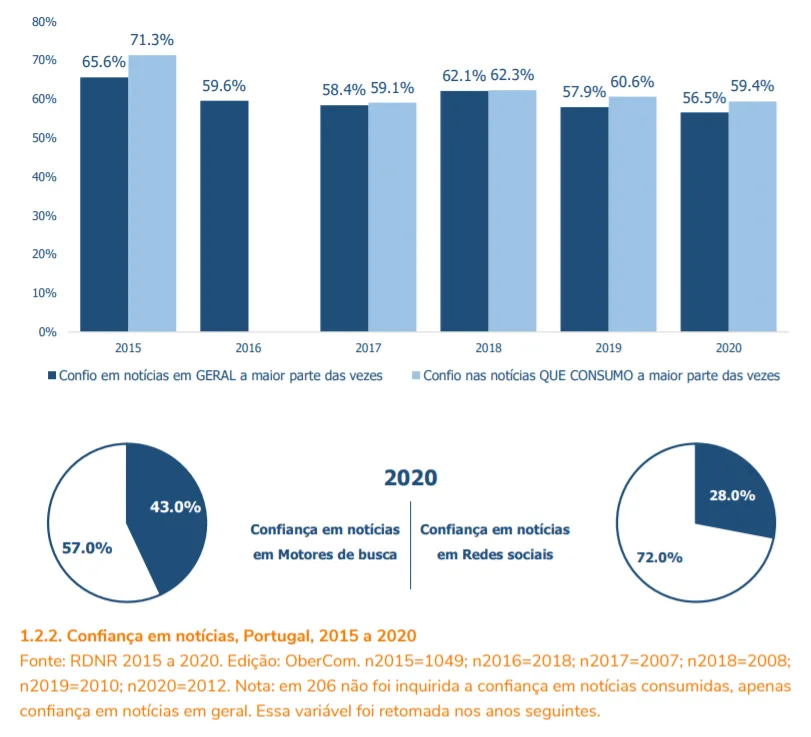
In other words… trust seems to be biased. Going by the results of this study, the Portuguese place noticeably more trust in what interests them or grabs their attention than in the news as a whole. And that's the open door for fake news, which is itself biased and, very often, sensationalist. And with fake news come the consequences, which we'll get to shortly.
Deco Proteste also ran a survey to find out how the Portuguese view fake news. From the 1,006 valid responses, it emerged that 58% of respondents frequently spot fake news on social media. 41% spot false information in celebrity gossip magazines and in messaging apps such as WhatsApp. To a lesser extent, they also spot fake news in online newspapers and blogs, printed newspapers and magazines, and television programmes (including news bulletins), which calls into question the good journalism being done in Portugal.
Only radio scored lower, with just 6% of respondents saying they frequently come across fake news there. This may mean radio stations are less prone to spreading fake news. Then again, it may simply tell us that the Portuguese don't pay as much attention to radio news — or don't listen to radio at all. In this case, it isn't a variable we can analyse.
What is clear is that 77% of respondents believe the spread of fake news is a danger to democracy. As for penalties, 75% believe outlets that share fake news should face heavy fines and 70% argue that journalists who write fake news should be punished.
The best (or worst) examples and their consequences
The 5G case
The 5G and fake news controversy was covered in this article, particularly in the section “The link to COVID-19 and the acts of vandalism”, but it's worth revisiting. In short, Twitter was the spark that set off a conspiracy theory: the new virus coincided with the arrival of the 5G network. But… was it really just a coincidence? Plenty of people decided it wasn't and concluded that COVID-19 was a harmful consequence of the 5G network. In the UK, dozens of 5G telecoms masts were set alight in protest and supposed self-defence.
Doctors' voice notes on WhatsApp
When COVID-19 arrived in Portugal, so did a lot of armchair doctors. They're like armchair pundits who spend the whole match barking out opinions, except here they pass themselves off as doctors. They always know more than everyone else, have access to privileged information and know every trick for keeping the public safe. And in March 2020 in particular, WhatsApp was awash with these doctors and the audio messages they recorded.
But in reality we were never able to confirm who these doctors actually were. We don't know their names, where they work or what they specialise in. We were never able to verify their identity, and that alone is a warning sign.
Fake news was already spreading widely before, and the arrival of a pandemic made it far worse.
From the outset we have seen, day after day, stories that turn out not to be true. Scaremongering, conspiracy theories, false testimonies. All of it has been given airtime over the past year. And the speed at which information is obtained, the speed at which it changes and the speed at which news spreads have all combined into an explosive recipe for disinformation.
The Social Dilemma — a documentary about the reality of social media
True stories take six times longer to reach 1,500 people than false ones.
The documentary The Social Dilemma shows us the consequences of our actions on social media. And it gives several examples of the role social media plays in spreading fake news, such as the Pizzagate case in the US. The information doing the rounds, especially on Facebook, was that pizzerias were being used as a human trafficking network, specifically for children, who were being held in basements beneath the restaurants. One man even walked into a pizzeria armed to rescue the children from the basement — which didn't even exist. What's most striking is that it was Facebook itself putting this information in front of people, without them actively looking for it. Its algorithms suggested groups related to the topic to anyone who might be interested, based on Facebook's own analysis of users' profiles.
This is clearly a case that ended in extremes, which doesn't always happen. It's also true that networks like this can exist. Human trafficking is, after all, still very real today and undoubtedly happens every day. Even so, this particular case had no basis whatsoever, and no attempt was made to verify the information.
The documentary also cites a 2018 study by the Massachusetts Institute of Technology (MIT), which gives us some interesting figures. According to the study, false information is shared more often, more quickly, more prominently and more widely than true information.
In fact, the study notes specifically that on Twitter fake news is 70% more likely to be retweeted than true news. And that true stories take six times longer to reach 1,500 people than false ones.
How to spot and filter out fake news
The first step in judging how reliable any story is: read all of it. Reading only the headline or the standfirst (the short introductory summary) isn't enough, as these are often deliberately eye-catching — and sometimes downright misleading. This is what's known as clickbait, a lure designed to generate more clicks, more reach and, ultimately, more revenue.
The second step is to work out where the information came from. Was it published by a credible source, or is its origin unknown? Are there real sources? Depending on the type of story, are there studies, witnesses or official statements to back it up? It's worth remembering that an opinion piece is not a news story — although these too should have some kind of basis and support.
So it's important to be demanding with the news we read, in order to understand where it comes from and how credible it is.
The third and final step is research. There's nothing like checking whether that specific topic has been covered by other outlets — which ones, when, and what they said. If it isn't a story exclusive to Portugal, it's worth searching in English to get more results. One last tip is to search the topic using various different terms that invite either confirmation or debunking. For example, if we want to know more about the presidential elections, we could try searches like “the truth about the presidential elections”, “lies in the presidential elections” or “presidential election scams”. This can lead us to discoveries we'd otherwise never make, and also expose some fake news.
Become a fake news hunter
If you want to become a “professional detective” at spotting fake news, you can always work through the content of the course Fake News – não se deixe enganar. This free course was made available by NAU, an online training platform for large audiences run by the FCCN Unit of the Fundação para a Ciência e a Tecnologia (FCT). Although the course is archived, the content is still available to view. It's ideal for anyone working in communications and the media.
In short, the best way to protect ourselves and be more certain about the information that reaches us is to think critically. We should never take anything as absolute truth, least of all at first glance. Questioning and researching are crucial to gaining more knowledge. Only then will we be able to navigate this world, the digital one especially, with greater confidence and conviction in what we consider right and true.

Get what we write
No fixed calendar: only when there is something worth your time.