For a more immersive YouTube
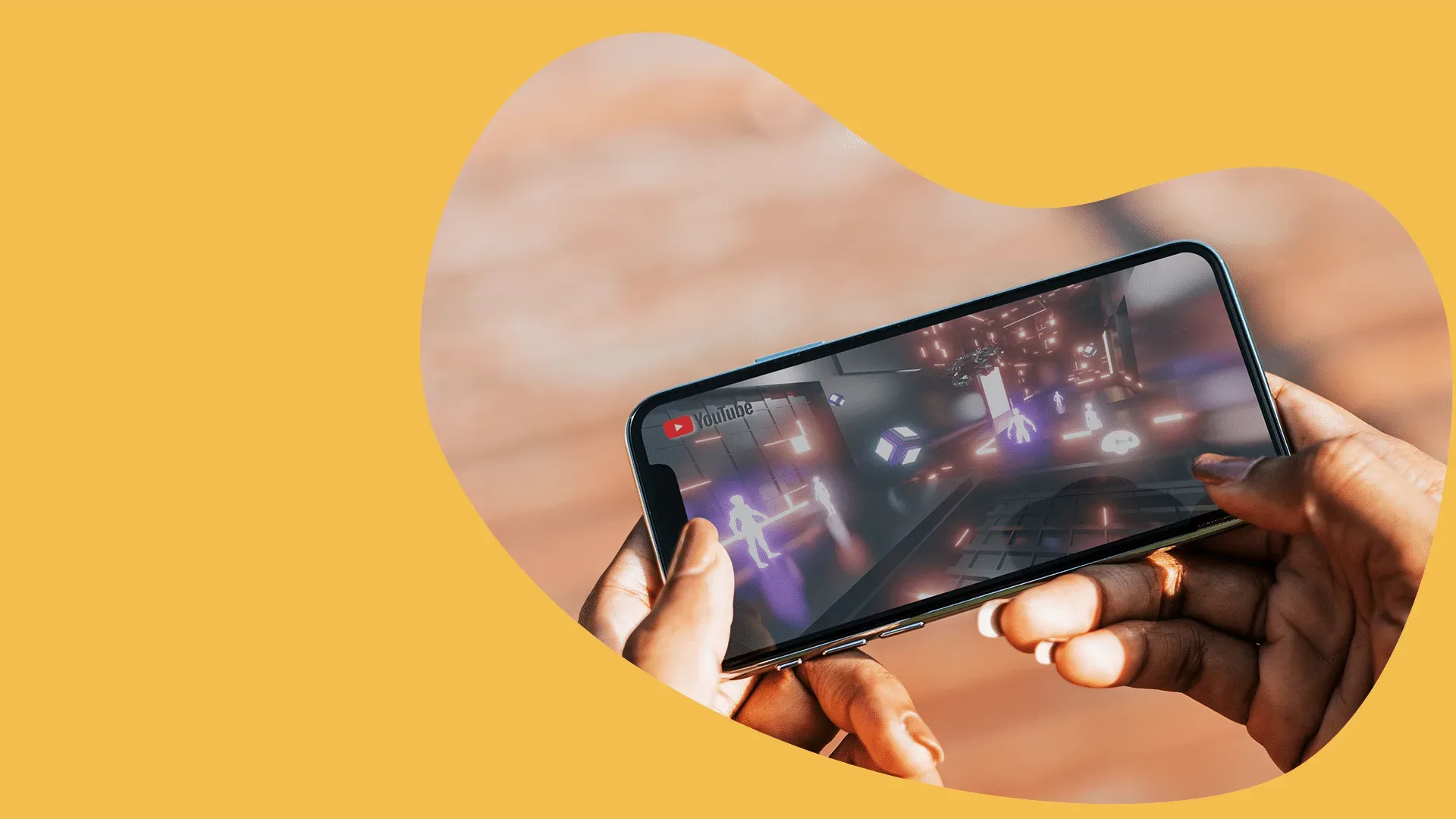
Marta Peral Ribeiro – Communications Consultant – A few months ago Facebook announced its shift to Meta, keeping pace with the technological developments behind the metaverse experience. Now, with no great surprise, it's YouTube that plans to integrate Virtual Reality and Augmented Reality features, starting with games.
Marta Peral Ribeiro – Communications Consultant – A few months ago Facebook announced its shift to Meta, keeping pace with the technological developments behind the metaverse experience. Now, with no great surprise, it's YouTube that plans to integrate Virtual Reality and Augmented Reality features, starting with games. The metaverse experience
In a one-minute video, Neal Mohan, YouTube's Chief Product Officer, runs through some of the platform's new features for 2022.
The one we'll look at in this article is the integration of metaverse features — for now at the level of games — to make the user experience more immersive.
Through emerging technologies such as Virtual Reality (VR), Augmented Reality (AR) and other technological elements, people “become” their own avatars and can interact in a 3D virtual world that mirrors the real world to a greater or lesser degree.
In short, the metaverse is where the two realities, physical and virtual, meet.

We've already covered the potential of the metaverse here, around the time Facebook became Meta. Zoom in: YouTube as an ecosystem
At first glance, there are factors that easily put the platform's next step into context:
Almost two decades of technological innovation
Since 2005, the year YouTube launched, we've watched the platform evolve technologically, particularly on the visual side, through its different content formats. Bearing in mind, too, that it's a subsidiary of Google LLC, exploring the potential of Web3 was, at the very least, to be expected.
The user experience
Putting the user at the centre of the action, alongside developing algorithms to understand them better, has guided the platform's every move, with the aim of offering personalised experiences and apps that meet each person's needs.
The rise of online monetisation
The explosion of e-commerce in recent years, and the evolution of virtual products themselves (cryptocurrencies, for example), particularly within social networks, has turned these platforms into a source of business.
And that leads to another point: knowing not just who the target audience is, but who has the purchasing power.
Zoom out: the environment around YouTube
From a more distanced perspective, now considering the changes taking place across the wider digital landscape, many of them accelerated by the pandemic, there are other circumstances that end up converging on the metaverse:
The rise of the gaming industry
According to Yahoo Finance, the gaming industry's estimated global revenue for 2026 is $314 billion. Those figures will probably be reached even sooner.
Given the exponential growth of the gaming industry and, in parallel, the rapid progress of emerging technologies, YouTube's decision to start with this category makes sense.
Gen Z's purchasing power
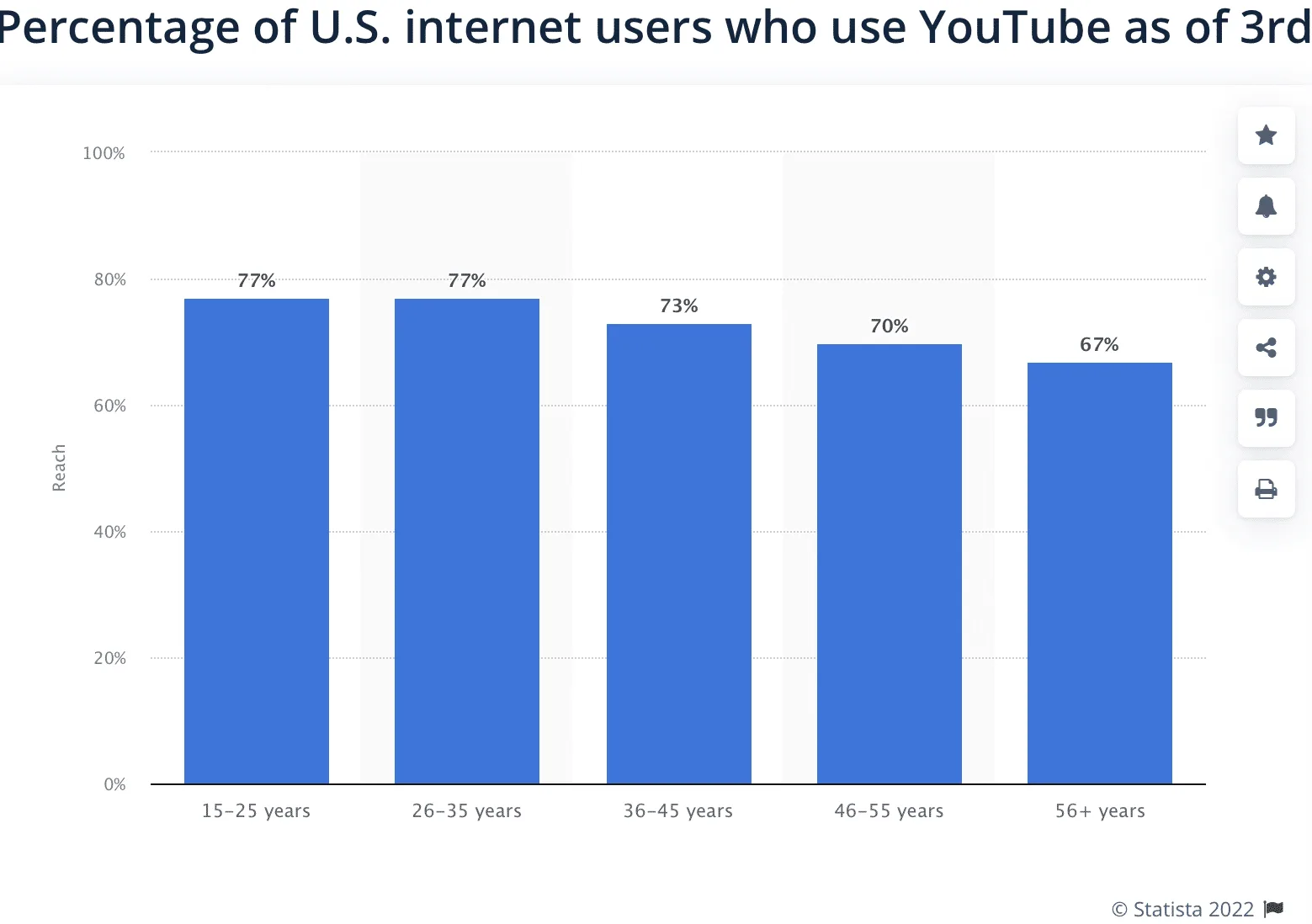
The YouTube universe takes in audiences across a range of age groups: Source: Statista
Although it refers to 2020, the chart is unlikely to have shifted significantly since. So, if Gen Z (born roughly between 1996 and 2010) makes up a generous slice of the audience consuming not just YouTube (77%) but video games too, and holds purchasing power of around $143 billion, investing in metaverse experiences is undoubtedly a smart move.
And YouTube isn't the only one to have worked this out. The metaverse: fertile ground for brands?
We already know one of marketing's golden rules is to be where your audience is. And it's also well established that users build stronger relationships with brands that have a stronger digital presence.
If you consider that YouTube has a universe of more than 2 billion active users, the platform is, on the one hand, a fantastic source of entertainment and, on the other, a convenient resource for businesses.
After all, if the metaverse represents a virtual reality, it's natural that business opportunities will emerge on the virtual plane too, with virtual products and, eventually, a bridge between the two planes (virtual and physical).
The idea becomes even more fascinating when you consider that the virtual environment doesn't have the same barriers as the physical world!
Above all, technology should be viewed pragmatically: as a means to improve experiences, not simply an end in itself.
The Portuguese picture
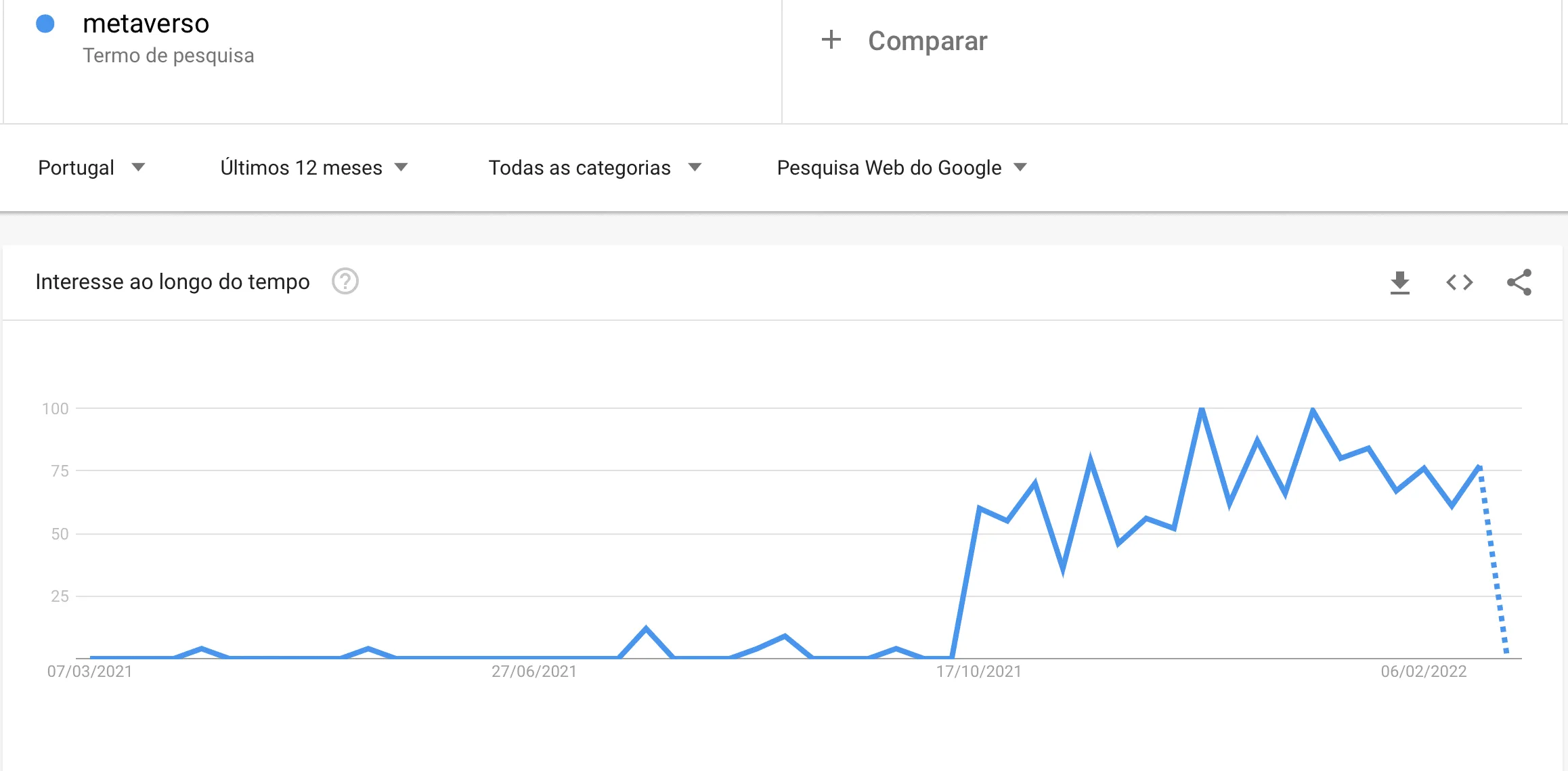
In Portugal, the metaverse is equally a subject that sparks the interest of many users, especially since it became a talking point at the end of 2021: Source: Google Trends Alongside the enormous transformation of the World Wide Web, the metaverse represents, without any doubt, a business opportunity waiting to be explored.
Indeed, the companies already keeping up with these emerging technologies are also the ones that stand to gain greater visibility and, in doing so, secure a solid position in the market. In the not-too-distant future, it will be perfectly normal for brands to be present in virtual reality.
Brands that are (already) repositioning themselves in the metaverse
To finish, here are a few examples of brands making waves in the virtual world through partnerships with major video game platforms such as Roblox and Fortnite: Nike

Last year Nike created Nikeland within the Roblox universe. In the game, as well as choosing their Nike kit, players can build a mini game — proof that Nike is paying attention to its audiences, particularly Gen Z, who want to be part of the process rather than just see what brands have to offer. Source: Nike Balenciaga


The bold Balenciaga went further, building a bridge between the virtual and physical worlds: as well as letting users choose the brand's clothing inside the game, the Fortnite partnership was promoted through three-dimensional billboards in New York, where the character takes on a limitless dimension, just as in the metaverse. Source: YouTube video KAWS

It isn't only clothing and sports brands innovating in the metaverse. Also in a collaboration with Fortnite, and with London's Serpentine Gallery, American artist KAWS took his work into the virtual world through a digital version of his exhibition. Source: StirWorld Source: Epic Games video Emerging technologies are bringing us the metaverse. First announced by Meta (Facebook), we're now seeing YouTube, which will soon integrate new features, initially for gaming.

Alongside this, we're also seeing some companies already waking up to the metaverse's potential, above all as a way to position themselves in the market. There's no doubt the innovative nature of these new technologies represents a major opportunity for brands to stand out, both inside and outside the digital space. Especially among younger generations, who not only grow up in a technological environment as a matter of course but also hold purchasing power that should by no means be underestimated.

Get what we write
No fixed calendar: only when there is something worth your time.