AI agents for 24/7 customer service: a practical guide

It's Friday night. A prospective customer sends a message expressing interest in a service, waits for a reply and, by the time the silence stretches into Monday morning, they've already gone with another company. Not because the product was better, but because the other company replied within seconds. This scenario plays out again and again in small and medium-sized businesses that still rely solely on human teams to handle customer service. And this is exactly where AI agents that reply to customers automatically 24 hours a day make the difference: they remove the dead time between interest and the first qualified contact.
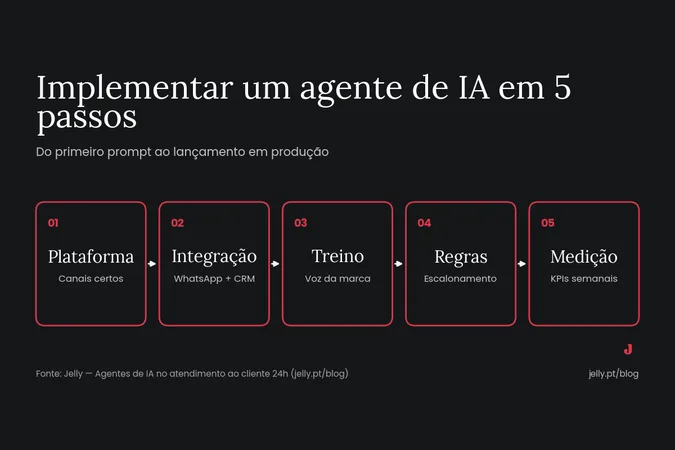
Automating customer service with artificial intelligence agents is no longer the preserve of large corporations. In this guide, we look at how to choose the right platform for your business, what you need in order to integrate with WhatsApp and your CRM, what it actually costs and how to measure whether it's working. For companies that would rather not handle the technical setup themselves, JELLY implements this kind of system in Portugal, from the first prompt to going live in production.
What changes when AI agents reply to customers automatically 24 hours a day Genuine availability without the cost of extra staff
The main gain from an AI agent that is always available isn't the technology itself: it's removing the marginal cost of every additional hour of customer service. A well-configured agent handles hundreds of conversations at once for a fixed monthly cost, whereas a human operator has clear limits of scale and working hours. Based on estimates drawn from hands-on implementation experience, a typical SME can lose a considerable share of the interactions generated outside working hours, which translates directly into revenue left on the table.
Round-the-clock availability also changes the cost-per-lead equation. When the reply arrives within seconds, the conversion rate goes up because the customer's interest is at its peak. With AI agents replying to customers automatically 24 hours a day, you remove the gap between interest and the first qualified contact — and that gap is where most leads are lost.
Consistency and scalability in every interaction
AI agents always respond in the same tone, with no mood swings, no end-of-day fatigue and no variation in quality from one team member to the next. During a demand spike caused by a seasonal campaign — a Black Friday promotion that triples message volume in 48 hours, for example — the system scales automatically without any drop in experience. That's in stark contrast to human support, which fluctuates with the time of day, the workload and each person's motivation.
How to choose the right platform Supported channels and a unified inbox
The first thing to assess in any automated customer service platform is straightforward: the business needs to be present on the channels its customers already use. Platforms such as Respond.io, Botpress, Zendesk AI and ManyChat support WhatsApp, Instagram, Messenger and website chat in a single centralised inbox. The difference between them lies in the type of customer they suit: Respond.io and Botpress stand out for their unified inbox with a visual flow builder; Zendesk AI is a common choice for companies that already have a help desk infrastructure in place; ManyChat is geared towards social-media-led businesses and content creators.
The decision shouldn't be based on generic lists, but on the channels where the company's customer base is genuinely active. A clinic that receives most of its enquiries via WhatsApp has different needs from an online shop whose traffic comes mainly through website chat.
Off-the-shelf platform or custom build: which suits which company
An off-the-shelf platform is quicker to set up, cheaper to start with and less flexible — what's commonly known as a no-code solution. A custom solution, connected to the company's CRM and ERP, takes more time and investment but delivers customer service automation that is genuinely integrated with internal processes. For most Portuguese SMEs, starting with an off-the-shelf platform and evolving gradually is the sensible route: it lowers the risk, shortens the time to first result and lets you learn from real data before investing in something more complex.
Integrating 24/7 AI agents with WhatsApp and your CRM What you need before connecting to the WhatsApp Business API
Integrating an AI agent with WhatsApp requires, first and foremost, access to the official WhatsApp Business API. The prerequisites are:
- a verified Meta Business account with company documentation; a dedicated phone number not linked to any personal account or existing Business app; API access via Meta or a certified provider such as Twilio or 360dialog.
- a verified Meta Business account with company documentation;
- a dedicated phone number not linked to any personal account or existing Business app;
- API access via Meta or a certified provider such as Twilio or 360dialog.
You also need approved message templates for proactive sends. Approval usually takes between one and three days, although this can vary depending on the complexity of the template and the provider chosen; in some cases it takes longer.
One rule you can't ignore: the 24-hour window. During that period, once the customer has started the conversation, the agent can reply freely with no additional cost per service message. Outside that window, only approved templates can be sent. This detail has a direct bearing on how you design your conversation flows.
Connecting the agent to your CRM without losing conversation data
CRM integration is what turns automated customer service into an engine for generating qualified leads. Tools like Make.com or n8n act as a bridge between the AI agent and the company's CRM (HubSpot, Pipedrive), automatically creating or updating records with the data gathered in each interaction. Every conversation stops being an isolated event and becomes a structured record that feeds the sales process with no manual work.
This integration also makes it possible to trigger alerts for the sales team when the agent detects buying signals, or to route technical support requests automatically to the right department without the customer having to repeat themselves.
Training the agent with your brand's DNA and voice
How to structure the agent's knowledge base
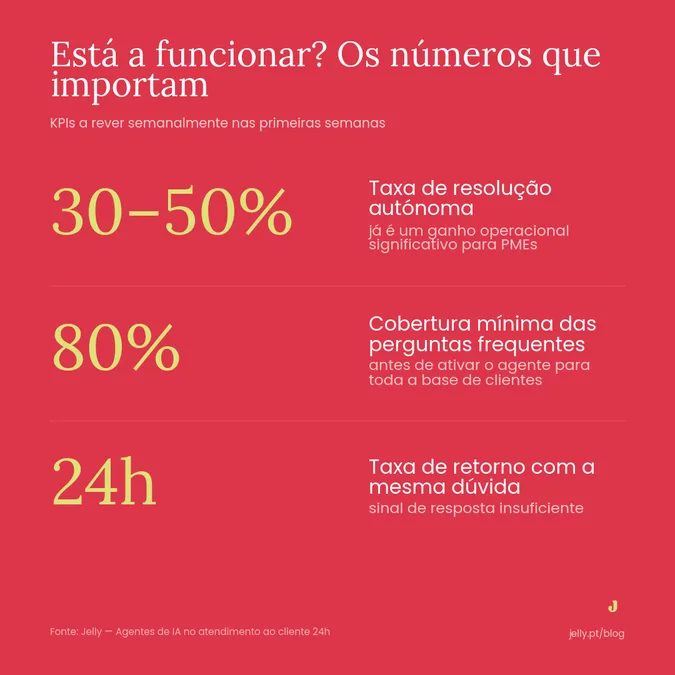
Training starts with gathering material: FAQs, policies, catalogues, support history and existing sales scripts. That material is then organised into semantic blocks, stripped of redundancies and structured into a knowledge base the agent consults in real time. In parallel, you define the agent's persona: the tone, the required vocabulary, the phrases it should avoid and the sequence of questions in each flow. The practical rule of thumb is to make sure the knowledge base covers at least 80% of the most frequent questions before rolling the agent out to your entire customer base; coverage below that threshold significantly increases the rate of unnecessary escalation. The hardest part for companies isn't the technology itself: it's making sure the agent sounds like the brand. At Jelly, this is precisely the stage we focus most attention on, from the initial prompt to fine-tuning the tone on each channel, so that no interaction breaks the identity the company has built up over the years.
Escalation rules for human operators
A well-configured AI agent knows when it shouldn't answer on its own. Escalation criteria should be defined before launch and include: repeated replies without resolution, technical complexity outside the knowledge base, dissatisfaction expressed by the customer, and questions involving sensitive data or legal implications. The handover to a human operator should be seamless, with the conversation context preserved so the customer doesn't have to repeat anything. In the first few weeks in production, it's advisable to review every conversation manually. Those escalated to humans unnecessarily should be analysed weekly and used as the basis for new FAQ entries, steadily reducing the rate of unwarranted escalation.
Real costs and expected ROI for an SME in Portugal What it costs to implement an AI agent that replies to customers automatically
Cost ranges vary with the complexity of the solution. For off-the-shelf platforms with a simple setup, you're looking at between €500 and €2,000 to get started. A more robust website agent means an initial investment of between €3,000 and €8,000, while a multichannel solution with WhatsApp and integrated telephony can run to between €12,000 and €24,000.
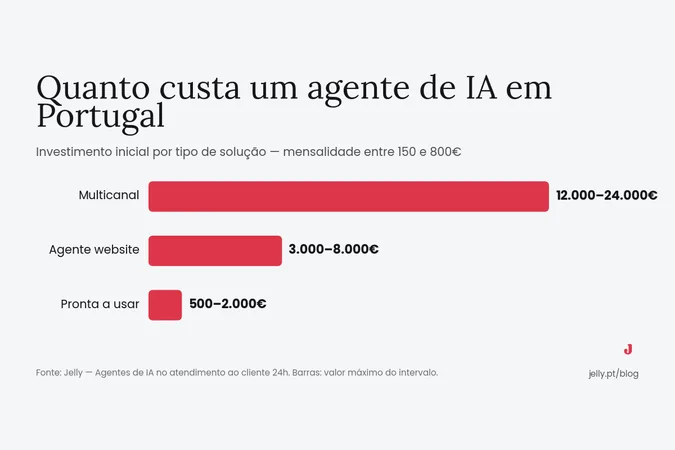
Monthly fees range from €150 to €800, depending on interaction volume and active channels. In 2026, PRR funding available to Portuguese SMEs may cover a significant share of this investment; we recommend checking the current programme conditions directly on the PRR portal, since eligibility criteria and co-funding percentages are subject to change.
How to estimate return on investment
The exercise is straightforward: work out how many hours a month your team spends on repetitive replies, multiply by the hourly cost of an employee and compare that with the agent's monthly cost. To that figure, add the value of the conversations recovered outside working hours, which would otherwise have been lost leads. SMEs that have implemented AI agents to reply to customers automatically 24 hours a day report payback periods of between four and nine months in the first year, although results depend on interaction volume, sector and the quality of the initial setup. The most direct indicator is the cost per interaction resolved autonomously versus the average cost of a human resolution.

The metrics that tell you whether the agent is working
Operational efficiency KPIs
The key performance indicators include the autonomous resolution rate (the percentage of conversations closed without human intervention), the rate of customers coming back within 24 hours with the same question (a sign the answer wasn't good enough), average response time and the unnecessary escalation rate. In well-configured implementations handling tier 1 queries, the autonomous resolution rate can reach high figures. For the average SME, a rate of between 30% and 50% already represents a significant operational gain, while more mature setups with fuller knowledge bases tend to exceed that range. These KPIs should be reviewed weekly during the first few weeks in production.
Customer satisfaction and cost per interaction
Business-impact indicators complete the picture: CSAT collected at the end of each conversation, NPS before and after implementation, and cost per interaction resolved with accuracy confirmed. Assessing the quality of responses should involve an independent human review, not just automated metrics. An agent with a high resolution rate but incorrect answers is creating a reputation problem that automation metrics can't detect on their own.
Starting well matters more than starting fast
That 11pm Friday message doesn't have to go unanswered. With AI agents replying to customers automatically 24 hours a day, and with a properly executed setup, that prospective customer gets a quality reply within seconds, on the channel they're already using, with the brand's tone intact. It isn't a generic response. It's an interaction that answers the question, qualifies the interest and logs the contact in the CRM — all before anyone on the team switches on their computer on Monday morning.
If you want to implement AI agents that reply to customers automatically 24 hours a day, the starting point is choosing the platform that fits your company's channels, integrating it with your CRM, training the agent with your brand's voice and DNA, setting solid escalation rules and tracking results with the right KPIs from day one. The technical learning curve can cost you time and avoidable mistakes, particularly during integration and initial training.
For companies that want to be sure the agent sounds like their brand from the very first interaction, and would rather not spend weeks on technical configuration, JELLY handles the whole process: from choosing the platform to fine-tuning the tone on each channel, including CRM integration and defining escalation rules. Get in touch with Jelly and find out how this system can be built for your business.
Get what we write
No fixed calendar: only when there is something worth your time.