How AI Is Transforming Digital Marketing

AI in digital marketing has stopped being a promise for the future. In 2026 it is an operational reality in agencies and companies across Europe, Portugal included, where the pressure to do more with fewer resources has never been so obvious. Campaigns that once took weeks of manual work, analysis, briefing and sign-offs are now set up, tested and optimised in a fraction of that time, with launch times often cut by around 50%, according to operational studies from the sector.
The shift is a concrete one. Generative AI tools, autonomous agents and recommendation engines are changing how brands talk to their audiences. The companies reaping the rewards are those that have understood the technology as a strategic lever, not as a shortcut around creativity. At Jelly, a Lisbon-based digital marketing agency with over 14 years of experience, building artificial intelligence into client strategies is part of the day-to-day work, from email marketing automation through to intelligent customer service agents. This article looks at what has changed, which tools already make sense, how to take the first steps and where the technology still falls short.
What has actually changed with AI in digital marketing
From data analysis to real-time decision-making
Machine learning processes volumes of behavioural data that would be impossible to analyse by hand. A user who abandons their basket can receive, in something very close to real time, a personalised email sequence based on their browsing history, the time spent on each product and the categories they visited. That isn't basic segmentation: it's automated decision-making driven by behaviour.
The impact on marketing teams is immediate. Less time spent on repetitive analysis means more room for strategy, creativity and positioning. AI doesn't remove human work; it simply reorders the priorities of the people doing the marketing.
Generative AI: content and creative at a different pace
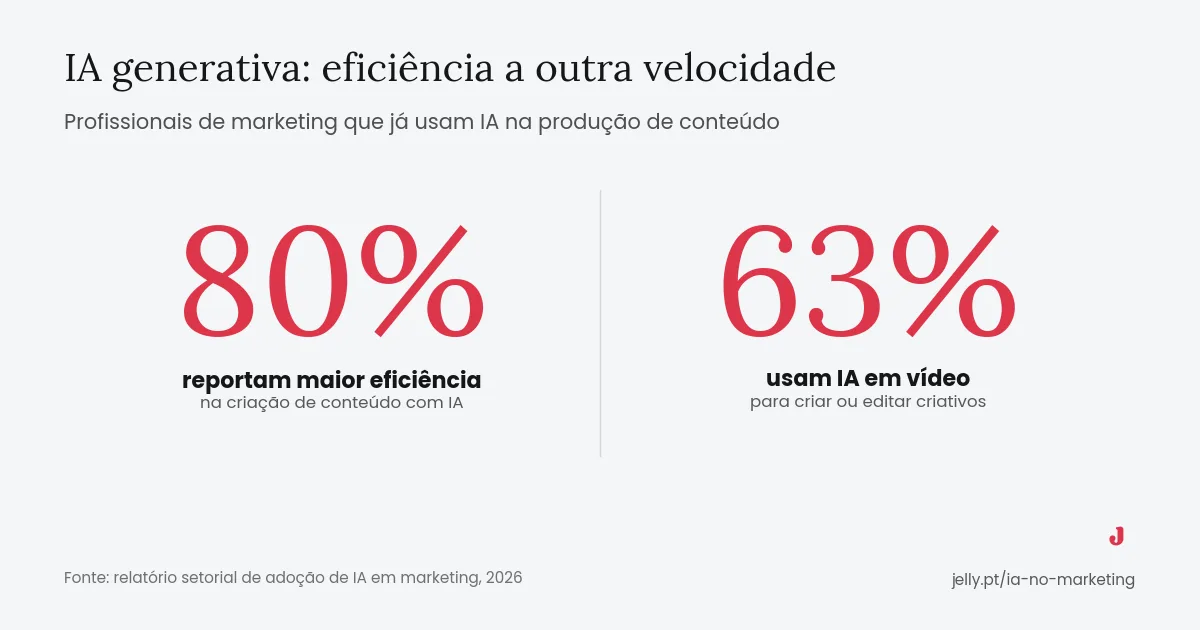
Generative AI has sped up the production of ad creative, blog articles and campaign scripts. What once took days of briefing, iteration and approval now has a first draft ready in a fraction of the time previously needed. According to a 2026 industry report on AI adoption in marketing, 80% of professionals report greater operational efficiency when using AI to create content, and 63% already use the technology to create or edit video.
Watch out for the most common misconception: generative AI is a tool for acceleration, not replacement. Brand voice, positioning and strategy remain human work. Publishing content without review is one of the most expensive mistakes a company can make, and damage to brand perception is rarely quick to repair.
The end of generic campaigns, thanks to behavioural segmentation
Predictive models make it possible to segment audiences on behavioural signals, pages visited, time on page and purchase history, rather than demographics alone. More relevant campaigns mean a lower cost per lead and a better return on investment. This logic isn't the preserve of big brands: with the right tools, an SME can achieve the same level of precision.
Personalisation at scale: when data replaces guesswork
Here's how dynamic personalisation works in practice: an email adapts its subject line, content and offer to each contact's profile and behaviour. An e-commerce site shows different products on the homepage depending on each visitor's browsing history. This level of personalisation, once available only to large brands with dedicated data teams, is now within reach of SMEs on modest budgets.
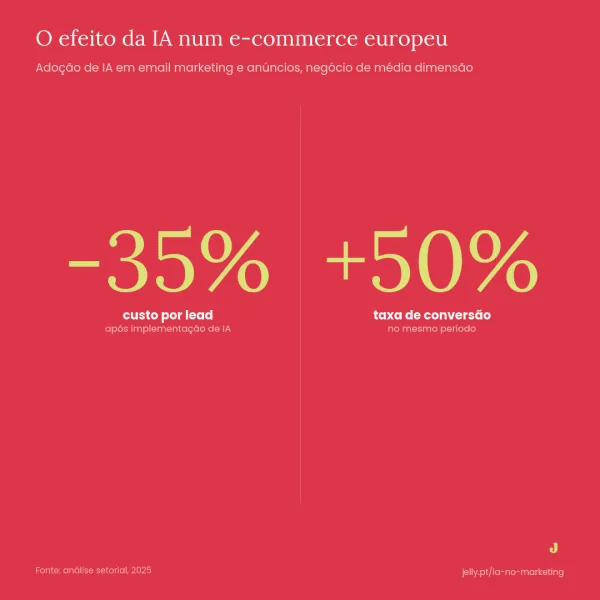
Recommendation engines have functional equivalents in tools such as HubSpot or Mailchimp for smaller e-commerce operations. One implementation at a mid-sized European e-commerce business, documented in a 2025 sector analysis, shows striking results: adopting AI across emails and ads cut cost per lead by 35% and lifted the conversion rate by 50%. These numbers are achievable when the data strategy is set before the tool is switched on. Without clean, well-structured data, the models produce mediocre results.
The link between consistent personalisation and customer lifetime value (LTV) is a direct one. Customers who receive relevant communications buy more often, take longer to drift away and recommend more. AI in marketing makes it possible to keep that consistency at scale, even with contact bases of thousands of people, without every interaction depending on manual input.
Intelligent automation: from lead nurturing to always-on customer service
AI agents versus traditional automation
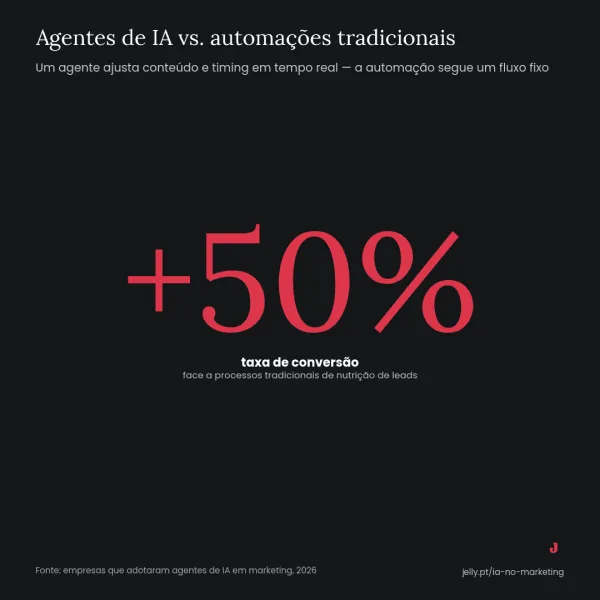
The difference between an AI agent and traditional automation is substantial. An automation follows a fixed flow: if the user clicks, email X is sent. An AI agent monitors the lead's behaviour and dynamically adjusts the content and timing of communications, with no human input at all. A lead who opens the email about product A but clicks on product B is automatically moved into a sequence built around product B.
Companies adopting this model report conversion rates up to 50% higher than with traditional processes. The gain for teams is just as significant: less time on manual tasks and greater precision in every message sent.
Predictive lead scoring: focusing on the right opportunities
Lead scoring with machine learning analyses the history of converted leads and assigns a score to each new contact based on the patterns it identifies. The practical result in a B2B context is clear: more sales from fewer leads contacted, and a significant reduction in the time the sales team spends on poorly qualified prospecting. The sales team concentrates its effort where the likelihood of conversion is highest, and the numbers reflect that precision.
Today's AI chatbots go well beyond FAQ answers. They qualify leads with contextual questions, route the best ones to the sales team and book meetings straight into the calendar. A clinic or service business that puts a chatbot in place to pre-screen enquiries outside office hours gets 24/7 coverage at no extra cost to the team.
AI marketing tools that already make sense in 2026
For content and creative production, ChatGPT and Canva AI are the most accessible options for copy, images and ad creative. AdCreative.ai is a specialist alternative for generating ad variations with predicted performance scores. None of these tools works well without a clear brief and a brand positioning defined beforehand. For a deeper strategic view on integrating AI into marketing, read the article Artificial Intelligence and Digital Marketing: The perfect match?.
For CRM and email marketing automation, HubSpot Breeze is often the recommendation in B2B contexts, bringing CRM, nurturing automation and predictive insights into a single ecosystem. Mailchimp is a widely adopted alternative for small businesses or B2C-focused operations, offering predictive segmentation and send-time optimisation. In both cases, integration with your existing CRM is the most important criterion before any purchase decision.
For data analysis, Google Analytics 4 with AI is the free starting point for behavioural analysis and conversion forecasting. Google Gemini within Workspace complements data analysis and the automation of internal marketing tasks. One warning that can't be ignored: making sure the data you collect complies with the GDPR has to happen before you feed anything into an AI marketing model.
How to take the first steps: team, technology and KPIs
Step 1: start with the problem, not the tool
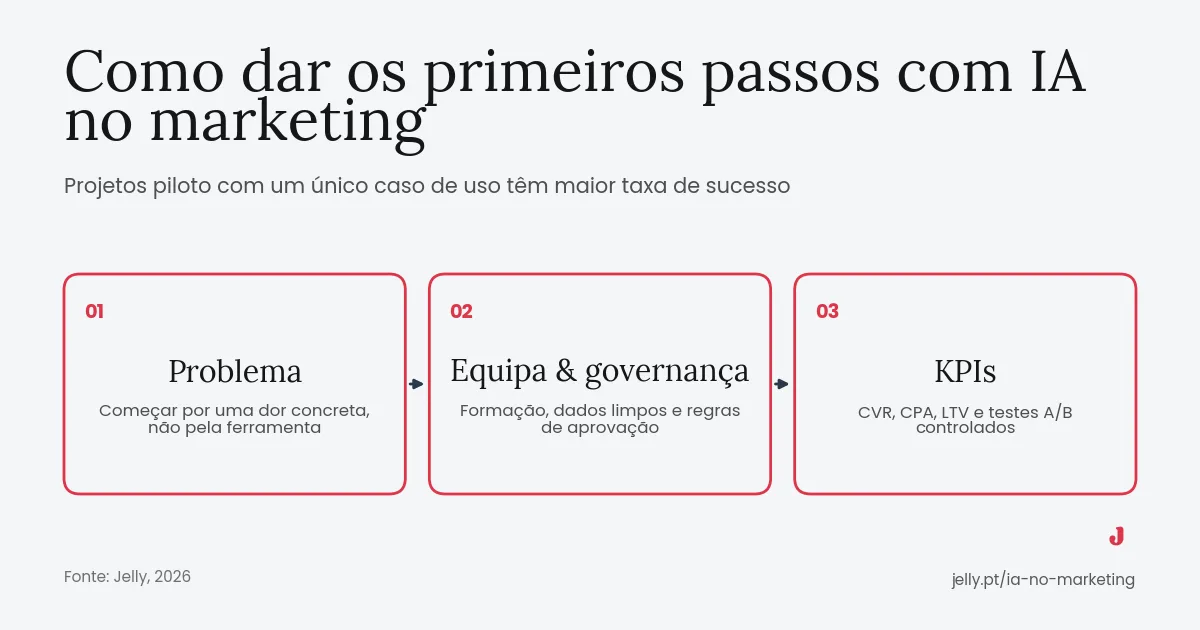
The most common mistake is starting with the tool instead of the problem you need to solve. The recommendation is to identify a process with a concrete pain point, such as lead qualification, which eats up too much of the sales team's time, and test AI in that specific context. Pilot projects with a single use case have a higher success rate than immediate company-wide rollouts.
Step 2: team, training and governance
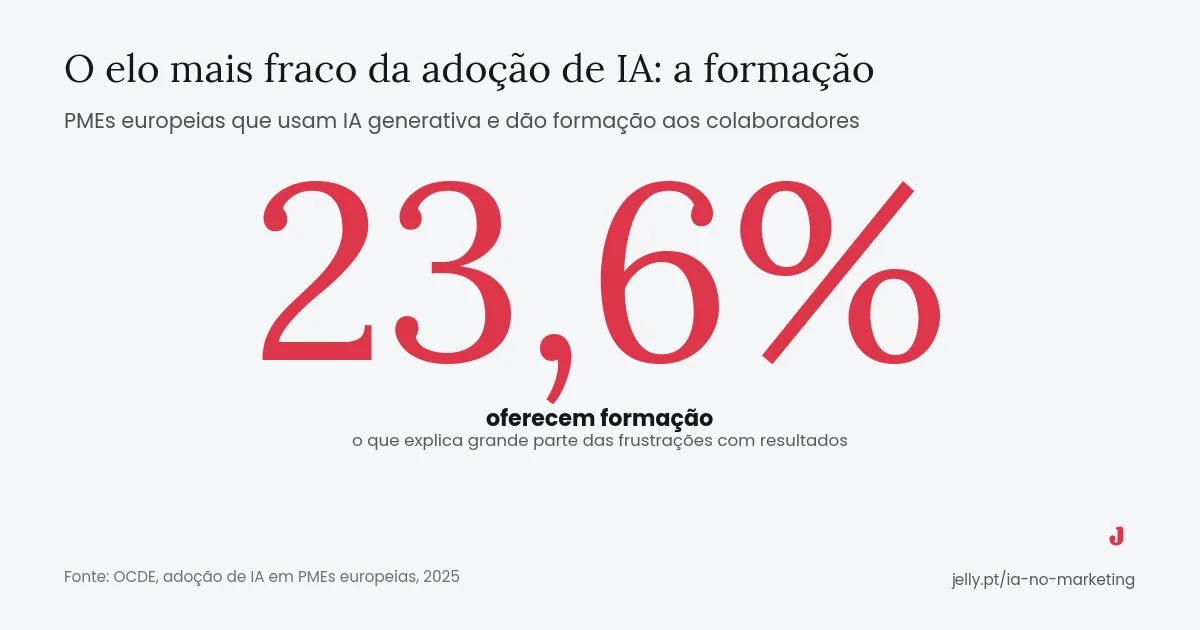
You don't need a data scientist to get started. You need someone to own the AI marketing strategy and safeguard data quality, and that alone makes a considerable difference to the results. Training the team is essential: according to the OECD report on AI adoption among European SMEs (2025), only 23.6% of SMEs using generative AI provide training for their staff, which explains a great deal of the frustration with results. For further reading and a range of perspectives, take a look at Jelly's AI Overviews archives.
Setting clear governance rules matters as much as choosing the right tool. Who signs off AI-generated content? How do you keep it consistent with the brand voice? These questions need answers before anything goes live.
Step 3: the KPIs that confirm AI is working
The main indicators to track are conversion rate (CVR), cost per acquisition (CPA), lifetime value (LTV) and operational efficiency measured by asset production time. The recommended measurement method is controlled A/B testing: one group without AI and one with, to isolate the technology's real impact. A pre-implementation baseline is essential, without it you can't attribute results to AI with any rigour.
What the technology can't solve on its own
Personalisation based on behavioural data falls under the GDPR. Explicit consent, the right to be forgotten and transparency in how data is used are legal obligations, not options. Excessive personalisation can also come across as intrusive and damage the customer relationship. Your data strategy should be reviewed by someone with legal responsibility before any AI is deployed in digital marketing.
AI optimises what already exists, but it doesn't set strategic direction or brand positioning: that remains human work. There are campaigns that worked technically, with a high CTR and a low CPA, yet damaged brand perception through a lack of strategic alignment. Human judgement isn't optional: it's what turns data into decisions that make sense.
Jelly is an agency with over 15 years of experience that builds artificial intelligence into clients' marketing strategies in Portugal at an operational level, from lead generation and pre-qualification through to AI customer service agents. Working with an agency that specialises in AI for marketing shortens the learning curve, avoids the most common mistakes and makes sure the technology is aligned with real business objectives.
Conclusion
Adopting AI in marketing calls for clean data, controlled testing and human judgement at the heart of decisions, that's the only way AI in marketing creates real competitive advantage. The practical applications, from personalisation to automation and predictive analysis, are already available and within reach for SMEs in Portugal. According to 2025 figures from INE and the European Commission, the AI adoption rate among small Portuguese businesses sat below 10%, which means the window of opportunity is still open for those who act now. For specific examples of AI's impact on online shops, see the articles on The impact of AI on e-commerce.
Success comes down to starting with a concrete problem, getting your data in order, measuring rigorously and keeping human judgement as your strategic compass. The technology doesn't replace direction: it amplifies it. Companies that build AI into their marketing now are creating a competitive advantage that will be hard for latecomers to close.
Get what we write
No fixed calendar: only when there is something worth your time.