What is GEO and how does it help me show up in AI engines like ChatGPT

The question that used to be typed into a search box is now, increasingly, put to an artificial intelligence assistant. The answer arrives as running text, with two or three sources cited, and companies' goals shift: being on the first page of results is no longer enough — you need to be the source the AI uses to answer.
That is GEO's territory.
GEO: an acronym born in an academic paper
GEO stands for Generative Engine Optimization. It covers the set of practices that increase the likelihood of a piece of content being retrieved, used and cited in the answers produced by systems such as ChatGPT, Claude, Gemini, Perplexity, AI Mode and Google's AI Overviews.
The term did not come out of marketing. It was proposed by researchers from Princeton, the Georgia Institute of Technology, the Allen Institute for AI and IIT Delhi, in a paper presented at the ACM SIGKDD conference in 2024. The study also created GEO-Bench, a set of 10,000 real questions across 25 domains, and showed that adjustments to content can increase visibility in a generated answer by up to 40%.
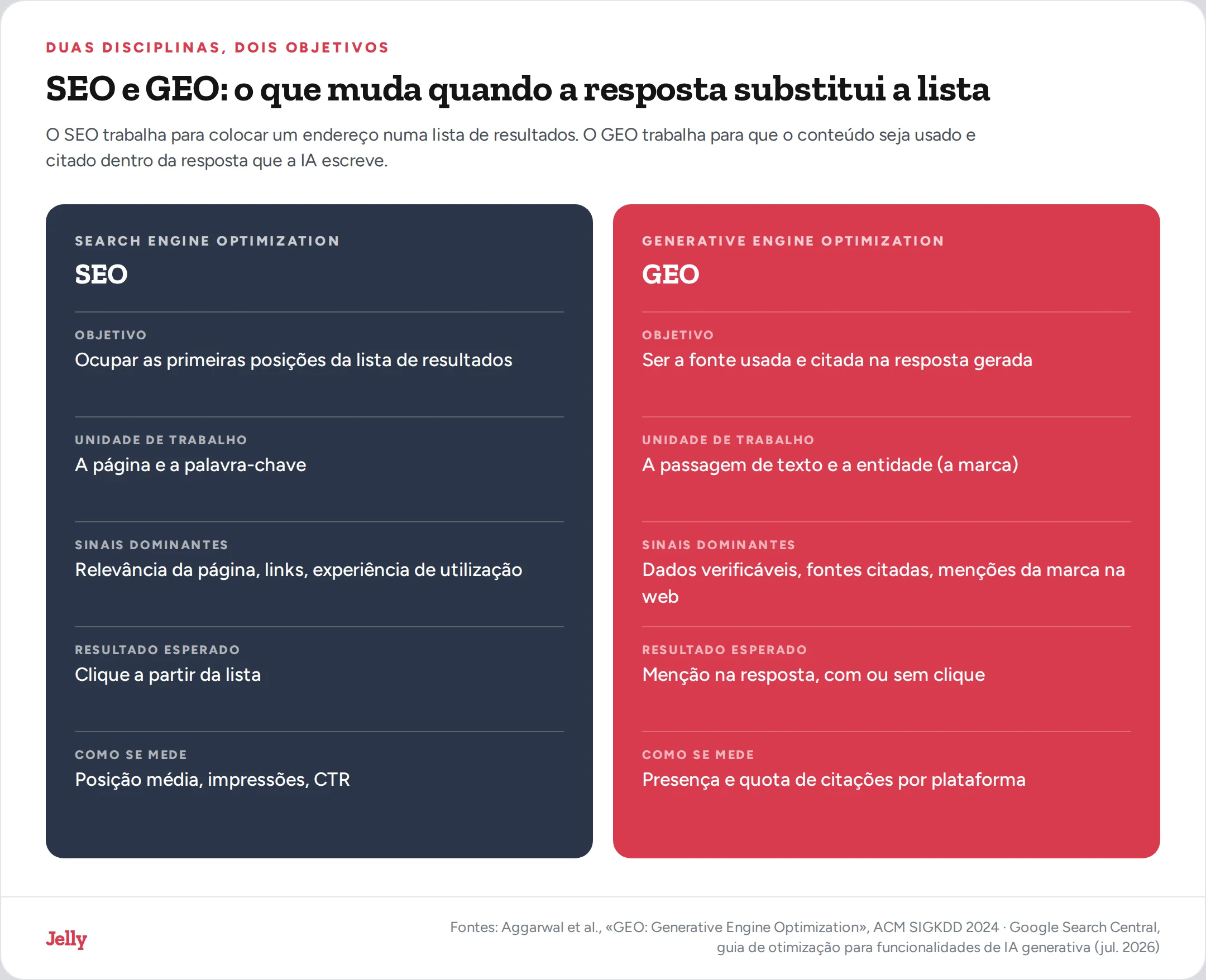
The difference from SEO is one of objective, not of tools. SEO seeks a position in a list of ten addresses. GEO seeks to get a passage of your content into the answer the assistant writes, which can happen without a single click.
Why this has stopped being a topic for the future
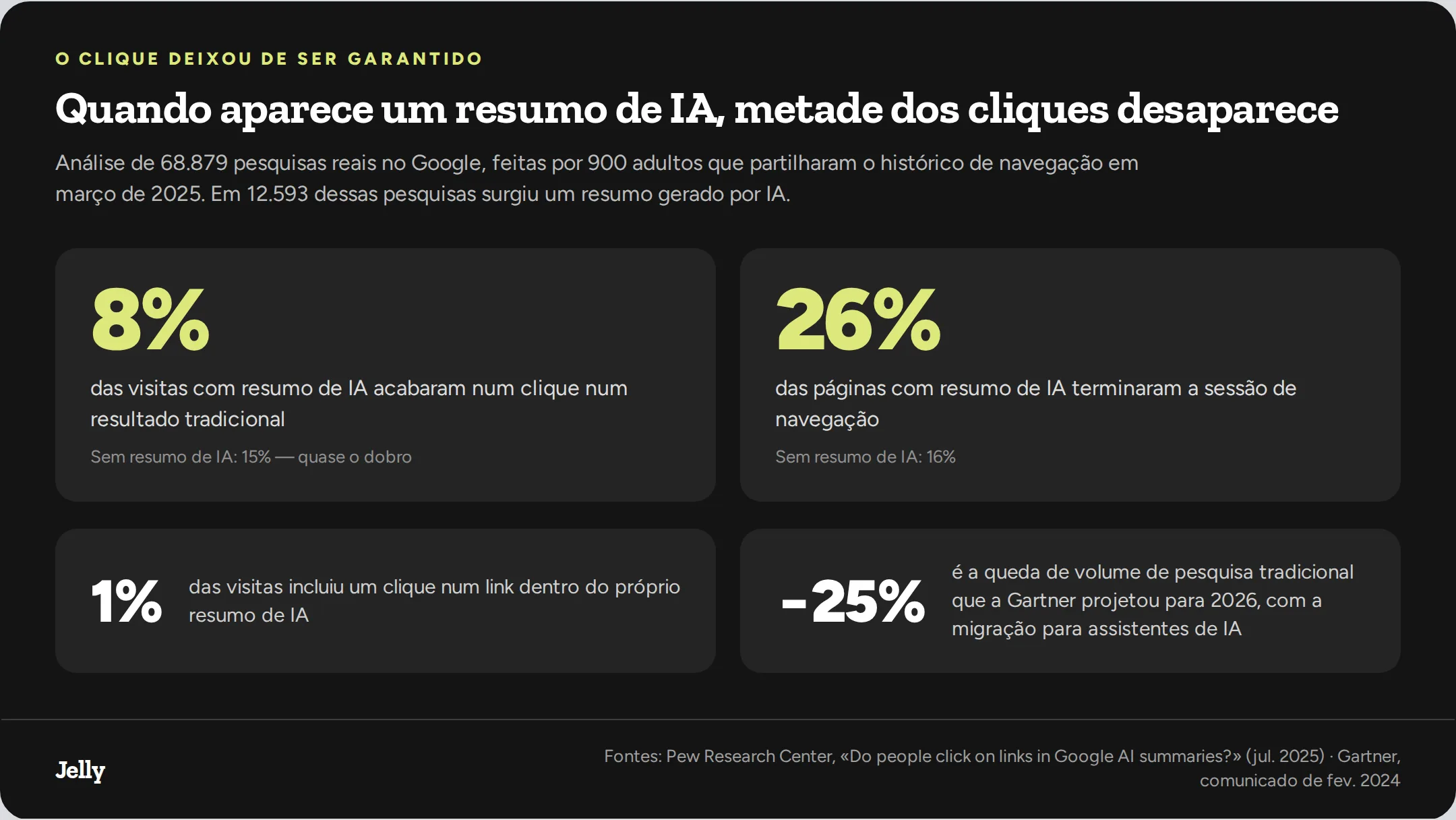
The first signal came from user behaviour. The Pew Research Center analysed 68,879 real Google searches carried out by 900 adults who shared their browsing history in March 2025. When the results page included an AI-generated summary, users clicked on a traditional result in only 8% of visits; without a summary, they clicked in 15% — almost double. And 26% of visits with a summary ended the browsing session there, against 16% of the rest.
Gartner's projection, made in February 2024, points the same way: a 25% drop in traditional search volume in 2026, as questions migrate to AI assistants.
In terms of direct traffic, the volume arriving from assistants is still modest: an SE Ranking analysis of 101,574 sites, between January 2025 and April 2026, puts AI platforms at 0.32% of total traffic. But it is growing fast — Similarweb counted 770.7 million monthly visits referred by AI platforms in the year to May 2026, an increase of 117% — and it converts better. Adobe's data for US retail in the first quarter of 2026 shows AI traffic converting 42% better than other channels, with visits 48% longer.
The right reading is this: the immediate effect of GEO is not visit volume, it is influence. Those who are cited enter the decision; those who are not disappear from the conversation before it ever reaches the site.
In Portugal, search already starts inside AI
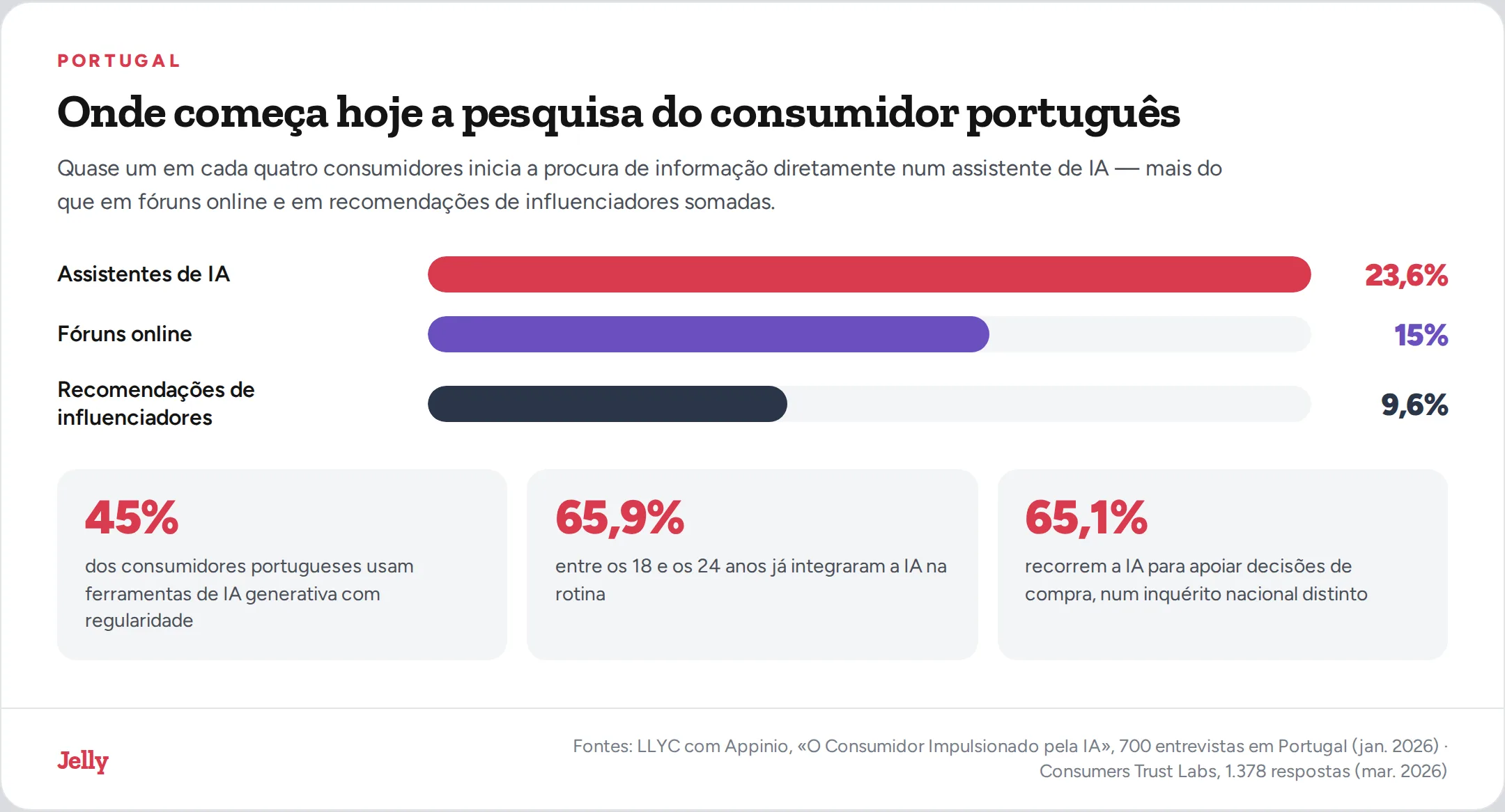
The study «O Consumidor Impulsionado pela IA», carried out by LLYC with Appinio from 700 interviews in Portugal, shows that 45% of Portuguese consumers use generative AI tools regularly and that 23.6% begin their search for information directly in an AI assistant — more than in online forums (15%) and influencer recommendations (9.6%). Among 18- to 24-year-olds, adoption rises to 65.9%.
An independent survey by Consumers Trust Labs, with 1,378 responses in March 2026, reaches a converging figure: 65.1% of consumers already turn to AI tools to support purchase decisions. And 60.2% of regular ChatGPT users check the information against other sources — in other words, the AI's answer works as a first filter, not the final word. Being inside that filter is what is at stake.
What the research shows does work
The GEO-Bench study tested nine writing techniques on the same content and measured the visibility gain in generated answers. The results are consistent and rather counter-intuitive for anyone coming from classic SEO: the winning techniques are the ones that make the text verifiable.
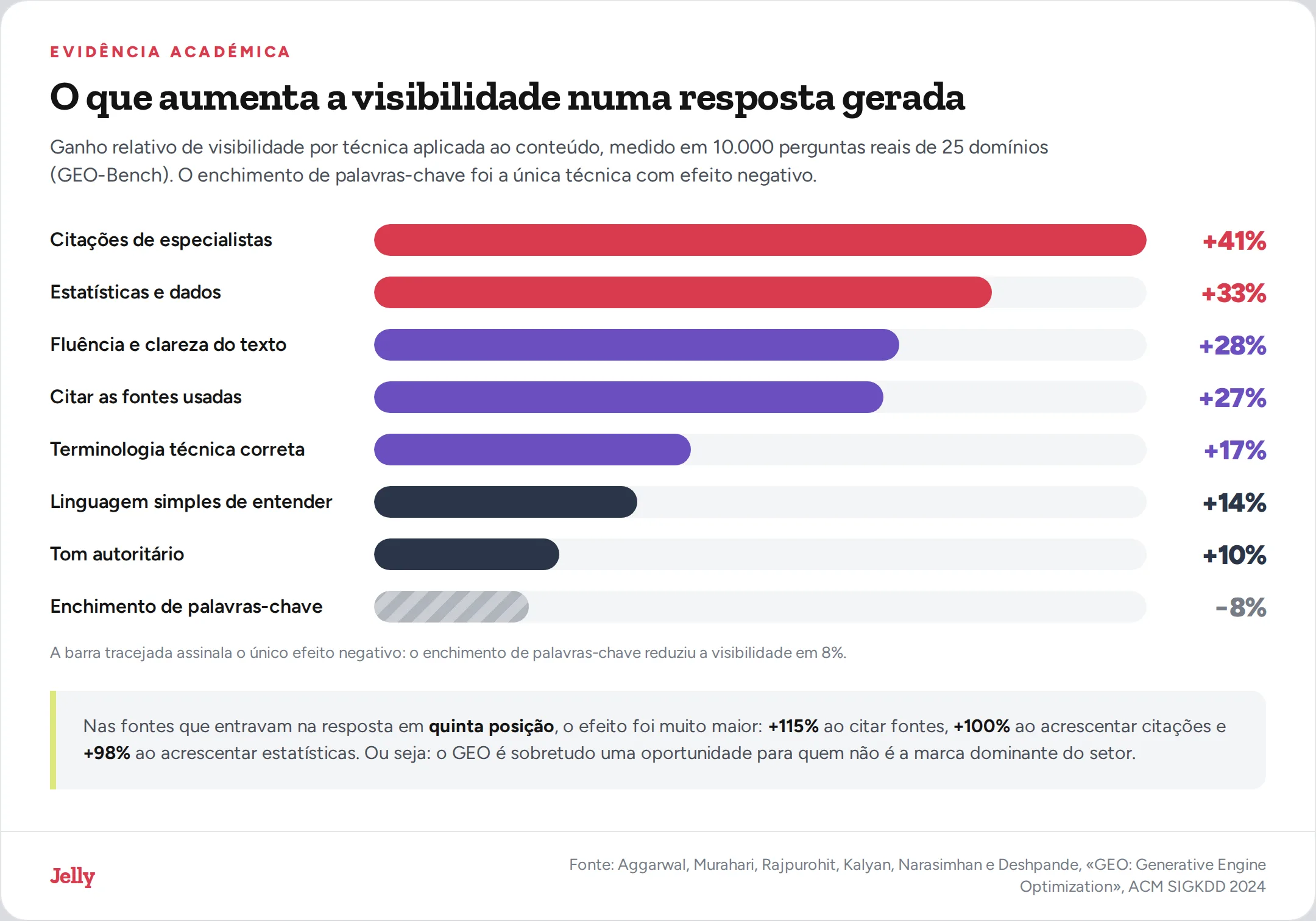
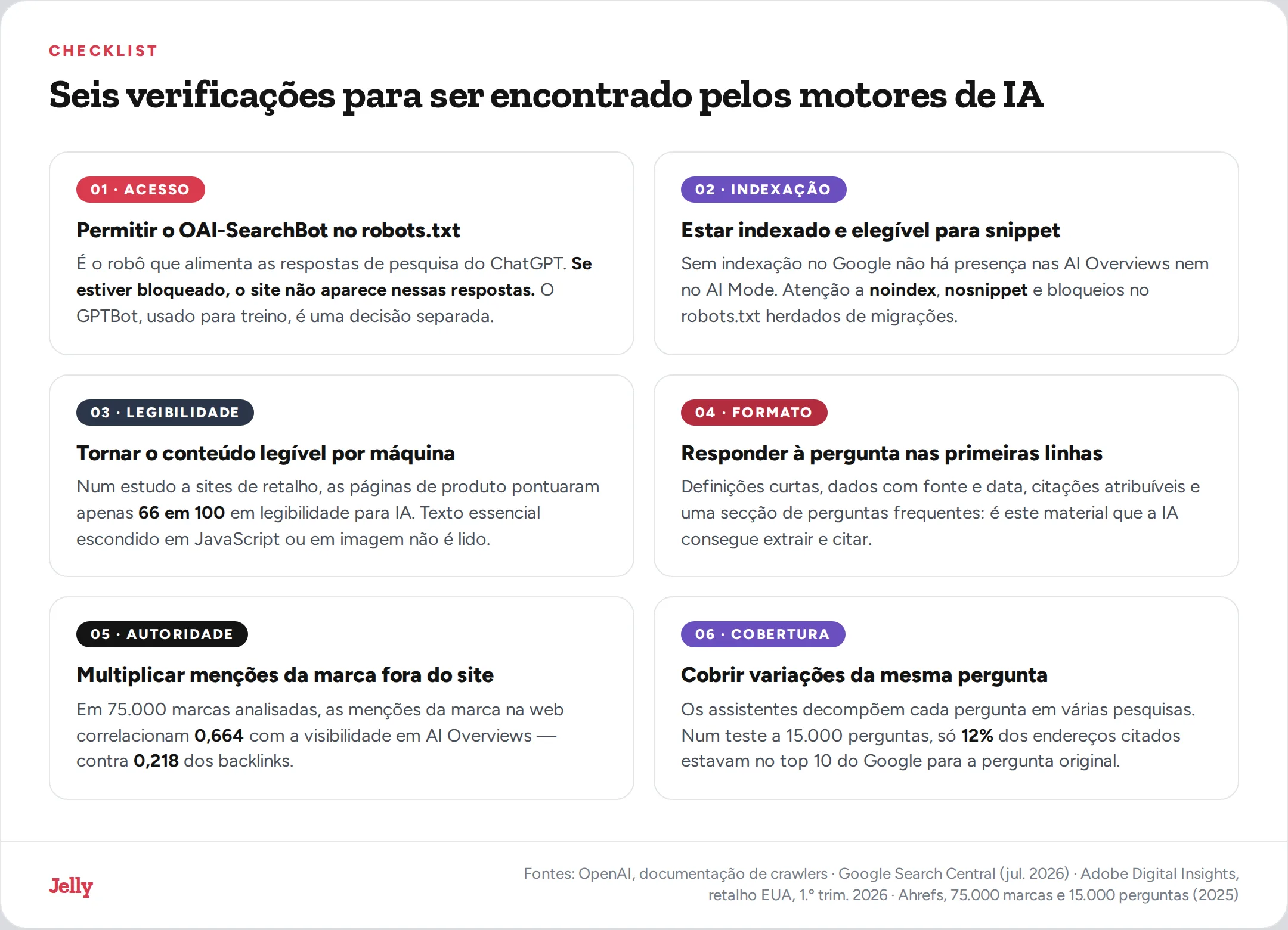
Adding expert quotes returned +41%, including statistics +33%, citing the sources used +27% and improving the fluency of the text +28%. Keyword stuffing was the only technique with a negative effect: −8%. More relevant for most companies: for sources entering the answer in fifth position, citing sources was worth +115% and adding quotes +100%. GEO is, above all, an opportunity for those who are not the dominant brand in their sector.
There is a second finding that changes how you plan content. An Ahrefs test of 15,000 questions across four assistants concluded that only 12% of the addresses cited were in Google's top 10 for the original question. Assistants break each question down into several parallel searches, so covering variations and adjacent questions counts for more than a position on a single keyword.
The platform matters too. Semrush's AI Visibility Index, which analysed 126 million prompts between January and April 2026, found that ChatGPT cites around 15 sources per answer on average and Gemini just three — and that only 36 brands worldwide held visibility in the top 100 across all four platforms analysed, every month. AI visibility is not transferable from one platform to another.
What Google says and the myths worth dropping
In July 2026, Google published its own documentation on optimising for generative AI features in Search. The official position is blunt: optimising for AI is still SEO. To appear in AI Overviews and AI Mode there is a single technical requirement — the page has to be indexed and eligible to be shown with a snippet.
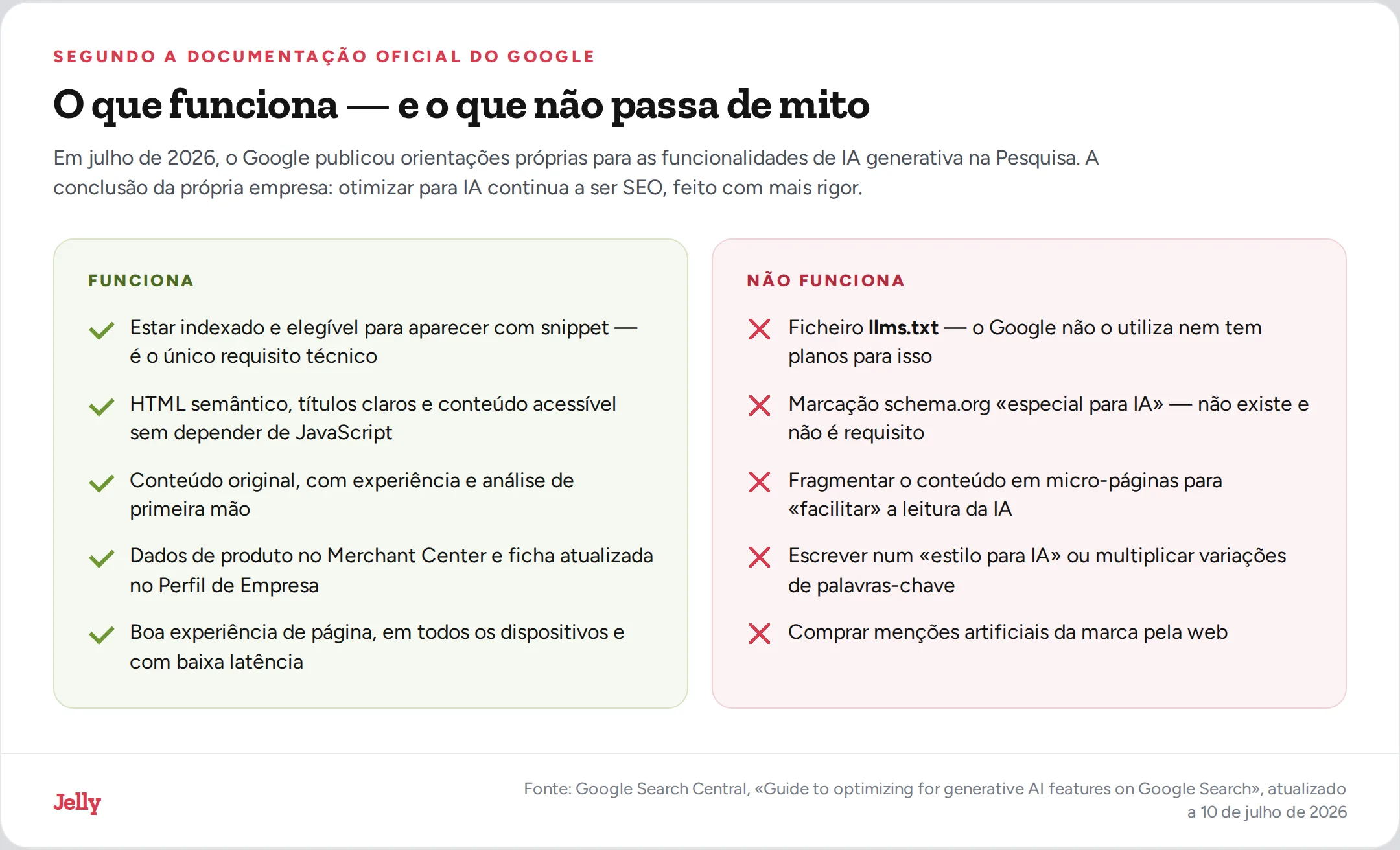
The same documentation dismantles several practices doing the rounds as good ideas: the llms.txt file is not used by Google and there are no plans for it to be; there is no “special for AI” schema.org markup; fragmenting content into micro-pages does not help; and artificial brand mentions bought across the web do not improve visibility. The contrast is worth holding on to: none of this replaces original content, with first-hand analysis, well structured and technically accessible.
The technical checklist almost nobody checks
Before rewriting the content, it is worth making sure the AI engines can reach it and read it. Two frequent examples: the OAI-SearchBot crawler, which feeds ChatGPT's search answers, is blocked in many robots.txt files as a knock-on effect of rules created to stop model training; and in an Adobe survey of retail sites, product pages scored only 66 out of 100 on machine readability, mainly because they rely on JavaScript to display essential information.
How to measure and where to start
Measurement is the weakest point in the process: in Semrush's survey, 45% of marketing leads admit they cannot accurately assess their brand's visibility in AI-generated answers. There are three instruments available to any company today: the generative AI performance report in Search Console, separating AI traffic in the site's analytics, and a manual, recurring test of a fixed set of questions on each platform, recording who gets cited.
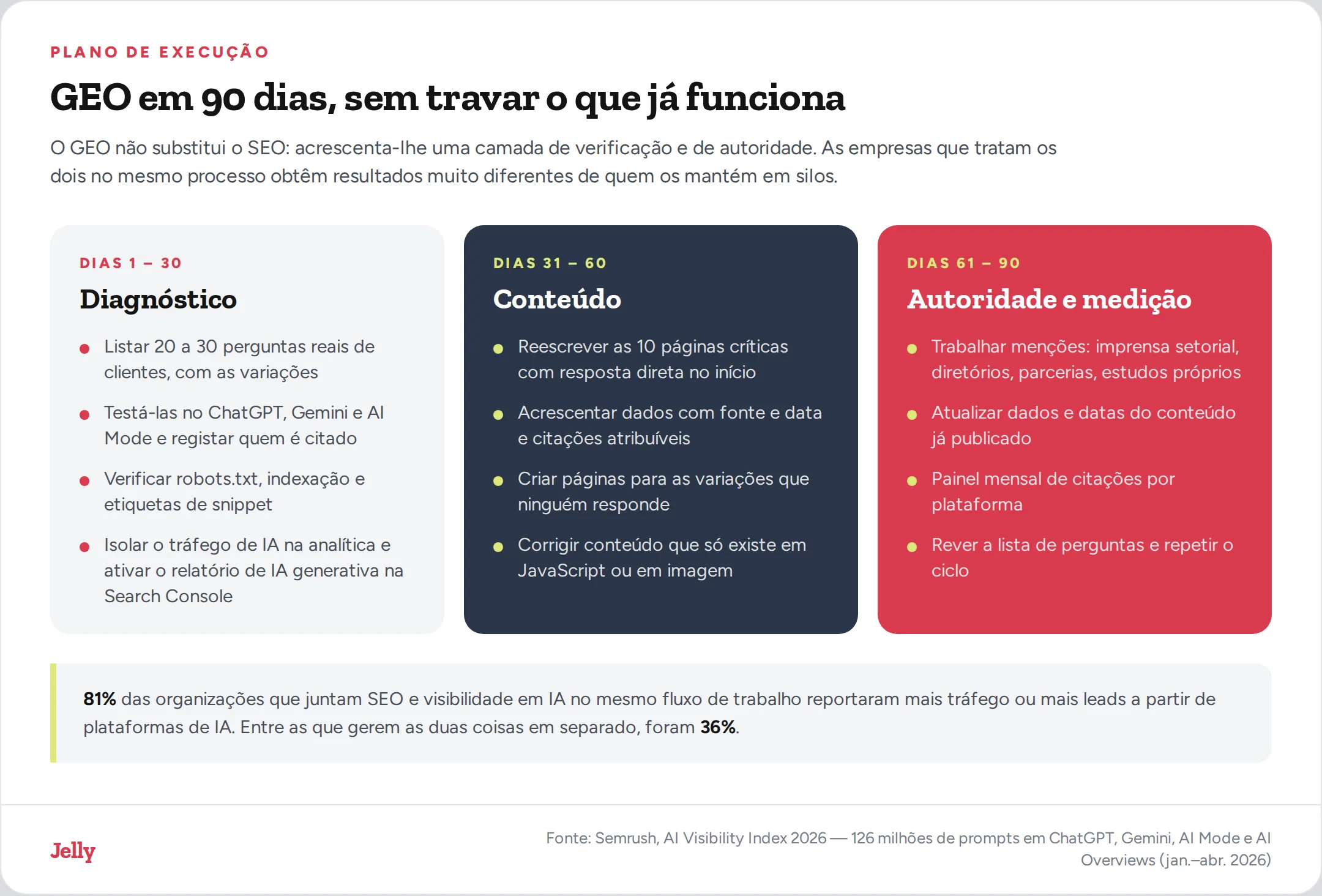
Sequencing has measurable consequences. Again according to Semrush, 81% of organisations that handle SEO and AI visibility in the same workflow reported more traffic or more leads from AI platforms; among those managing the two separately, it was 36%.
GEO is a layer, not a strategy
There is a limit to what technique can do on its own, and the GEO-Bench data shows it indirectly: the techniques that increase visibility are the ones that make content verifiable — quotes, statistics, sources — and the only one with a negative effect is the one that tries to manipulate the signal without adding substance. In other words, the algorithm does not create a brand's authority. It reads an authority that already exists. Where it does not exist, no amount of technical structuring will invent it.
This inversion is the basis of Algorithmic Immunity, the methodology we use at Jelly: substance first, technique after. Five layers, in this order: substance (the real quality of the offer and an unambiguous positioning), record (documenting experience in reviews, cases and verifiable citations), coherence (the same name, the same promise and the same data at every touchpoint), amplification (the technical structuring this article deals with, GEO and AEO included) and immunity (the permanent regime, with owned distribution and continuous monitoring).
GEO lives in the fourth layer. It is indispensable: without it, a brand with substance remains invisible to the machines that now answer customers' questions. But amplification multiplies what exists; it does not replace what is missing. And because that state cannot be bought or switched on in a quarter, whoever reaches it first becomes hard to dislodge.
GEO is not a new channel or a technical shortcut. It is the discipline of writing and structuring information verifiably — with data, sources, dates and attribution — and of making sure that information is accessible to the machines that now answer customers' questions. For companies already doing SEO properly, it is a natural extension. For those that are not, it is the second time the same opportunity has knocked.
Transparency note: This article reflects our approach to innovation. The text was structured with the support of AI Co-Pilot tools and reviewed, expanded and edited by our editorial team. The embedded infographics were created using Generative Artificial Intelligence.
Frequently asked questions
Does GEO replace SEO?
No. The two disciplines share the same technical base — indexing, structure, quality and authority — and Google itself states that optimising for AI features is optimising for search. GEO adds a layer: content verifiability, coverage of question variations and measurement of presence in generated answers.
Does it make sense for a small or medium-sized business?
It does, and possibly more so than for the leading brands. In the GEO-Bench study, the biggest gains were measured precisely on the worst-positioned sources: up to +115% visibility just from citing the sources used. Budget scale counts for less here than the rigour of the content.
Do I need to create an llms.txt file?
Not for Google, which has stated it does not use that file and has no plans to. More useful is to revisit robots.txt to confirm that the assistants' search crawlers, such as OpenAI's OAI-SearchBot, are allowed access, and to check whether essential content is available in HTML and not only generated by JavaScript.
Is a good GEO strategy enough to get cited by AI systems?
No. GEO ensures content is accessible, readable and verifiable for AI systems, but what assistants cite is the authority that already exists outside them — that is, the real quality of the offer, experience documented by third parties and entity coherence across every touchpoint. It is that combination we call Algorithmic Immunity; GEO is the layer that makes the brand visible to the machines, not the one that builds it.
Are GEO, AEO, AIO and LLMO the same thing?
In practice they describe the same work, but with different emphases: AEO starts from the question and the direct answer, LLMO from the behaviour of language models, GEO from generative engines as a whole. AIO calls for more care, because it is used both for the Google feature (AI Overviews) and for the optimisation itself. None of these acronyms corresponds to a distinct technical system — there is no schema.org markup «for AI» and no file that Google reads for this purpose. The basis is the same: verifiable content, accessible to machines.
Get what we write
No fixed calendar: only when there is something worth your time.