Brave new hybrid world: the shifting paradigm of work

Marta Peral Ribeiro – Communications Consultant –
Nobody doubts it: keeping work running during the pandemic was a huge challenge for many companies and their people. But adopting (and fine-tuning) a 100% remote model, or even a hybrid one, over the long term is another matter entirely.
More flexibility, more autonomy
Remote, on-site or hybrid? Five days a week or fewer? Eight hours a day or six?
Flexibility at work has become a priority for many professionals, especially over the past couple of years, prompting companies to review the working model they operate under and reassess factors such as location, time and productivity.
Marta Peral Ribeiro – Communications Consultant –
Nobody doubts it: keeping work running during the pandemic was a huge challenge for many companies and their people. But adopting (and fine-tuning) a 100% remote model, or even a hybrid one, over the long term is another matter entirely.
More flexibility, more autonomy
Remote, on-site or hybrid? Five days a week or fewer? Eight hours a day or six?
Flexibility at work has become a priority for many professionals, especially over the past couple of years, prompting companies to review the working model they operate under and reassess factors such as location, time and productivity. This article sets out to look at the advantages of different working models on the one hand and, on the other, to imagine scenarios in which people work less and produce the same — or even more.
Is remote work the future?
remote working arrangement
it is usually the worker who decides where they work and when, using their own resources (technology and so on). Pay and entitlements may also differ from those of a regular company employee.
- 82% believe remote work is the future
- 68% of workers want to carry on working remotely after the pandemic
- 42% is the rise in productivity reported by companies
These are just a few of the findings from the 2021 Remote Work Report.
In Portugal, many people have gone back to working on site, but plenty of companies have stayed remote.
Clearly, remote work isn't for everyone, as some jobs involve tasks that can only be carried out on site.
The challenges of remote work
Appealing as it is, the remote model has its drawbacks, even for workers. Here are the main challenges:
The time fallacy
When you work remotely — and anyone who came to teleworking for the first time will have noticed this straight away — it's easy to lose track of time. Partly because none of it goes on commuting, but also because of the constant interruptions at home.

Disconnection
When there's no face-to-face contact with colleagues, the dynamic is completely different. It's normal to feel isolated and to lose that sense of belonging within the team. Source: Unsplash Lack of focus
While working from home removes the distractions caused by colleagues for some people, others (especially those with family or pets at home) miss the office environment that makes them more productive. After all, our brains tend to associate a physical space with a particular mindset.
Burnout
For anyone working remotely, it isn't always easy to keep to a routine and know when to stop, even now we're out of lockdown. The report mentioned above shows that around half of those surveyed struggled to set boundaries around their working hours.
Managing and onboarding new team members
For a new employee, joining a team they barely know can bring its own difficulties. Settling into a new organisation is an important part of the individual's experience, and it takes a fair bit of tact on both sides.
The advantages of the hybrid model
The balance between all the factors mentioned above seems to lie in the hybrid model, which combines remote and on-site work. In other words, some days at home and some at the office.
Under this arrangement, the employee works away from the office (usually at home, the so-called home office), performs the same duties and keeps the same hours as they would at the office, is in constant contact with their team and uses technology provided by the company. Their rights are also exactly the same as they are in the office.
In Portugal, many companies have adopted this system. It appears to be the most beneficial option for workers and companies alike.
Beyond the time saved on travel, spending more time with our pets and being in for online deliveries, the hybrid model brings other advantages. And not just for workers:
Lower costs
Companies spend less on maintaining premises, and the space itself can be smaller because fewer people are in at any one time (which means lower rent). Employees spend less on commuting and food.
More flexibility, more productivity
When there is flexibility and autonomy, people tend to be happier because they can manage their own time and balance work with their personal lives. With that in their hands, they can perform better and deliver better results for the company.
Less turnover and less red tape
When people are satisfied, they tend to stay put, which allows the company to put its resources into improving products and services and developing its own people, rather than wasting them on the endless hunt for new hires and training them up.
A wider pool of candidates
Many professionals, particularly younger ones, are currently looking for remote or hybrid working because of the flexibility it offers. Organisations that offer these options widen their chances of attracting good candidates.
A smaller environmental footprint
Lockdown saw a drop in CO2 emissions, and a model that requires fewer trips to company premises can also help shrink the environmental footprint — especially where working hours are flexible, which can also mean using less electricity.
A hybrid model that works
Why strategy matters
For the shift to a new working paradigm to succeed, the company needs to set out a carefully considered strategy.
Take stock
What no longer makes sense? What has delivered the best results over the past two years? What are employees saying? How can we work more intelligently to maintain or improve our KPIs?
Consider the various scenarios
Some people prefer to go into the office every day; others work at home with children around; then there are new joiners who barely know the team, and so on. It's important to consider the full range of situations so that everyone is accommodated fairly. Sharpen communication
Good communication between leaders and their teams makes sure everyone is aligned and everyone plays their part. Any new company policies, non-negotiable requirements and communication preferences need to be spelled out clearly.

Just enough autonomy
Giving people autonomy isn't enough on its own. Tasks, days and hours need to be clearly defined. That way, people feel more confident and can manage their autonomy far more effectively. Source: Unsplash Leadership with a firm hand
Companies should back the people running the business and its teams. Leaders also need autonomy and flexibility so they can get involved and shape the employee experience in a personal way, not least because they are key to connecting everyone.
Onboarding new team members
New joiners have less face-to-face contact with the team, so settling in can be more complicated. The company should invest in a strong digital dynamic, with practical technological and administrative processes, so it can convey its organisational culture and the metrics it works to.
In the meantime, how can employees improve their remote experience?
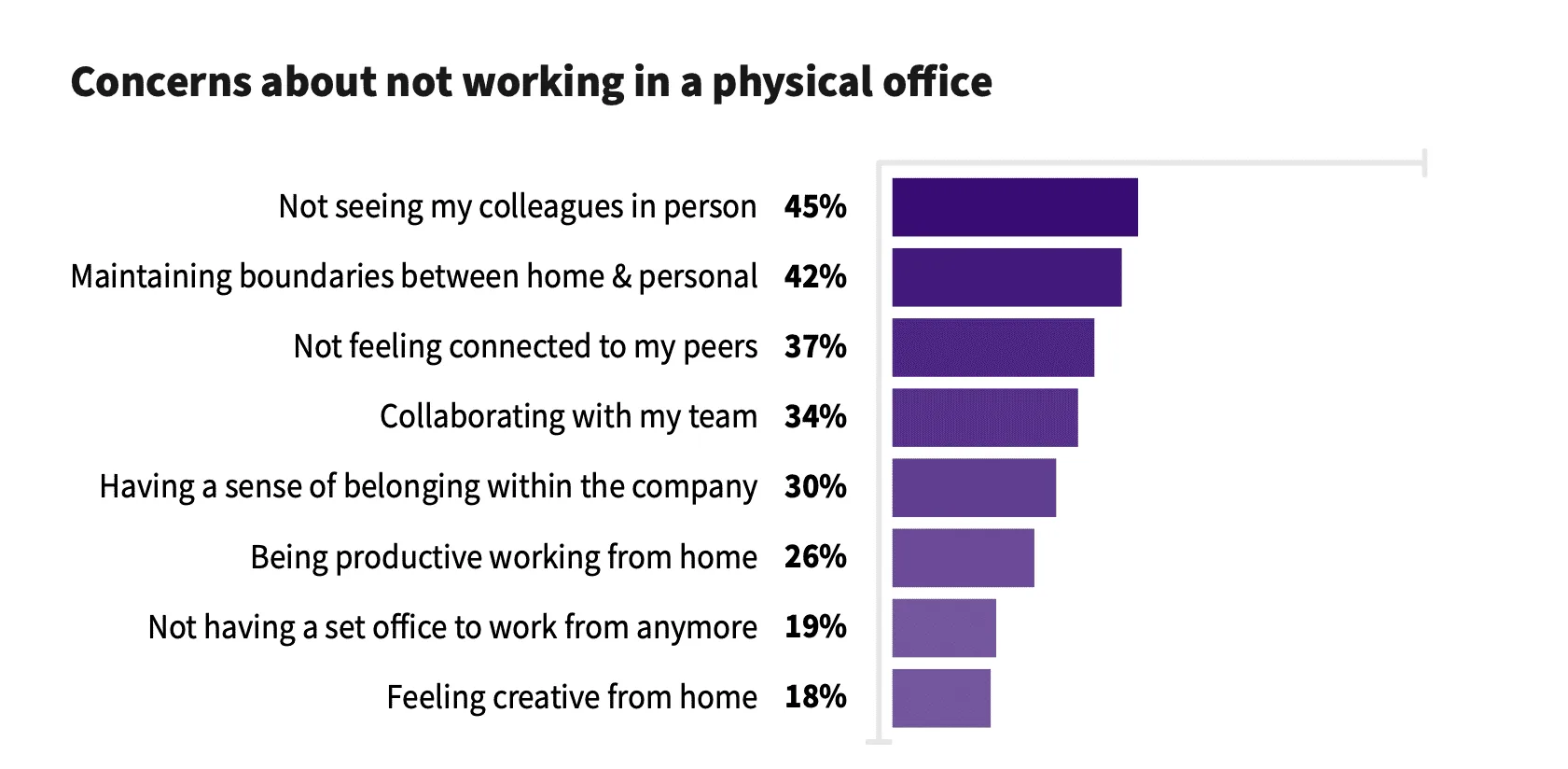
Teleworking and remote work may have plenty of advantages, but it isn't all rosy. And it isn't only companies that worry about how efficient work outside the office is.
According to the GitLab report mentioned earlier, employees have a number of concerns about teleworking, chief among them the lack of face-to-face contact with colleagues and the difficulty of separating personal life from work. Source: Remote Work Report (2021), GitLab Here are some ways to make the remote experience more efficient:
- Make sure you have everything you need
A computer and a stable internet connection are essential if working from home is going to run smoothly. Without them, you hold up not only your own work but everyone else's. It helps to know how to sort out technical issues, or who to turn to if they crop up. If you can have a decent-sized monitor and an ergonomic chair, so much the better.
- Create a disciplined working environment
Set a start time and a finish time for the working day to avoid the overload mentioned earlier. Your physical space should also be set up for work, with everything you need, including a glass of water. These routines and rituals help the brain switch into "work" mode — and out of it too.
- Work with discipline
What's the priority today? Decide at the outset what the priorities are for the day (or the week, if possible) and stop halfway through to check whether you're still focused on them or whether something needs adjusting.
- Talk to your team regularly
As well as seeing how your colleagues organise their work (they may have useful tips), you can look for interesting ways to connect with them, including meeting up in person. The main thing is not to slip into isolation.
Less time at work, more life: where are we heading?
It's news to nobody, and it certainly didn't take a pandemic to show us, that we've long been living in a culture of enormous pressure, where working life frequently overrides personal life in a spiral of productivity and exhaustion, technological connection and emotional disconnection.
But the pandemic did show us one thing: that things which until then seemed unthinkable are, in fact, possible. So it's realistic to explore other opportunities, other ways of working. Not least because the countries where people work the longest hours are not, as we can see, the ones with the strongest economies — Portugal being a case in point.
What we can learn from other countries
The United Kingdom recently began a trial reducing the number of working days. The idea is to keep productivity at 100% while working 80% of the hours for the usual salary. For six months, workers at nearly 100 companies will be working four days a week.
Over that period, the focus of the analysis will be the relationship between working time and productivity.
In Sweden, almost a decade ago, a range of companies trialled cutting the working day from eight hours to six (in start-ups, hospitals, the car industry and elsewhere). Some had to take on new staff to cover the remaining hours, it's true, but in others employee productivity went up with no need for extra jobs. Either way, aren't both outcomes a good sign? In the first case because it's a chance to bring unemployment down, and in the second because employees would be more efficient and more satisfied, which in turn makes them more likely to stay with the company long term.
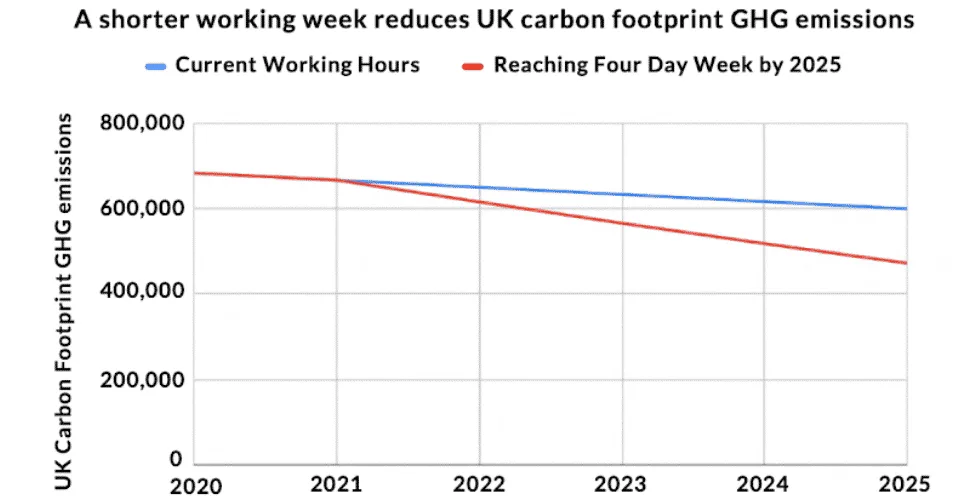
Between 2015 and 2019, Iceland also trialled a shorter working week on full pay, and the results were clear: productivity held steady or improved in most workplaces (schools, offices, social services and hospitals). On top of that, it's potentially a more sustainable option for the environment, as a 2021 Platform London report from the UK shows: Source: Platform London And what's the picture in Portugal?
In Portugal, people are also starting to talk about the possibility of a shorter working week, but we'll have to wait a while longer. Naturally, there are fears attached to the prospect of a shorter week, particularly the need to create more jobs and the tax and social security costs that would come with it.
The bill for shorter working hours has already been debated and approved during the State Budget discussions, and a study is under way to assess the feasibility of a four-day week. The other piece of good news is that, having heard about the project, a number of companies have already volunteered to trial it.
According to this article, Worten, Xerox, Blip and JLL are some of the companies in Portugal where employees work fewer hours on Fridays.
At Jelly, a shorter working week is already a reality, with a 7.5-hour working day. And over the summer, employees also have the option of leaving even earlier on Fridays. Since the pandemic in particular, with teleworking becoming essential and technology improving, many organisations have adopted a less rigid working model.
On the one hand, flexibility and autonomy at work have been shown to bring plenty of benefits for both companies and workers (hybrid working especially), largely thanks to lower costs and less administrative burden.
On the other hand, there's more resistance when it comes to cutting the number of hours worked each week.
What is certain is that, particularly over the past two years, it has become glaringly obvious how urgently we need to rethink the working model we've been operating under — not only because of the burnout so many people are experiencing from the imbalance between work and personal life, but also because more hours at work doesn't necessarily mean greater success for companies or for a country's economy.
In the meantime, we can learn from the experiences of other countries that have trialled, or are trialling, shorter working weeks, and consider how that might be applied here in Portugal.

Get what we write
No fixed calendar: only when there is something worth your time.