Growth isn't guesswork. It's arithmetic.

We live in an age where everything gets asked of artificial intelligence, including the most expensive question of all: where should my company grow? The irony is that the most reliable answer was never in a generative model. It was always in the least glamorous corner of the business: the sales ledger. What was missing was a method for reading it. And that is precisely what Informa D&B's Customer Portfolio Growth Opportunity Analysis does, with a methodology that, despite pre-dating the current hype around data and AI, remains not only current but increasingly relevant.
How it works
The starting point is disarmingly simple: the company's customer database, with the tax number and the sales made to each customer over the past year. Those records are cross-referenced with Informa D&B's database, which reflects the entirety of the business landscape operating in Portugal, with information onmore than 1.6 million companies, updated daily.
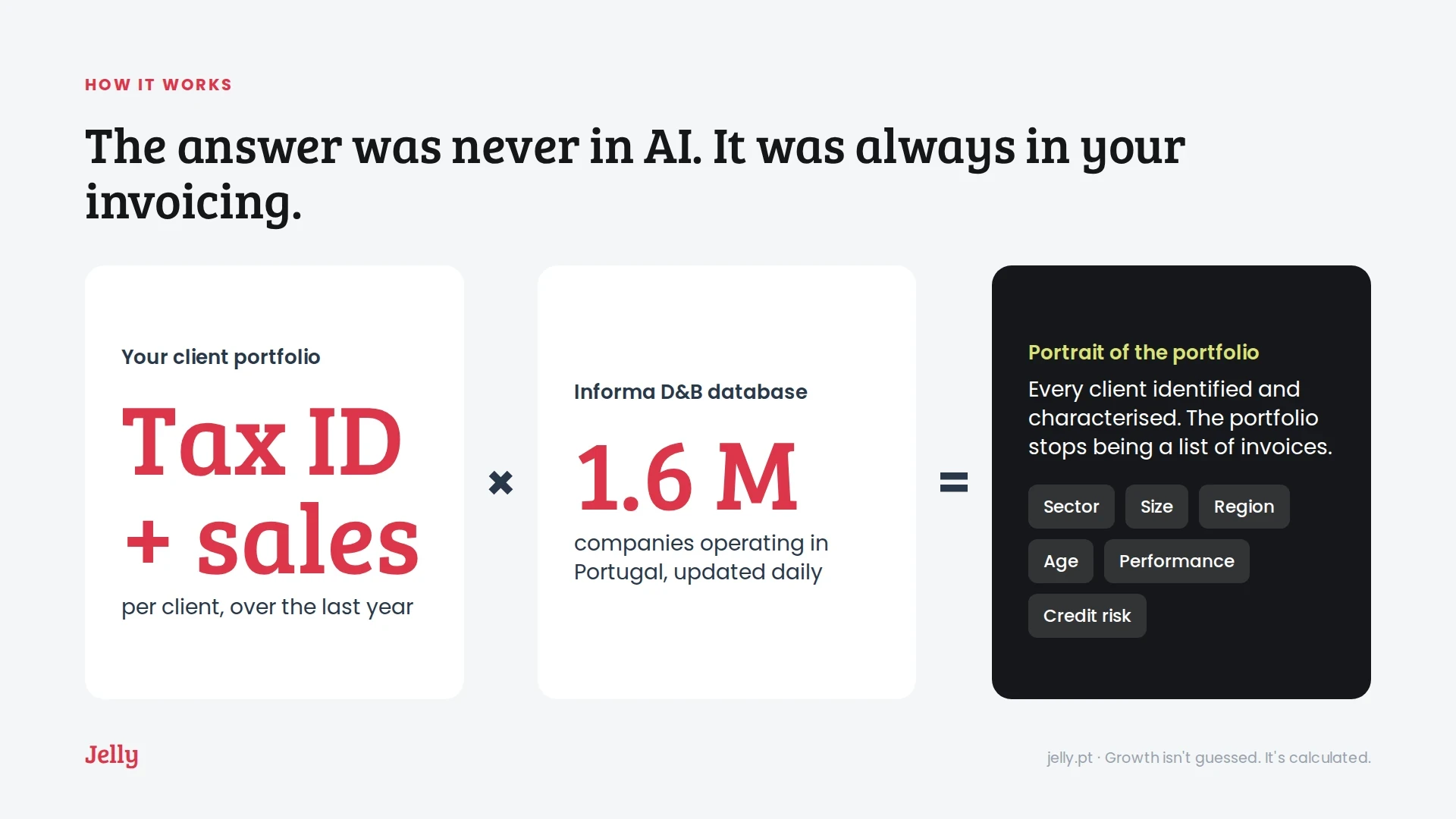
That match identifies and profiles every customer in the portfolio: sector of activity, size, region, age, financial performance, commercial risk. Suddenly, the portfolio stops being a list of invoices and becomes a demographic and financial portrait of who actually buys from the company. And once we know who our customers are and what each one is worth, we can extrapolate to the national market.
The fine mesh of lookalikes
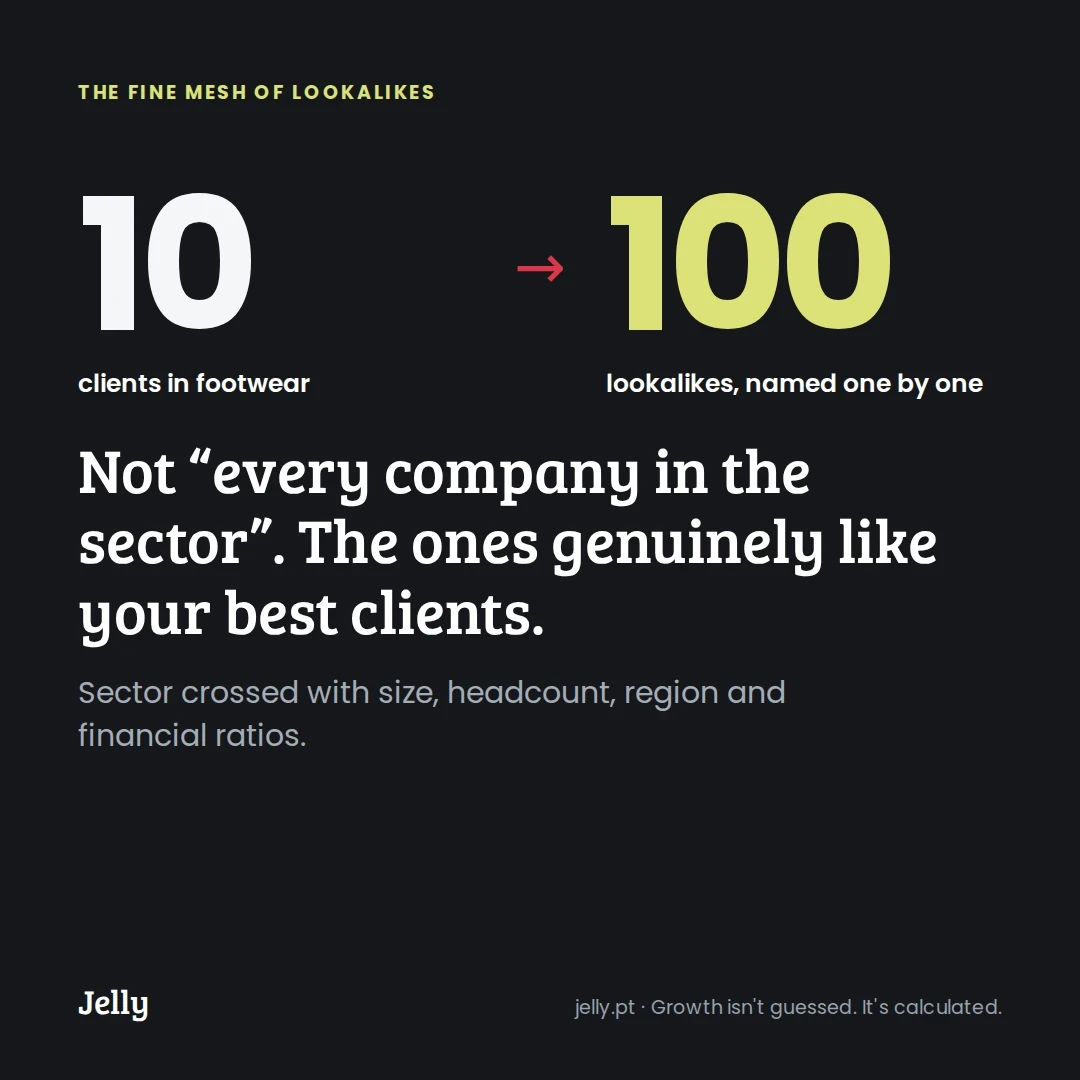
Here's the detail that separates this methodology from a superficial exercise. If I have ten customers in the footwear industry, it would be easy to say that my potential market is every footwear company in the country. Too easy, and therefore useless.
The analysis cross-references matrices: sector versus sales size, sector versus headcount, sector versus region, sector versus whichever financial ratios are worth measuring. It is this cross-referencing that produces a fine mesh, capable of identifying not just companies in the same sector, but companies genuinely similar to my best customers, in demographic profile and in financial performance. My ten footwear customers may reveal a hundred lookalikes in the market, and I get to know who they are, one by one.
Beyond identifying, the analysis qualifies. Knowing what my current customers of a given profile are worth, the model assumes that if I win new similar customers at my current penetration rate, my potential in euros is X. It stops being a hunch and becomes a calculation.
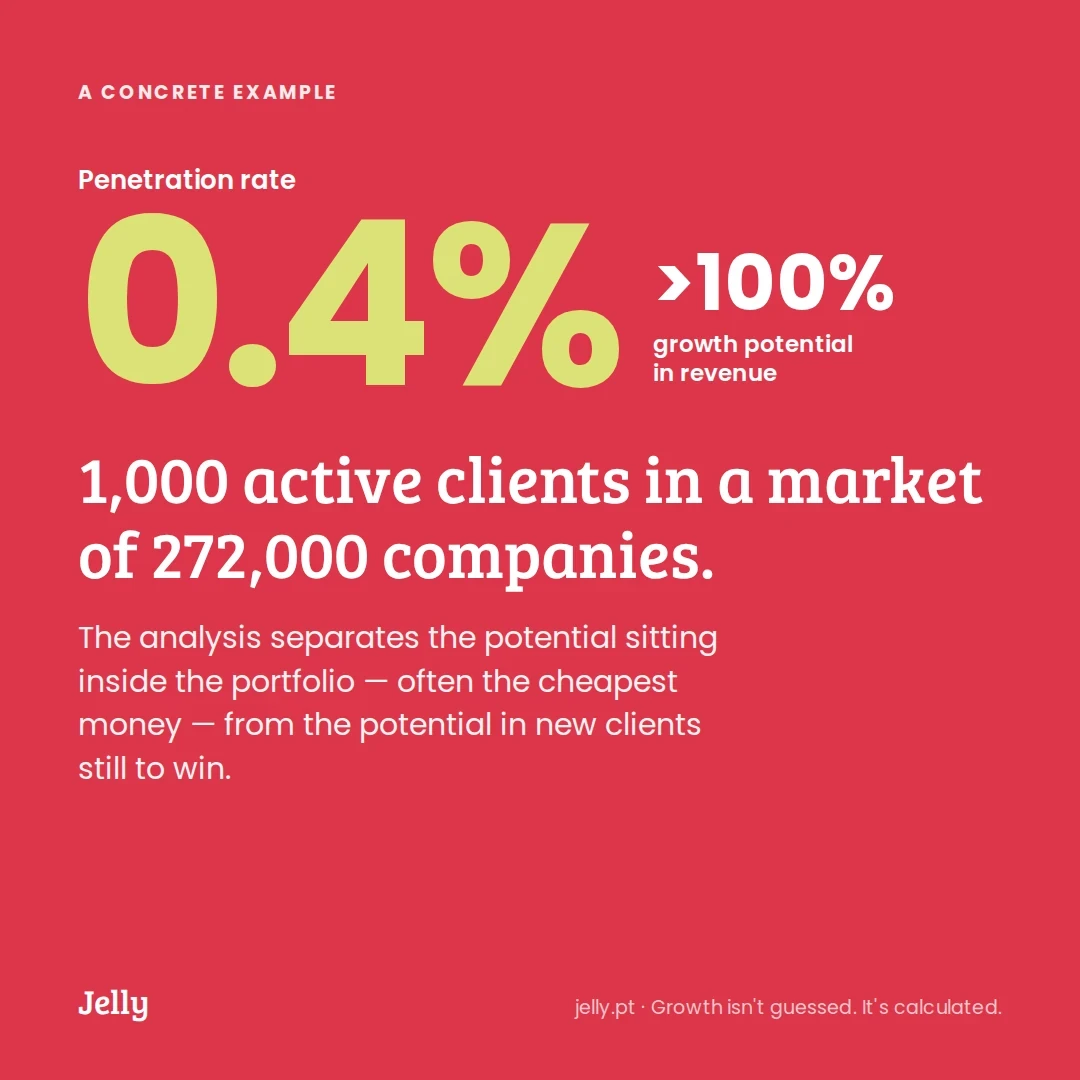
A concrete example of the kind of reading this allows: a portfolio of a thousand active customers in an addressable market of 272 thousand companies represents a penetration rate of 0.4%. The analysis might reveal revenue growth potential of more than 100%, and distinguish the share of that potential sitting inside the portfolio itself from the share sitting in new customers still to be won. Because yes, the analysis also uncovers growth opportunities among the customers we already have, which is often the cheapest money to go after.
Two levels of depth
The methodology is available at two levels. The Portfolio Diagnostic gives the macro view: quantification of the portfolio against the addressable market, customer profile by age, size and region, characterisation of the portfolio's commercial risk (probability of closure, of default, and resilience) and the quantification of growth potential, with the most promising segments identified.
The full Opportunity Analysis goes to the fine mesh: it cross-references the business with company age, with size, with sectors and sub-sectors, with regions, with export and import profile, and identifies the largest customers in each sector and each region. It is a genuine market analysis, one that returns an objective view of the company's current positioning: where I'm strong, where I'm absent, where my penetration rate sits below what my own track record proves to be possible.
Why the methodology has stayed current
It might seem that a methodology built on database matching would be outdated in the age of AI. The opposite is true, for three fundamental reasons.
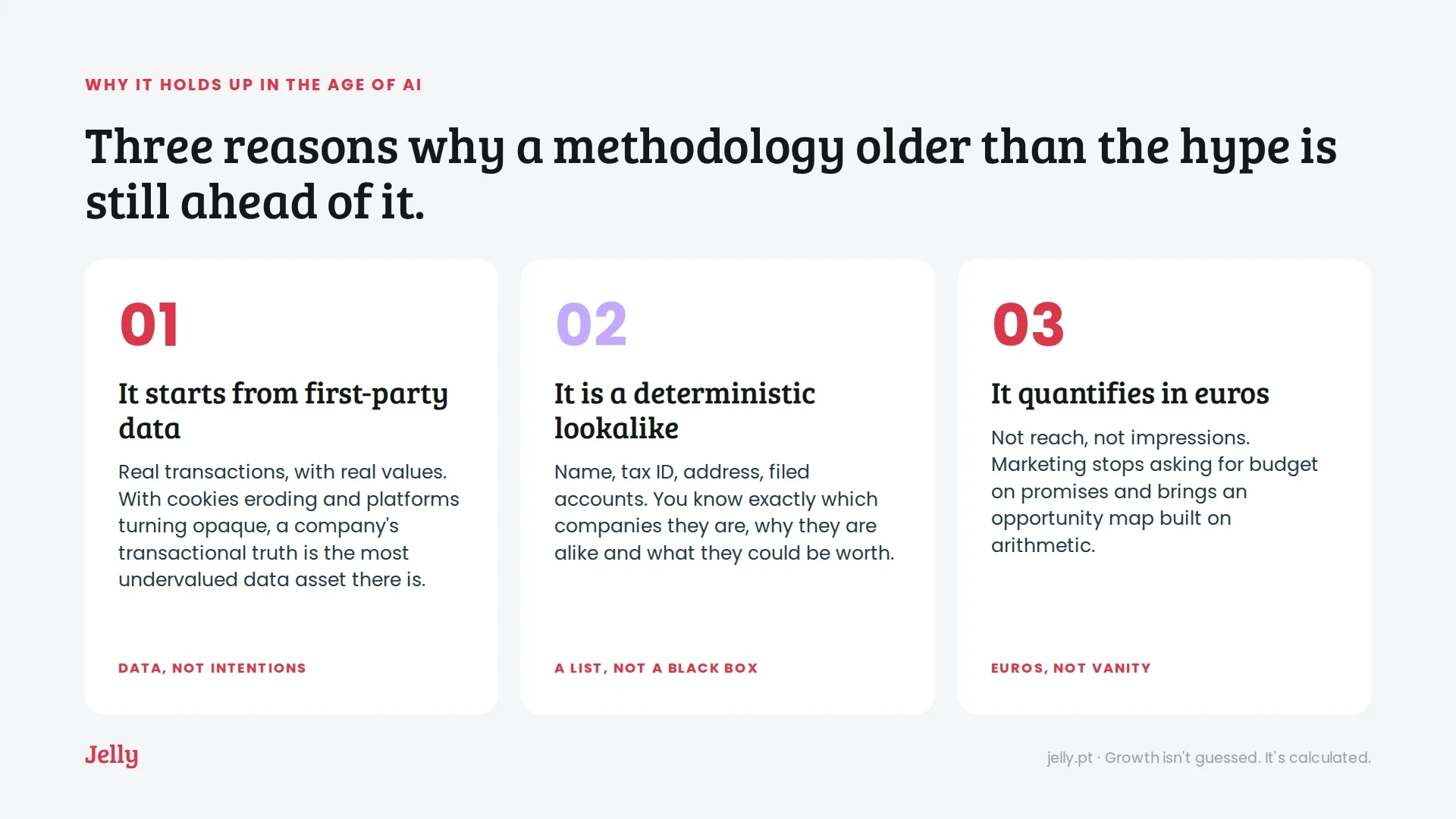
First, it starts from first-party data. Not from declared intentions, not from inferred behaviours, not from estimated audiences: from real transactions, with real values. At a time when digital marketing is facing the erosion of cookies and the growing opacity of the platforms, a company's own transactional truth is the most undervalued data asset there is.
Second, it's a deterministic lookalike. Advertising platforms have popularised similar audiences, but those are probabilistic and closed: the algorithm says it has found similar people, and we have to take its word for it. Here, the lookalike has a name, a tax number, an address, filed accounts and financial ratios. I know exactly who the companies are, why they're similar and what they might be worth. It's the difference between trusting a black box and working with a verifiable list.
Third, it quantifies in euros, not in vanity metrics. The end result isn't reach or impressions: it's revenue potential, segment by segment. And that changes the nature of the conversation inside the company, because marketing stops asking for budget on the back of promises and starts presenting an opportunity map built on arithmetic.
AI doesn't make this methodology obsolete; it feeds on it. Models and agents are only as good as the data we give them, and a portfolio profiled by tax number with quantified potential is first-rate raw material for any intelligent marketing and sales system. As I've been arguing for years: mindset first, tools second. The right philosophy doesn't age; it's the tools that keep updating around it.
From the report to the field
There is, however, something we shouldn't forget: no analysis creates value while it sits inside a PDF. The potential identified only converts into revenue when it feeds the operation, on both the sales and the marketing side.
This is where the work we've been developing at Jelly comes in. In an exclusive partnership with Informa D&B, we integrate this capability into the tactical plan of the digital strategies we produce for our clients. The highest-potential segments identified by the analysis go on to guide sales prospecting in the field and, at the same time, the performance and content plan in digital. The same fine mesh that tells the sales team who to visit tells the marketing team who to reach, with what message and in which region. The result is a cohesive view of the company's business plan, orchestrated by marketing and sales working from the same map.
Ultimately, this is what separates the companies that grow consistently from those that grow by accident: the former know exactly where their next customer is, because they've seriously studied the ones they already have. Growth isn't guesswork. It's arithmetic.
Get what we write
No fixed calendar: only when there is something worth your time.

Gonçalo Malho Rodrigues
Fundador & CEO
Fundou a Jelly – Digital Agency em Portugal em 2010 e a Strivesync – AI-Native Systems no Dubai em 2026. Detém outras empresas, noutros setores, como a Stronddo – Online Art Galleryl, a Scallent – Human Talent. Gonçalo, criou a The Change Framework, que apoia líderes a gerar a mudança através da mobilização de equipas em torno de uma causa.