ChatGPT Ads – The conversation arrives in Portugal

Advertising arrived on Chat GPT in 31 European markets at the end of August 2026 and, since 31 August, companies based in Portugal have been able to access the Ads Manager, still in beta. A new media channel opens up inside a conversational experience, with one essential distinction from the outset: paying to appear next to an answer is not paying to be recommended within it.
What happened
OpenAI began testing advertising on Chat GPT in the United States in February 2026. Six months later, it extended the model to Europe. Ads appear below the answers, clearly labelled as sponsored and visually separated from the content generated by Chat GPT. OpenAI states that advertising runs on an independent system and does not alter the answers given by the model.
The early data reinforces the separation between the two layers. In a study by SE Ranking covering more than 50,000 commercial prompts, the advertiser's domain also appeared among the cited sources in just 3.63% of the ad placements analysed.
THE POINT THAT CHANGES THE PLAN
Buying advertising on Chat GPT buys sponsored visibility, it does not buy organic presence within the answer. A brand can pay to appear next to an answer that recommends a competitor, and it can be recommended without investing in advertising.
Who can see ads
Ads may be shown on the Free and Go plans. Plus, Pro, Business, Enterprise and Edu remain ad-free, and there are further exclusions and controls, namely for under-18s and for certain product experiences.
Chat GPT is approaching a billion weekly active users, but OpenAI does not publish a breakdown detailed enough to calculate precisely what percentage of that audience is actually available for advertising. For brands, then, the relevant question is not the total size of Chat GPT. It is working out whether the audience they want to reach uses the plans where ad inventory exists.
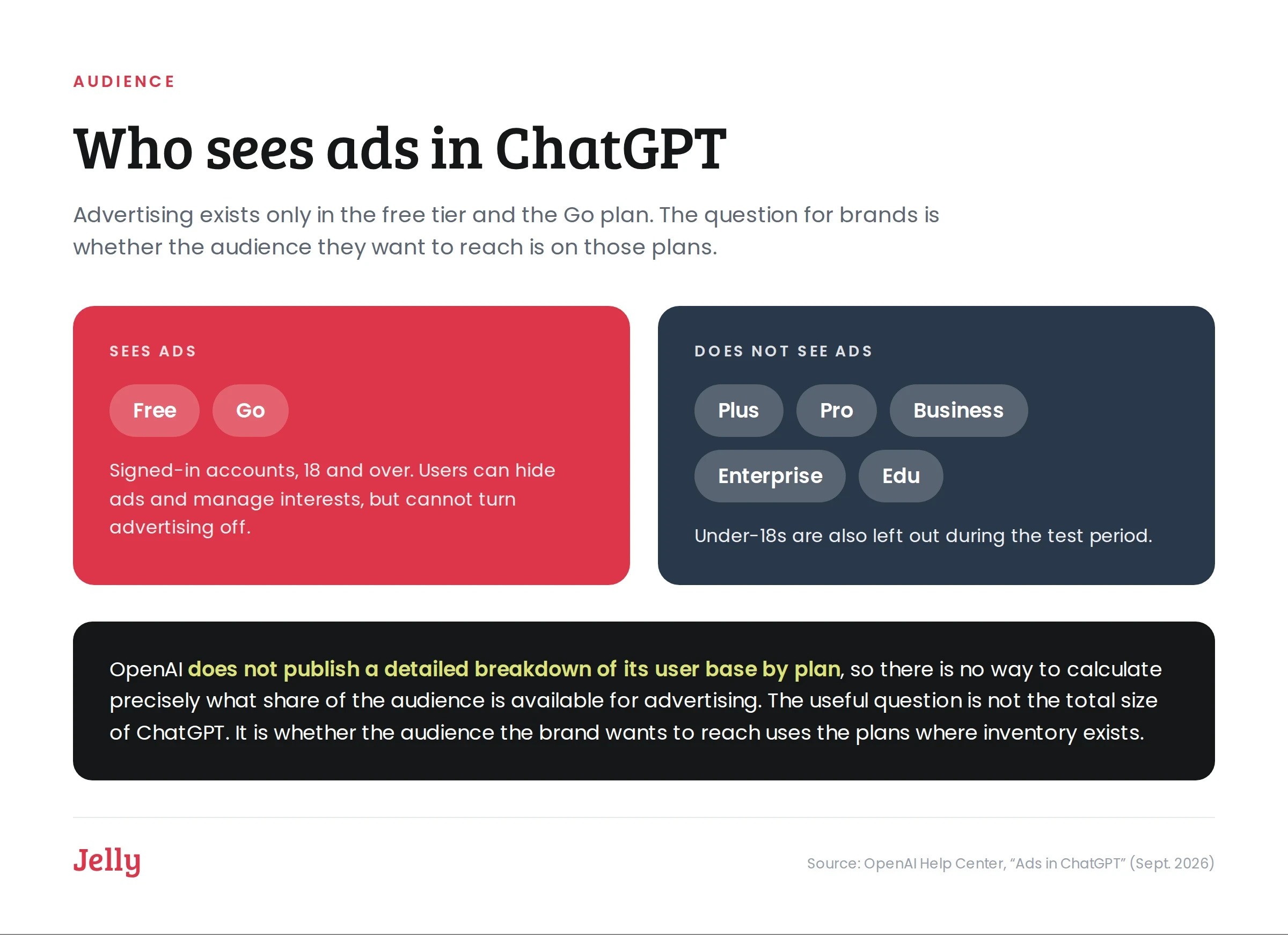
Advertising exists only on the Free and Go plans.
A different buying logic
Chat GPT Ads does not work like a traditional search campaign in Google Ads. When setting up a campaign, what the advertiser defines are the “Context clues”: indications of the topics, products or keywords for which their products or services may be relevant. Unlike what is usual on other platforms, these clues do not work as targeting keywords: they guide delivery, but they do not guarantee that the ad will appear in a specific conversation.
According to OpenAI, ad selection combines those clues with other signals assessed automatically by the system, such as the context and intent of the ongoing conversation, the landing page, the headline and the ad copy itself. The advertiser does not get access to the conversations that triggered the ad's appearance.
There is another important difference in Europe. At this stage, personalised ads are not available in the European Economic Area or Switzerland. Selection is therefore based mainly on the context of the current conversation and on basic contextual information, such as language or general location.
The Ads Manager also allows you to create custom audiences by uploading contact lists (email, phone or hashed variants), in order to include, exclude or adjust the bid for an ad group when the viewer belongs to that audience. This feature is not available for campaigns targeting the European Economic Area or Switzerland, the same restriction that already applies to ad personalisation.
In practice, for a brand advertising in Portugal, custom audiences are not, for now, an available targeting option.
A channel growing fast, but still small
In less than 200 days, Chat GPT Ads reached one billion dollars in annualised revenue. The speed of growth is significant. The scale is still quite different from advertising tied to Google search. In 2025, the “Google Search & other” line generated 224.5 billion dollars in revenue. The comparison is not like for like, one is an annualised revenue run rate and the other is revenue actually recorded over a year, but it helps put the channel's current size into perspective.
The early results counsel caution. In a case published by Search Engine Land, involving around 1,500 users who reached the same site, Google Ads traffic converted at 3.71% and Chat GPT Ads traffic at 0.21%. Engagement time and engaged sessions were also lower. It is a single case, not a benchmark, and OpenAI itself acknowledges that there are still no consolidated performance references by advertiser, sector or campaign type. The conclusion is not that the channel works or does not work, it is that it still needs to be tested and measured as a new channel.
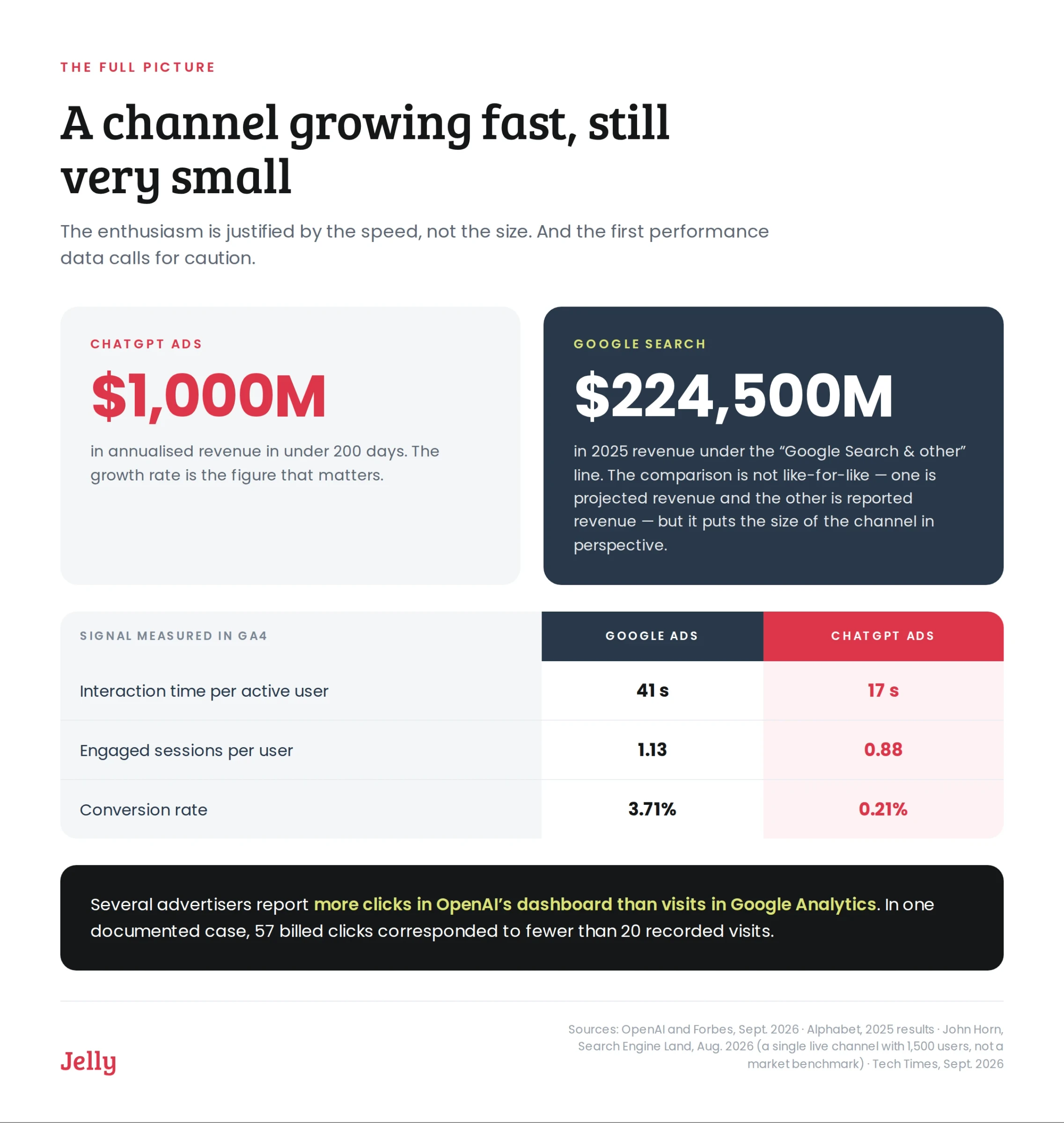
The channel's current size and the first comparative performance signals.
In Portugal, the audience is already on AI
The shift in consumer behaviour began before advertising did. According to Deloitte, 70% of Portuguese adults surveyed have already used generative AI tools, up from 41% in 2023, and Chat GPT is the most used solution, at 61%. In a study by LLYC with Appinio, 23.6% of respondents said they start their search journey directly on AI assistants.
On the business side, adoption is considerably lower. In 2025, 11.5% of Portuguese companies covered by Eurostat statistics were using at least one AI technology. It is in this gap that an opportunity appears: brands can start working on their visibility in AI systems before the market reaches the maturity of other digital channels.
When to test, and when to wait
It makes sense to consider a test when there is an e-commerce or consumer lead generation business, when the brand already receives organic traffic from Chat GPT, when it can measure results beyond the click, and when there is dedicated budget to experiment without taking investment away from channels that have already proven their return.
Waiting may be more sensible when the target audience is concentrated on ad-free plans, when the category is subject to additional eligibility rules, when there is no measurement in place, or when the test would have to replace investment that is demonstrably profitable.
The main mistake would be to treat Chat GPT Ads as just another Google Search campaign and expect the same costs, volumes or conversion rates. The opposite mistake would be to wait for the paid channel to mature and, in the meantime, ignore organic visibility.
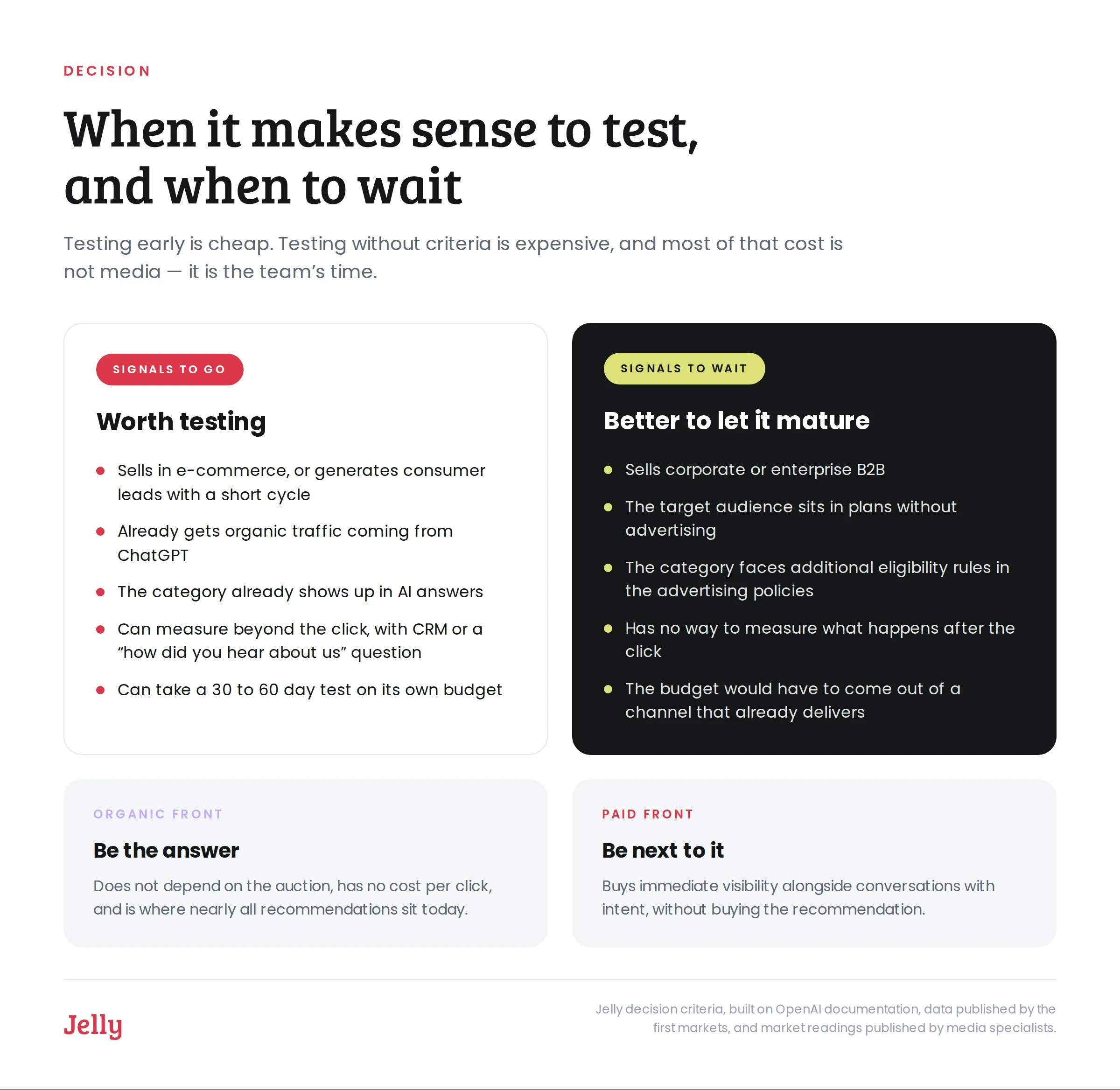
Decision criteria before investing, and the two fronts to work on in parallel.
Technical aspects to bear in mind
When setting up the account, the brand logo is a mandatory validation element, something not usual on other advertising platforms: OpenAI requires confirmation of the account name and logo exactly as they should appear in the ad, and ads are not served until this step is completed.
In terms of ad setup, there is less scope for varying headlines and descriptions than in Google Ads, but the ad image can be used to reinforce the message.
Another relevant point is that installing the conversion pixel does not follow the familiar model of Meta Ads or Google Ads. Whenever the code is copied directly in Ads Manager → Conversions → Data Source → Copy data source, the snippet arrives with debug:true included by default:
oaiq(“init”,{pixelId:”YOUR_PIXEL_ID”,debug:true});
This behaviour is intentional on OpenAI's part, to make initial testing easier, but it should not go into production. Before publishing the code in a new tag or replacing it in an existing tag, the debug:true parameter should be removed.
There are also other specific adjustments being validated depending on the number of accounts activated and the objective of each campaign, namely at the level of the e-commerce data feed for online shops that do not use Shopify.
Not all companies, brands and categories can advertise
OpenAI's Ads Policies add an essential filter to the investment decision. At this stage, the focus is mainly on consumer categories such as lifestyle and home goods, local services, travel and experiences, digital products and education. For a brand in Portugal, eligibility should be checked before any test: financial and healthcare services outside the United States are, as a rule, prohibited at this stage, legal services are not permitted, and categories such as alcohol and tobacco, gambling, political content and recreational drugs remain excluded.
The rules apply to the full ad experience. The advertiser must present a truthful identity and affiliations, use only authorised brand assets and direct users to a landing page consistent with the offer. Misleading or unsubstantiated claims, false associations and creatives that imitate the ChatGPT interface or voice can lead to the ad being rejected. Ads for property or specific job offers are also not permitted, although platforms with multiple listings may be eligible when the creative and the landing page do not promote a specific listing.
Approval also does not guarantee presence in any given conversation. OpenAI blocks ads in contexts it classifies as inappropriate or sensitive, including situations of emotional vulnerability, conversations about mental health and personal health, fraud, graphic violence, self-harm, politics, misinformation, weapons and regulated goods. The review covers the advertiser, the creative, the landing page and the placement. It combines automated systems with human oversight and continues after approval, with delivery potentially being limited or the ad removed in the event of non-compliance.
How we help
At Jelly, we work on these two fronts in parallel. We start by understanding where the brand appears in AI engine answers, which competitors come up and which sources are used. From there, we work the organic front with GEO methodology to increase the likelihood of the brand being found, considered and cited, not to guarantee a recommendation.
On the paid side, we assess whether the conditions are already in place to test ChatGPT Ads, we set up measurement before the investment, and we define clear criteria for deciding whether to scale, adjust or wait.
THE IDEA TO TAKE AWAY
Advertising can buy space next to the answer. Organic visibility is built to try to become part of it.
Sources
OpenAI, Testing ads in ChatGPT and ChatGPT Ads expands across Europe · OpenAI Help Center · Index Lab, availability by country · John Horn, Search Engine Land · SE Ranking study · Forbes and Tech Times · Alphabet, 2025 results · Deloitte Digital Consumer Trends, Portugal edition · LLYC and Appinio (Jan. 2026) · Eurostat, AI use by companies.
Transparency note: This article reflects our approach to innovation. The text was structured with the support of Co-Pilot AI tools and reviewed, expanded and edited by our editorial team. The infographics included were created using Generative Artificial Intelligence.
Get what we write
No fixed calendar: only when there is something worth your time.