First-party data, predictive audiences and more sales: how the Jelly x Clustie partnership is scaling e-commerce on Meta Ads
Anyone who has managed Paid Media for a few years knows it: the targeting that worked in 2019 no longer exists. iOS 14 cut signals, third-party cookies are disappearing, and Meta's "broad" campaigns have become a bet in which the algorithm guesses who our customer is. Often, it burns budget.
At Jelly, the question we ask every e-commerce client is always the same: how do we increase sales without simply increasing investment? The most effective answer we found was in the data that stores already had, and that almost nobody was using properly.
This is where our partnership with Clustie.
The problem: the algorithm doesn't know your customer
Meta is extraordinary at optimizing, but it only optimizes based on the signals it receives, and those signals have become poorer. Clustie sums up the diagnosis in three points I fully agree with: third-party data has collapsed, broad targeting wastes budget, and manual optimization doesn't scale.
There is, however, one asset that no privacy change can take away from a brand: first-party data. Purchase history, the value of each customer, repurchase frequency, the products that are sold together. In a Shopify store, all of this information is already there. The challenge is turning it into a useful signal for Meta.
What Clustie is
Clustie is an artificial intelligence platform developed by the FULLVENUE team, specialized in creating high-performance audiences for e-commerce, as described in the MacStore case study. In practice, it works as an intelligence layer between the online store and the Meta Ads account.
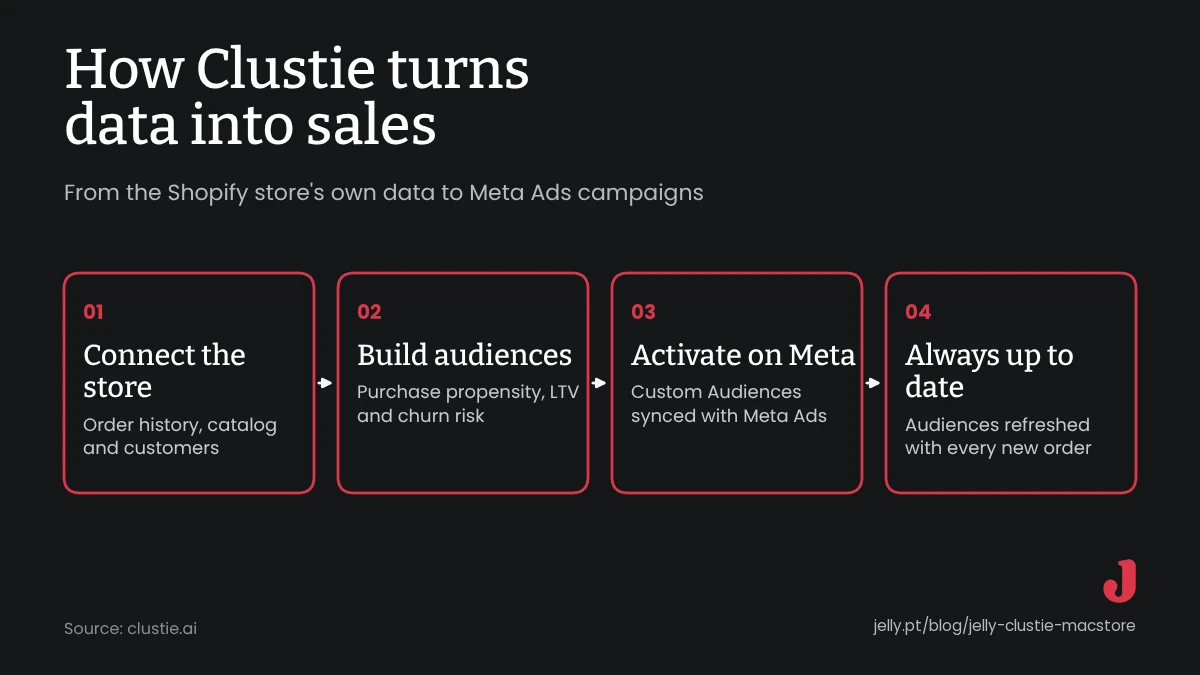
The process has three steps, according to Clustie itself:
- Connecting the store. The app installs on Shopify in a few minutes and starts learning from order history, the catalog and customer behavior.
- Building the audiences. AI models analyze purchase patterns and segment customers by purchase probability, lifetime value (LTV), churn risk and product affinity, sending these audiences directly to Meta Ads as Custom Audiences.
- Continuous updating. Audiences update with every new order, ensuring campaigns are always talking to the right people.
One of the models that interests us most from a growth standpoint is the predictive one: according to Clustie's blog, it identifies the users most likely to buy in the next 30, 60 and 90 days. These are audiences that deliver quick wins while "cold" lookalikes are still stabilizing, something that normally takes two to three weeks.
A question we get asked a lot: isn't this the same as Advantage+? No. As Clustie explains, Advantage+ works with anonymous signals, whereas Clustie uses real customer data (purchase history, LTV, churn risk) to build audiences that Meta's algorithm can't build on its own.
The MacStore case: +70% ROAS without increasing investment
MacStore is one of Portugal's leading retailers of Apple products and premium accessories, and is a Jelly client. As the e-commerce operation grew, a classic challenge emerged: improving the profitability of Meta Ads campaigns without increasing investment. The goal, as described in the case study published by Clustie, was to use data more intelligently, turning first-party information, such as purchase history and transaction data, into actionable insights.
In premium tech, the average ticket is high and generic traffic is expensive. We didn't need more clicks; we needed people who were ready to invest in Apple equipment.
The solution was to connect MacStore's Shopify store and Meta Ads account to Clustie, creating predictive audiences from the brand's own data. These audiences identified the customers with the highest purchase propensity and greatest value potential, which allowed us to replace broad targeting with far more precise campaign activation.
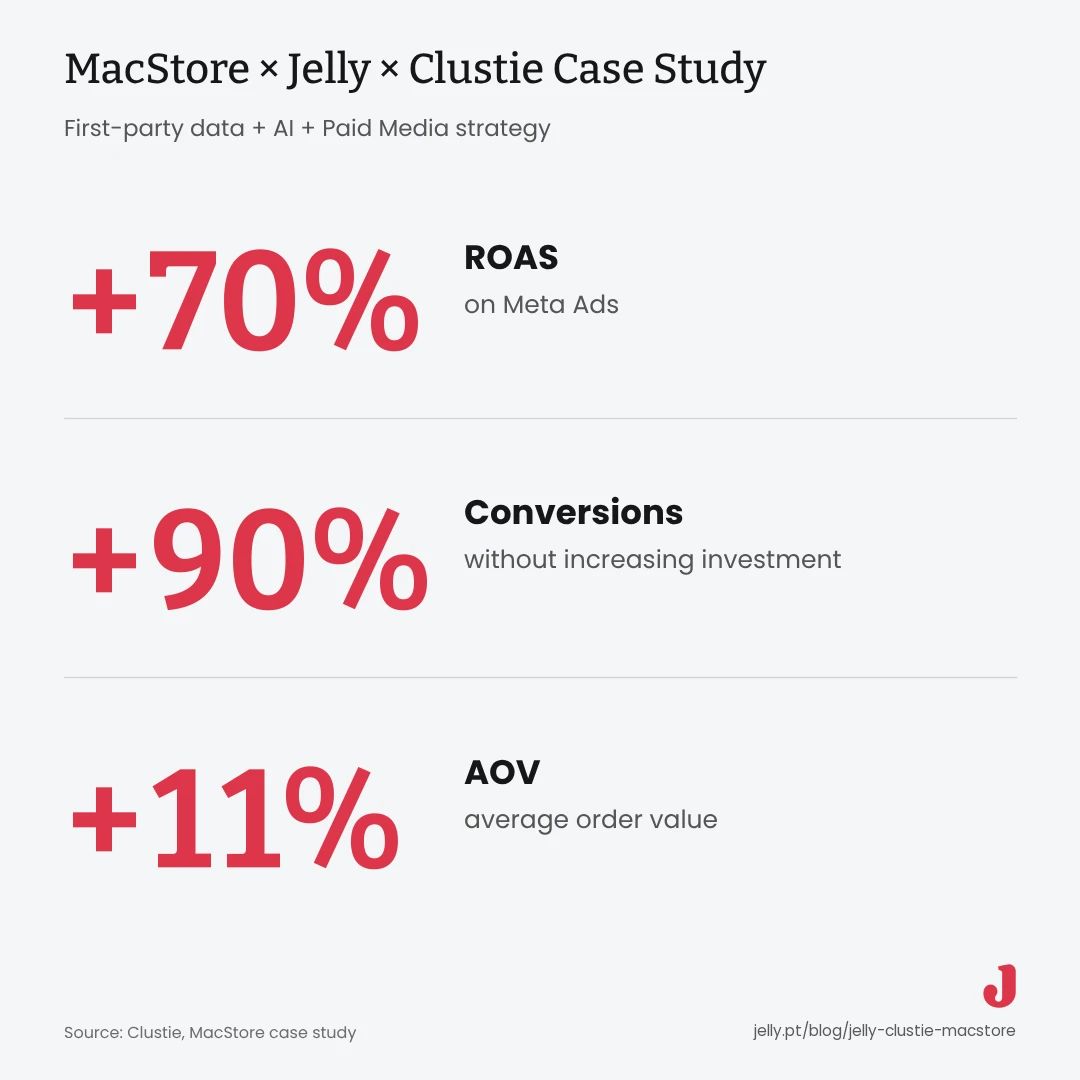
The results, published in Clustie's case study:
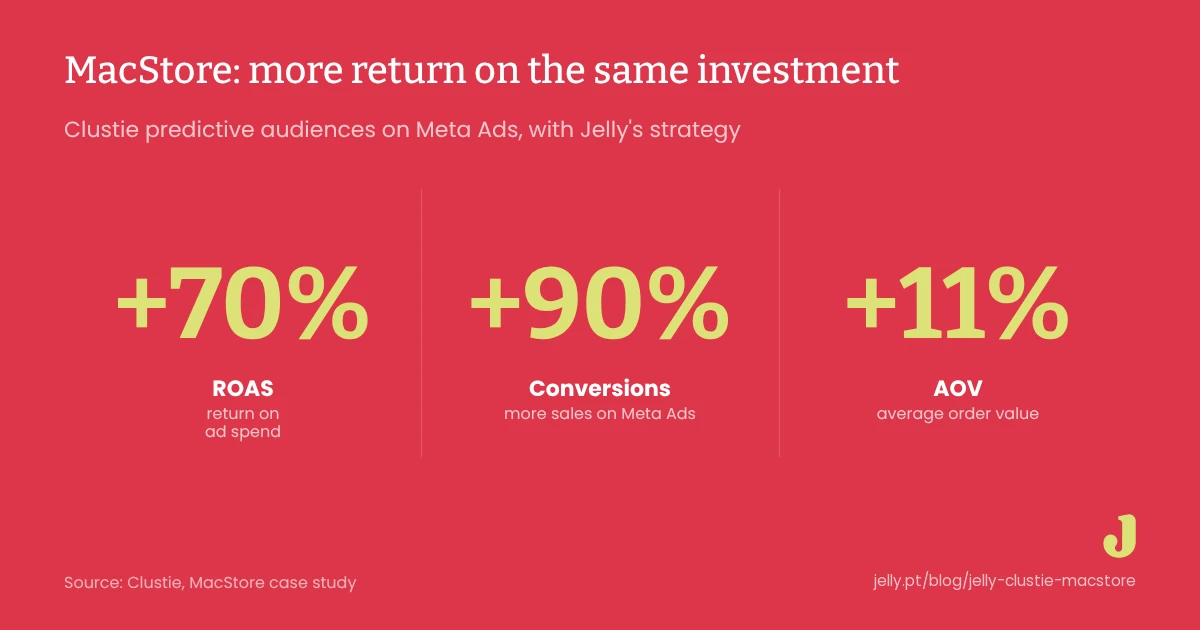
- +70% ROAS (Return on Ad Spend)
- +90% conversions
- +11% average order value (AOV)
On Clustie's homepage, MacStore also stands out with a 6.4× ROAS on Meta Ads.
Frederico Felner, CEO of MacStore, sums up the experience in a testimonial published by Clustie: "With Clustie, we quickly noticed a significant improvement in ROAS on Meta. We're excited to follow its evolution and keep driving the growth of our brand."
The figure I like most, as a performance specialist, is the increase in AOV. Improving ROAS by cutting investment is relatively easy. Improving ROAS while almost doubling conversions and increasing the value of each order means we are attracting better customers, not just cheaper ones.
Jelly's role: technology without strategy is just a tool
It would be easy to conclude that all it takes is installing an app. It isn't, and Clustie itself acknowledges this. On the company blog, the team admits that, for a while, the solution was positioned as a replacement for existing campaigns, when the real goal is to complement them and improve customer quality, AOV and LTV.
That is exactly our take. Clustie's audiences are high-quality fuel, but someone has to design the engine. At Jelly, that means:
- Campaign architecture. Defining where predictive audiences enter the funnel (prospecting, consideration, reactivation) and how they coexist with existing Advantage+ and remarketing campaigns.
- Creative aligned with the segment. An audience of high-LTV customers shouldn't see the same ad as a segment at risk of churning. The message has to match the precision of the targeting.
- Structured testing. We run Clustie's audiences in parallel with our best campaigns, with comparable budgets and windows, to measure the real uplift rather than the perceived one.
- Business-level analysis. We look beyond ROAS: CPA, AOV, repurchase rate and margin. That's where you see whether the growth is sustainable.
Maria Félix da Costa, COO of Jelly, described this partnership well in a testimonial to Clustie: "Clustie allows us to turn online stores' first-party data into smart audiences that drive real growth. It's a solution that combines technology with close support from the whole team, helping us scale results on Meta sustainably and add value to the e-commerce brands we work with."
And there is an efficiency gain that doesn't show up in the client report but weighs heavily: Maria stresses elsewhere in that testimonial that, in some cases, with roughly half the reach it was possible to achieve practically the same volume of conversions. In growth, that's gold: less waste, more margin to reinvest.
Does it only work with Shopify?
It's the question we hear most, and the answer has two layers.
Clustie's "plug and play" solution is a native Shopify app, with one-click installation and automatic sync with Meta Ads. This is where the product is most mature, and it's the scenario where we can implement it fastest.
That said, in the site's FAQ, Clustie states that it integrates with the main e-commerce platforms, including WooCommerce and others. There is also the Clustie 360 offering, with custom pricing, designed for events, sports and enterprise brands, with multichannel activation. In the case of the Football Association of Wales, for example, the audiences were used in campaigns on Google and Meta.
Our practical recommendation: if your store is on Shopify, activation is practically immediate. If you use WooCommerce or another platform, it's worth having a conversation first to assess the integration.
Who it makes sense for
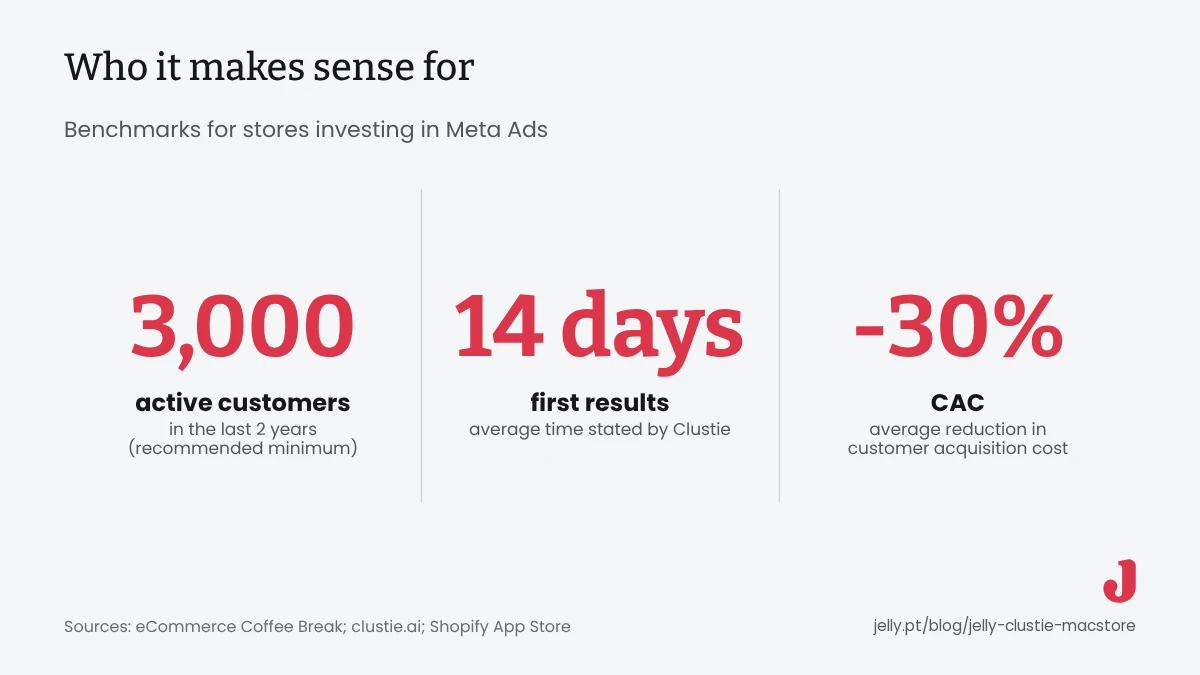
AI needs data to learn. According to Tiago Costa, CEO of Clustie, in an interview with eCommerce Coffee Break, the recommended starting point is at least 3,000 active customers in the last two years. Clustie also cites an average 30% reduction in acquisition cost for the brands it works with, and the first results typically appear after about 14 days.
If your brand has a sales history, invests consistently in Meta Ads and feels that ROAS has stagnated, this is probably the next step.
Conclusion: the next leap isn't in the budget, it's in the data
The MacStore case proves something we have long championed at Jelly: sustainable growth in Paid Media doesn't come from spending more, it comes from spending better. When we combine a store's first-party data, Clustie's predictive intelligence and a well-executed performance strategy, Meta's algorithm stops guessing and starts working in our favor.
Do you have an online store and want to know how much ROAS you're leaving on the table? Talk to the Jelly team and we'll run the diagnosis with you.
Get what we write
No fixed calendar: only when there is something worth your time.

Gonçalo Malho Rodrigues
Fundador & CEO
Fundou a Jelly – Digital Agency em Portugal em 2010 e a Strivesync – AI-Native Systems no Dubai em 2026. Detém outras empresas, noutros setores, como a Stronddo – Online Art Galleryl, a Scallent – Human Talent. Gonçalo, criou a The Change Framework, que apoia líderes a gerar a mudança através da mobilização de equipas em torno de uma causa.