Meta's Product Browsing and its impact on Facebook and Instagram campaigns
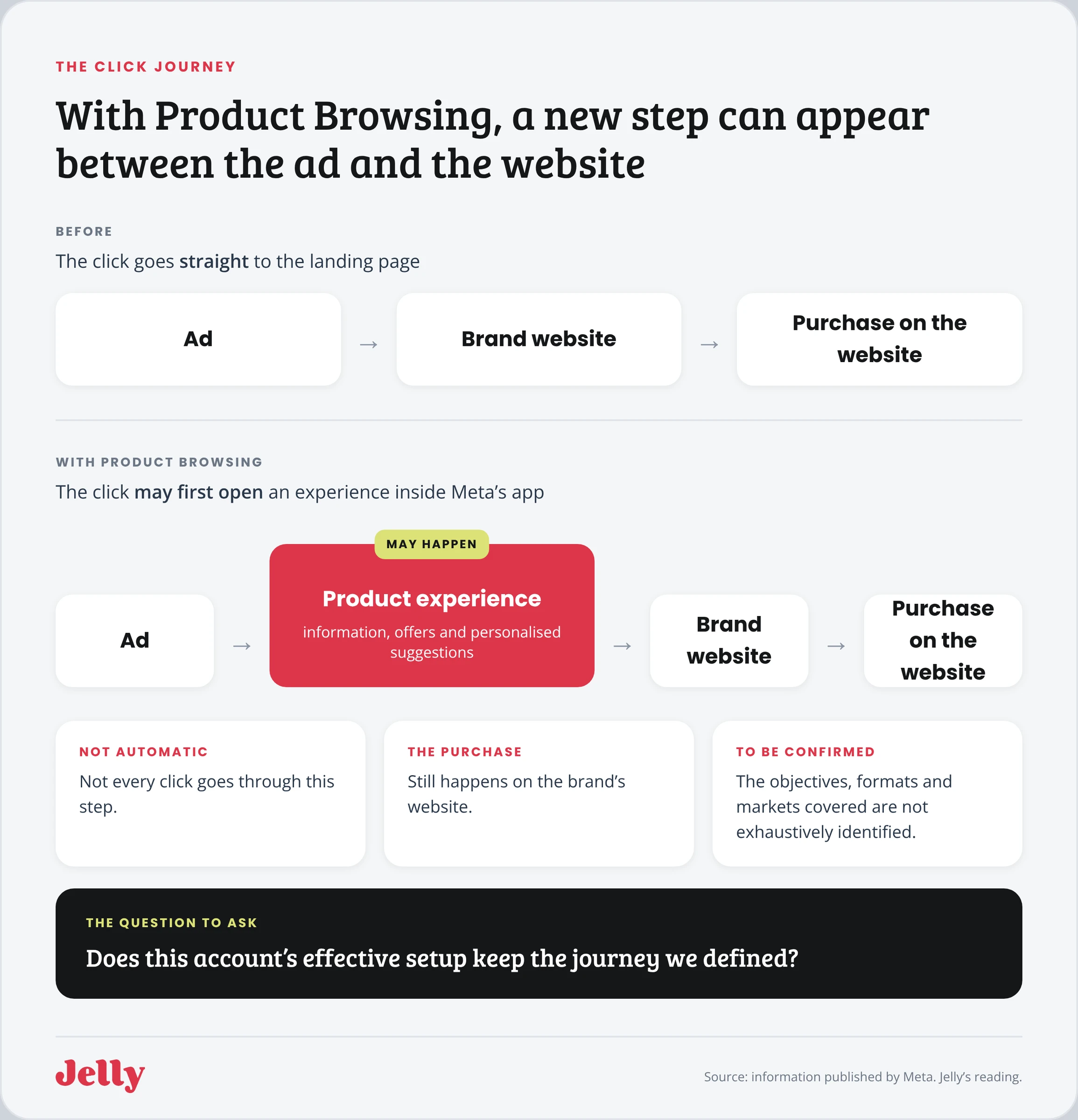
From 28 October 2026, Meta has enabled Product Browsing by default on existing ads covered by the change, unless an opt-out was made beforehand. With this feature, clicking an ad can open a browsing experience within Facebook or Instagram before taking the user to the brand’s website.
For advertisers, the issue starts with control over the campaign journey. A step added automatically can change the link between the ad, the offer and the intended landing page. At Jelly, we believe this decision should be assessed against business objectives and the results expected and observed in each account. Default activation is not an immediate benefit for those managing campaigns or for advertisers: it introduces a change to the defined strategy, whose impact needs to be assessed in practice.
What changed in the journey between the ad and the website
Product Browsing allows product information, offers and personalised suggestions to be shown within Meta’s apps. When this experience is shown, users can explore products on the platform before visiting the website. This does not mean that every click goes through this step, nor that the purchase stops happening on the website.
What is new is default activation on ads that were already running. Meta’s notice does not exhaustively identify the objectives, formats and markets covered. It is therefore important to check the effective configuration of each account and ad, rather than assuming the change applies in the same way to every campaign.
The conversion uplift announced by Meta needs context
In the notice sent to advertisers, Meta reports an average 3% increase in conversions in experiences with Product Browsing, compared with campaigns without this feature. The figure comes from a test run by the platform itself, between 6 and 21 August 2026, with around 117,700 advertisers worldwide.
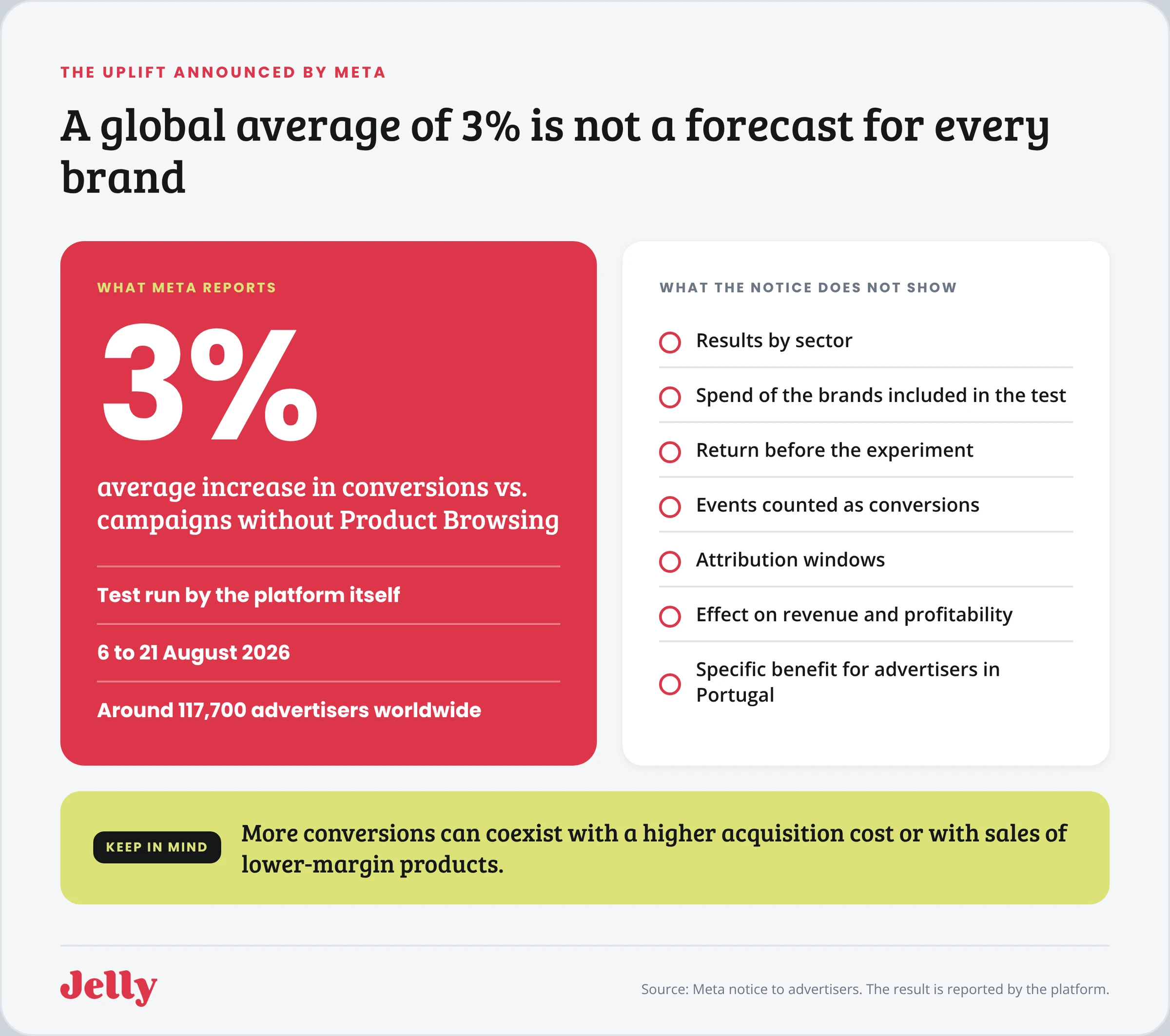
This result does not allow the performance of any particular brand to be predicted. Although the notice refers to broad categories, such as e-commerce and retail, it does not present results broken down by sector, the spend of the brands included in the test, or the return they were already achieving before the experiment. We therefore do not know whether the results are close to the reality of a business with a different budget, offer or performance history.
The notice also does not sufficiently detail the events counted as conversions, the attribution windows or the effect on revenue and profitability. A global average of 3% does not reveal how results were distributed across accounts and does not demonstrate a specific benefit for advertisers in Portugal. These are limitations of the published information that should accompany any reading of this indicator.
An increase in the number of conversions can coexist with a higher acquisition cost or with sales of lower-margin products. To assess the benefit, we need to compare spend, sales and profitability with the performance the account was already delivering, taking into account the objectives set for the campaign.
An automatic setting can shift the focus of the campaign
A campaign is built on a relationship between the audience, the message, the products promoted and the landing page. That choice may respond to a specific commercial priority, such as selling a collection, highlighting an offer or explaining a proposition that requires more context.
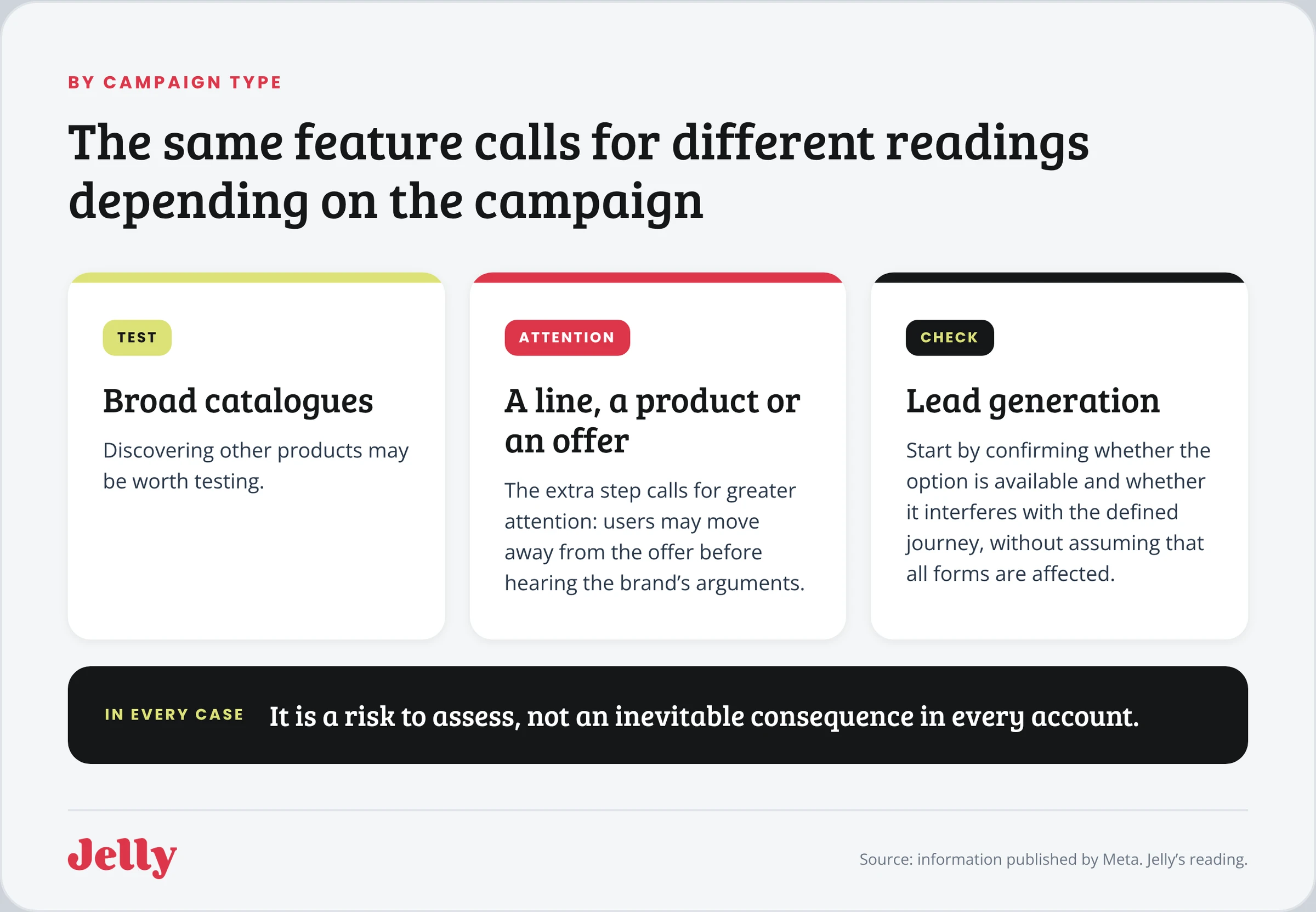
Imagine a campaign dedicated to a product line, with a landing page prepared to clarify differences and support the purchase decision. If the intermediate experience presents other suggestions from the catalogue, users may move away from that offer before learning the brand’s arguments. This is a risk to assess, and not an inevitable consequence in every account.
In broad catalogues, discovering other products may be worth testing. In campaigns focused on a single product or a specific offer, the additional step calls for greater attention. In lead generation campaigns, the starting point should be to check whether the option is available and whether it interferes with the defined journey, without assuming that all forms or lead campaigns are affected.
More interaction inside the app may not bring more visits or sales
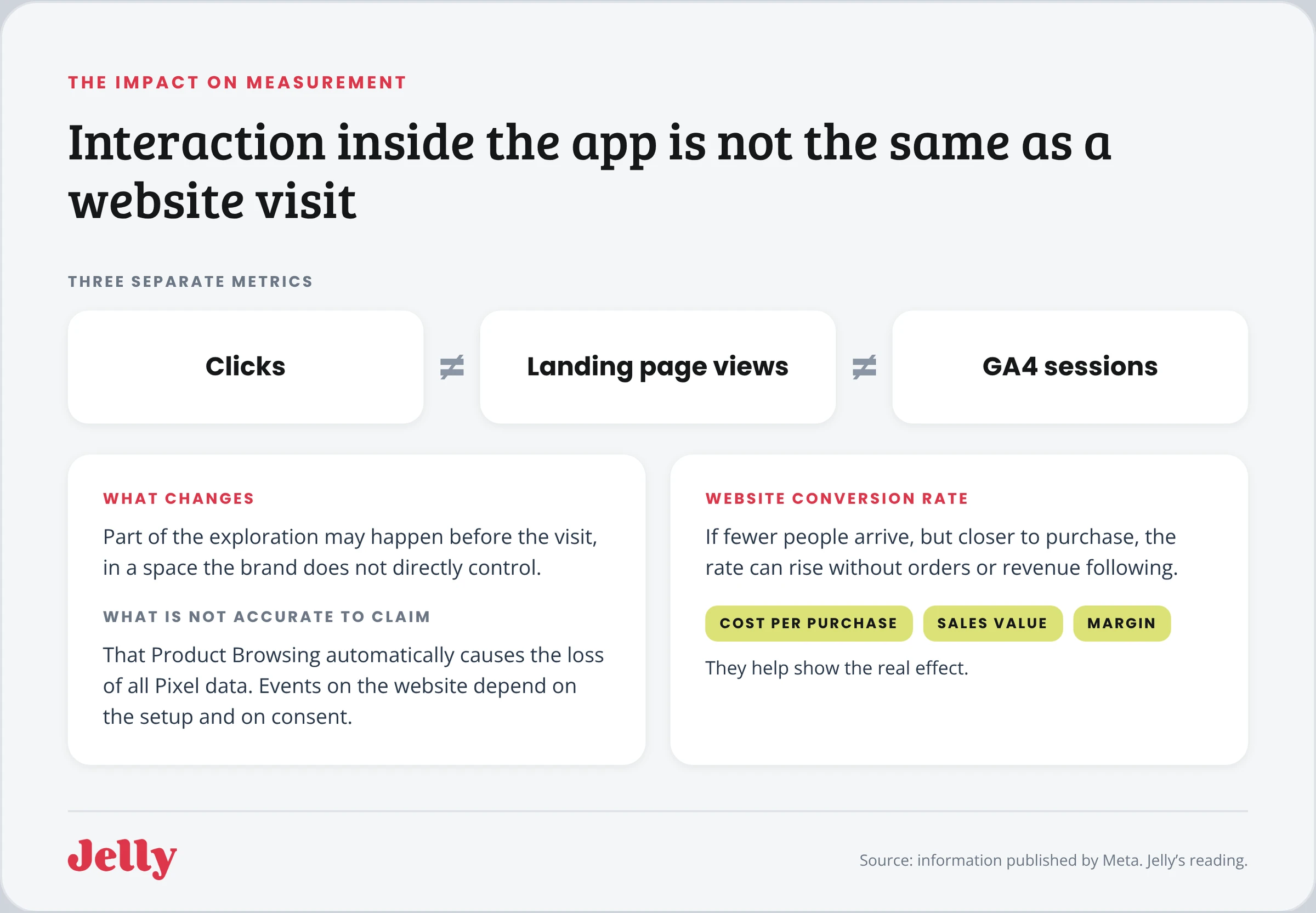
A click that opens an experience within Meta is not, in itself, equivalent to a visit to the brand’s page. If users stay in that experience and leave without reaching the website, that interaction does not correspond to a session on the site. Clicks, landing page views and GA4 sessions should therefore be analysed as separate metrics.
Nor is it accurate to claim that Product Browsing automatically causes the loss of all Pixel data. Events that happen on the website continue to depend on the measurement setup and consent conditions. What changes is the possibility that part of the exploration takes place before the visit, in a space the brand does not directly control.
A possible rise in the website conversion rate deserves the same attention: if fewer people arrive, but closer to purchase, the rate can increase without the total number of orders or revenue following. Cost per purchase, sales value and margin help to understand the real effect.
What to review now in campaigns
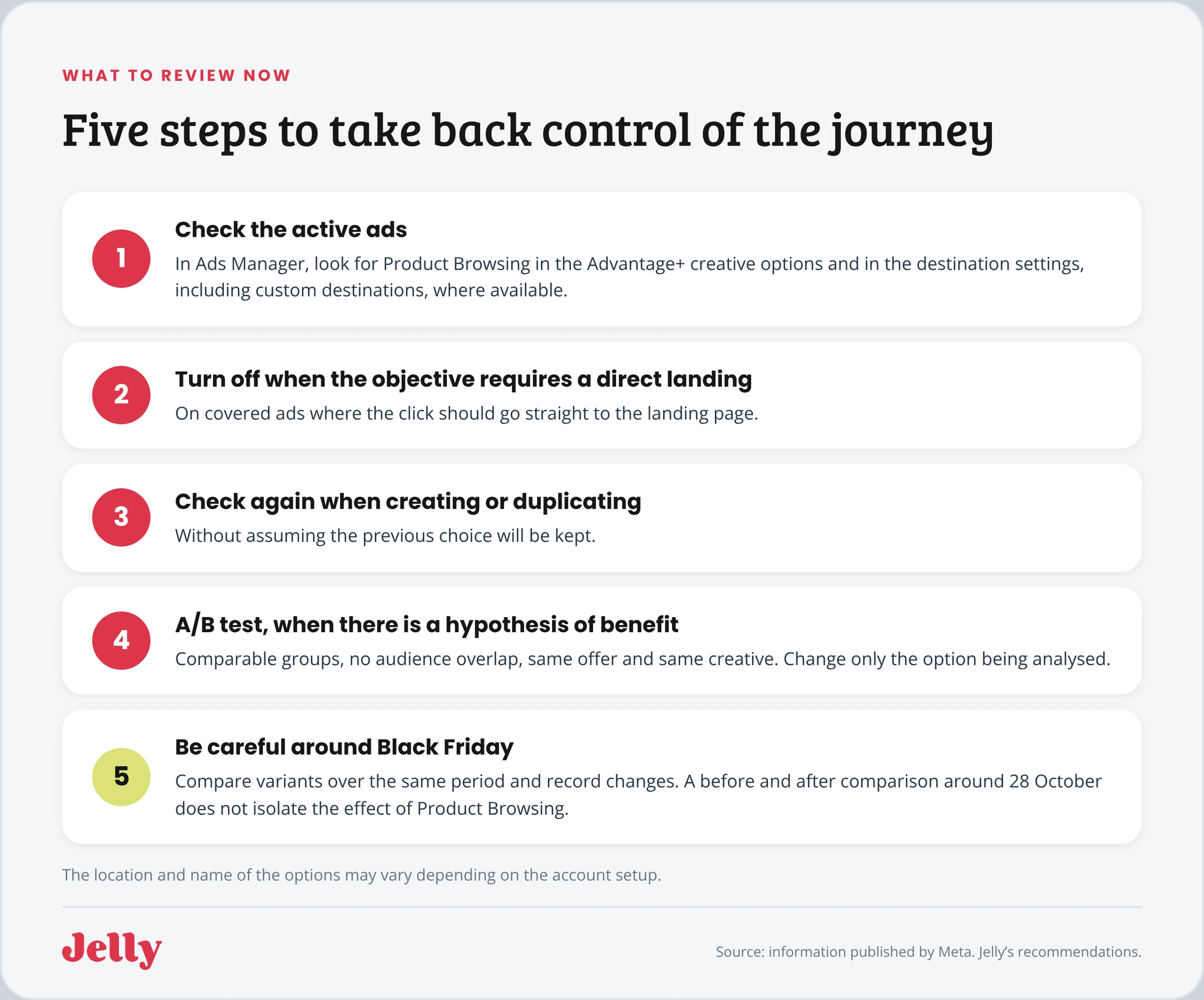
As the change has already been introduced, the immediate step is to check active ads. In Ads Manager, look for Product Browsing in the Advantage+ creative options and in the destination settings, including custom destinations, where available. The location and name may vary depending on the account configuration.
The feature can still be turned on or off in the settings indicated by Meta. Whenever the objective requires users to land directly on the landing page, we recommend turning it off on the ads covered. The setting should be checked again when creating or duplicating ads, without assuming that the previous choice will be kept.
When it makes sense to test product browsing, we recommend an A/B test with comparable groups and, whenever possible, without audience overlap. The offer, the creative and the other relevant conditions should remain equivalent, changing only the option being analysed. Running two ads at the same time, with unequal budget distribution, does not guarantee a valid comparison.
The proximity of Black Friday makes this assessment more demanding. Promotions, budget increases and changes in demand can influence results. A simple comparison between the period before and after 28 October does not allow an improvement or decline to be attributed solely to Product Browsing. Recording changes and comparing variants over the same period helps reduce this uncertainty.
Jelly’s position on automatic activation
At Jelly, we believe that a change to the journey between the ad and the landing page should result from a conscious decision by whoever manages the campaign. Default activation on existing ads adds a variable to a strategy that has already been defined, without the advertiser necessarily having chosen to test it.
The improvement announced by Meta needs to be validated in practice, against business objectives and the results expected and observed in each account. Without knowing the context of the brands included in the test and without data from the campaign itself, we should not treat a global average as a prediction of return. Our recommendation is to review the settings, preserve the journey in campaigns where it is decisive, and test the feature when there is a concrete hypothesis of benefit for the business.
Other Meta updates worth following
Product Browsing is part of a broader set of changes to Meta advertising. Among the announced novelties and features still in testing, there are changes to performance analysis, measurement and ad delivery options. Availability may vary across accounts and markets.
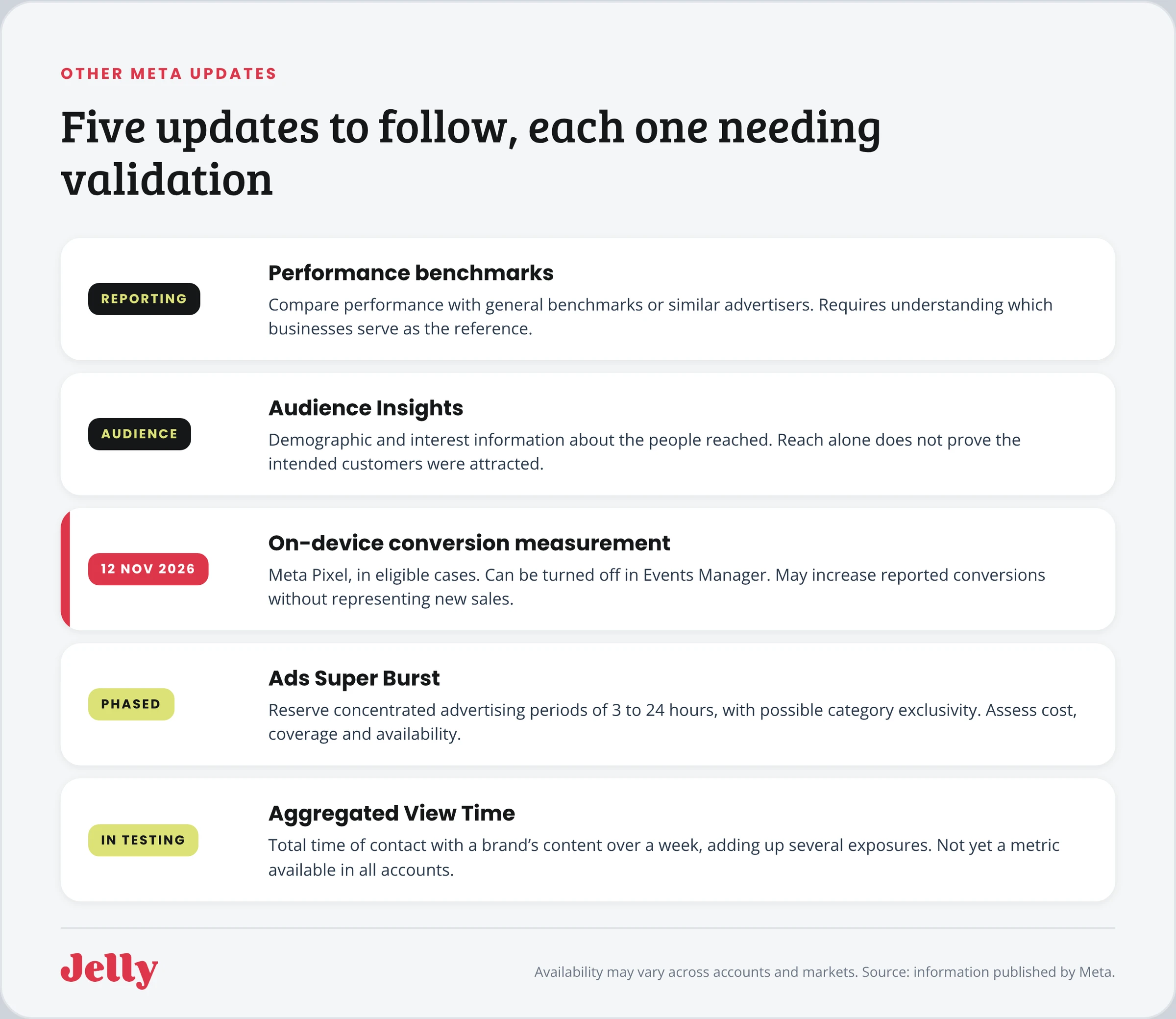
- Performance benchmarks: a new reporting option to compare performance with general benchmarks or with similar advertisers. This comparison can give context to results, but it requires understanding which businesses are being used as a reference and it does not replace the objectives and history of the account itself.
- Audience Insights: new demographic and interest information about the people reached by ads. It can support analysis of the audience actually reached, although reach alone does not allow us to conclude that the intended customers were attracted.
- On-device conversion measurement: the Meta Pixel update has an announced start date of 12 November 2026, in eligible cases, and is expected to measure conversions on the customer’s device. The option can be turned off in Events Manager. Geographic availability and conditions of application should be confirmed before assuming an impact on an account in Portugal. A change in measurement can increase reported conversions without representing new sales.
- Ads Super Burst: an option being rolled out in phases that allows concentrated advertising periods of between 3 and 24 hours to be reserved, with the possibility of category exclusivity. It can be assessed for launches or specific commercial moments, depending on cost, coverage and availability.
- Aggregated View Time: a feature still in testing that seeks to measure the total time of contact with a brand’s content over a week, adding up several exposures. It proposes a cumulative reading of attention, rather than assessing each view in isolation; it should not yet be treated as a metric available in all accounts.
For Jelly, this set of changes reinforces the need to follow what changes in each account and to distinguish new analysis options, changes in measurement and changes to the ad experience. The label of improvement given by the platform does not remove the need to validate its effect on the business. Each novelty should be assessed against the defined strategy and the expected and observed results, before a benefit is attributed to it.
Source
Article prepared on the basis of information published by Meta and the analysis of opinions shared by various digital advertising specialists on LinkedIn, considering the scale of the change and its potential impact on campaign management and results. The 3% average increase in conversions is a result reported by Meta. The critical assessment and the recommendations presented reflect Jelly’s position.
Get what we write
No fixed calendar: only when there is something worth your time.

Maria Félix da Costa
COO
Licenciada em Gestão de Marketing e pós-graduada em Marketing Digital e Direção Comercial e Vendas, Maria conta com mais de uma década de experiência na coordenação de equipas e projetos em diversas áreas do marketing digital - IT, media, seo, social media, automation.Positiva e resiliente, assume que: Knowledge has to be improved, challenged, and increased constantly, or it vanishes (Peter Drucker).Apaixonada por séries, praia, música, família e comida aproveita todas as oportunidades para uma escapadela e fazer o turn off. Assume, desde 2024, o papel de COO na Jelly.