ChatGPT Business Hub: How to Claim Your Business
A business can appear in a ChatGPT response before a user even reaches its website. What is said at that moment can help shape an opinion, answer a question or put a brand among the options being considered. For anyone running a business, this raises a practical question: what information is being used to present the company?
ChatGPT's Business Hub launched this week. Rather than the equivalent of Search Console that many expected for monitoring brand presence on the platform, this first version is closer to a Business Profile: a company profile where businesses can update information and view metrics about their presence. However, based on what we have been able to establish so far, the opportunities for analysis and control over what is said and when a company appears remain limited.
At Jelly, we have already submitted a request to claim our business and are waiting for information that will allow us to access the platform. In the meantime, we are following the experiences of businesses in other markets that already have access, to understand what can be done at this stage.
We want to combine this initial perspective with the AI visibility audits we already carry out at Jelly. What does this tool add? What information does it allow us to manage? And what can we really learn from the data it provides?
1. What is ChatGPT's Business Hub?
Business Hub is a place for companies to manage their presence on ChatGPT. It allows them to update information, share product catalogues and view metrics. For eligible businesses, it also includes business agents that respond based on the data and guidance provided by the company. This is a feature separate from the ChatGPT Business subscription plan.
A comparison with Google Business Profile helps explain the initial approach: there is a profile, information to complete and a connection to the business that must be verified. In the demonstration we reviewed, setup includes the business category, description, contact details, photos and options relating to deliveries and returns.
Having a place where a company can provide information about itself is useful. But understanding how it appears in responses, why it appears and what impact that has goes beyond managing a profile. That is where the questions begin for those working in marketing.
2. What steps should businesses take?
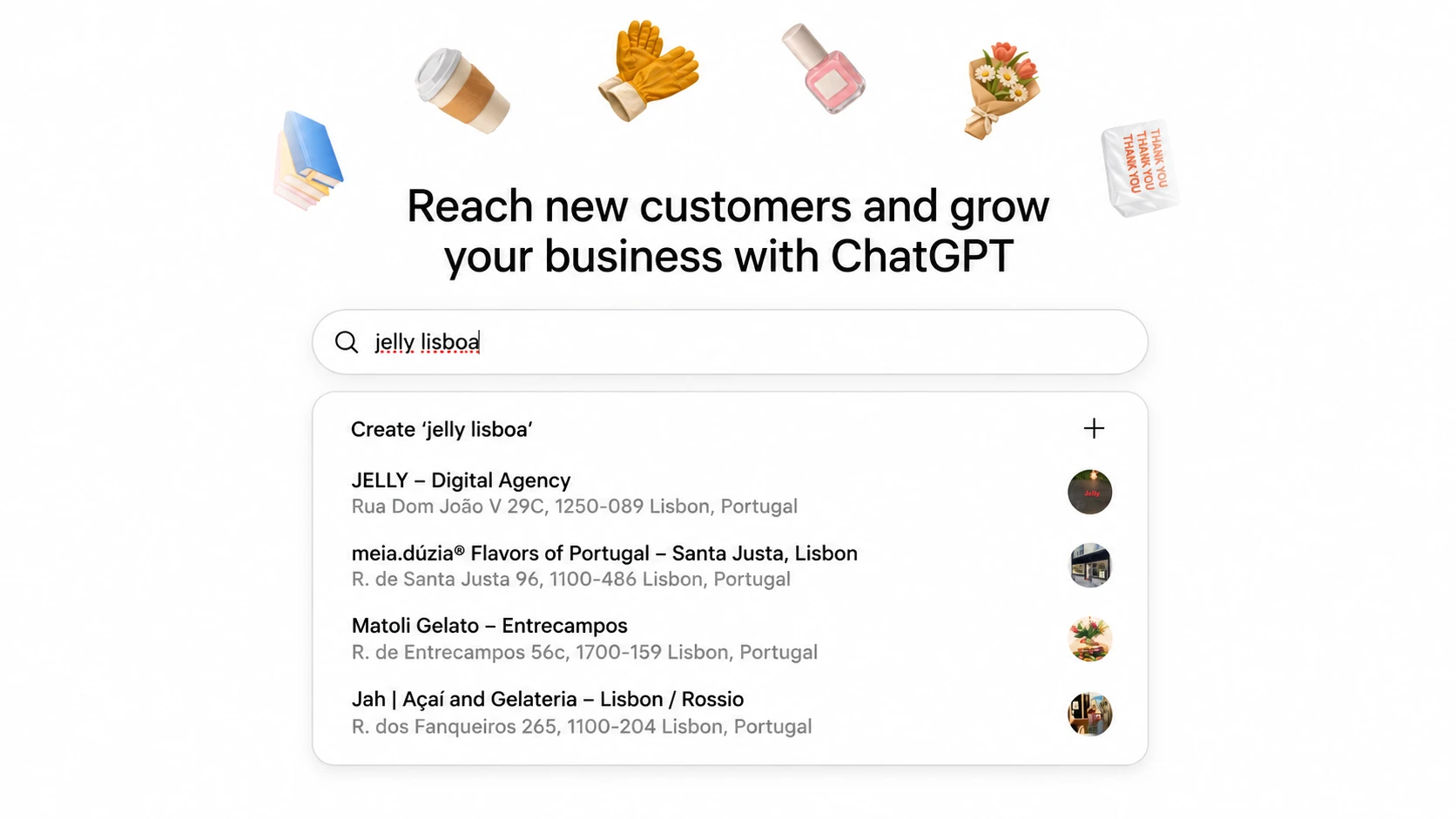
The first step is to search for the company and start the claiming process using an account authorised to represent it. The process begins on OpenAI's Businesses in ChatGPT page.
This is as far as we have been able to get at Jelly so far. We are waiting for further information before moving ahead. Based on the documentation we have reviewed and the experiences we have followed, the process should then involve these steps:
- Prove your connection to the business, using one of the available methods, such as a domain, business email, phone number or Shopify.
- Wait for the claim to be reviewed and complete the required identity verification. Claim approval and identity verification are separate steps.
- Review the information and explore the available features, once the approvals required for each have been granted.
For a Portuguese company, it is also important to confirm what is actually available. Eligibility varies, and business agents are currently limited to eligible e-commerce and online service businesses in the US.
What if a business has more than one address?
This is one of the questions we want to clarify. When we submitted Jelly's claim, we were only able to select one address. We do not yet have concrete information about how multiple locations belonging to the same business will be managed in our case.
For businesses with several shops, offices or branches, this has operational implications: will each location need to be claimed separately? How will information be kept consistent across profiles? And will it be possible to analyse metrics by address? This is one of the areas we will follow up on once we have access.
3. What metrics might be available?
Based on the available documentation and the demonstration we reviewed, there are three metrics to monitor:
- Mentions: for online businesses, these count references to the company's website. A mention of the brand name alone is not included in this count. For local businesses, the definition is linked to the display of a location result.
- Website clicks: these track visits through to the website.
- Discovery topics: these group the topics of responses in which the business was mentioned or cited.
In the demonstration we reviewed, the dashboard still offers limited depth for exploring these numbers. Questions remain about where clicks come from, which landing pages they lead to and the contexts in which the brand appears. Discovery topics do not provide access to individual prompts, nor are they, in themselves, a measure of purchase intent.
Our initial assessment is that businesses have plenty of room to provide information but are still given relatively little data with which to assess its effect. Once we have access, we want to understand how far we can take this analysis and which questions remain unanswered.
Being able to manage brand information is a step forward. Connecting that presence to results will be the next test.
4. What do we already analyse in AI visibility audits?
At Jelly, we already analyse brand visibility in large language models (LLMs), using tools that allow us to monitor prompts relevant to each business. We look at which assistants feature the brand, which questions trigger its appearance, how it is presented and which competitors appear in the same responses.
The analysis includes the brand's visibility percentage across monitored responses, comparisons with competitors and a review of the generated content. We want to understand which services are associated with the brand, which messages appear and whether the response accurately represents its offering.
Appearing, being recommended and generating business are different things. A brand may appear as an example, in a comparison or alongside incorrect information. How frequently it appears therefore needs to be assessed alongside the context and quality of that presence. Even a favourable recommendation does not allow us to conclude that an enquiry or sale took place.
This percentage must be understood in context. It refers to the prompts, platforms and time periods analysed; it does not represent all user conversations. It is a way to track patterns and changes within a defined sample.
In Jelly's audits, we also compare this monitoring with data from Google Search Console. The report dedicated to generative AI makes it possible to identify which website pages appear in Google's AI features and track their impressions. In this report, measurement focuses on impressions; it does not allow clicks or conversions generated by those appearances to be assessed independently.
Combining these sources adds another perspective to the audit: on one side, we analyse responses to monitored prompts; on the other, we observe which pages receive exposure in Google's AI experiences. These are complementary perspectives with different scopes. Search Console data does not measure presence on ChatGPT or other assistants.
The diagnosis helps us define actions to implement. If the offering is described inaccurately, we need to identify which information needs clarifying. If there are questions relevant to the business that its content does not answer, that content coverage needs work. If there are inconsistencies between the website and other touchpoints, they need to be corrected.
We recommend these actions to improve visibility and monitor how things evolve. What makes sense to implement depends on what we find in each audit.
That is why we are interested in following Business Hub. It may add data directly from the platform to an analysis we already carry out using monitored questions and answers. Its value will lie in bringing these perspectives together: profile information, the available metrics and what we observe when testing situations relevant to the business.
5. What impact could it have on brand management?
We see a practical opportunity in improving information quality. In our audits, we look at how a brand is presented. Having a place where we can update its information adds another way to take action.
Consider a shop with unclear return conditions or a service business whose offering has changed but is still described differently across various channels. A response based on that information may create expectations that the business later needs to correct.
Having a place where the company can provide up-to-date information may help reduce these discrepancies. Even so, OpenAI makes clear that responses may draw on other sources and that changes are not necessarily reflected immediately.
This is also why profile information and brand reputation need to be managed together. In our view, what a company says about itself should be consistent with the experience it provides and with what customers and other sources say about it. The profile becomes part of that work.
For the company, this also creates a responsibility: deciding who keeps the profile up to date and ensuring that services, contact details and commercial terms are consistent with what is communicated across other channels.
6. Will claiming a business make it appear more often?
OpenAI states that claiming a business does not guarantee greater prominence or sales, and that recommendations remain independent.
This is something we want to keep in mind in our initial analysis. It makes sense to explore the tool and manage company information. Any effect on visibility will need to be monitored; it should not be promised simply because a profile has been claimed.
This also connects with what we have already discussed about GEO and visibility in AI search engines. In our approach, a clearly defined offering, documented experience and brand consistency remain foundational. A new profile needs that substance in order to communicate something useful.
What we will be monitoring next
At Jelly, our next step is to gain access and understand what is available for our profile. In particular, we want to examine which information we can update, how useful the metrics are and how they relate to the responses we already monitor.
There is also a shift in how we look at results: if a user gets an answer to a question within the platform, some of a brand's influence may happen before a website visit takes place. An impression is not the same as a visit, but the absence of a click does not mean the response had no influence on the decision.
That is why we bring together exposure metrics, response analysis and business results, while respecting what each can actually measure. When users visit the website, we want to assess the quality of those visits, the enquiries generated and any sales we can identify. When there is no click, the impact is harder to attribute and should be treated with appropriate caution.
We see potential in this more direct connection between businesses and the platform. But to assess its day-to-day value, we need to understand what it genuinely helps us correct, monitor and decide. That is the perspective we will bring to exploring Business Hub.
For anyone managing a brand, claiming a business may be a useful first step. The work continues through information quality, response analysis and the actions that analysis makes possible.
Initial analysis based on information available as of November 13, 2026.
Sources
- Businesses in ChatGPT, OpenAI
- Setting up your business on ChatGPT, OpenAI Help Center
- Business Hub walkthrough, based on articles published on LinkedIn.
- Generative AI performance reporting in Search Console, Google Search Central
Get what we write
No fixed calendar: only when there is something worth your time.

Maria Félix da Costa
COO
Licenciada em Gestão de Marketing e pós-graduada em Marketing Digital e Direção Comercial e Vendas, Maria conta com mais de uma década de experiência na coordenação de equipas e projetos em diversas áreas do marketing digital - IT, media, seo, social media, automation.Positiva e resiliente, assume que: Knowledge has to be improved, challenged, and increased constantly, or it vanishes (Peter Drucker).Apaixonada por séries, praia, música, família e comida aproveita todas as oportunidades para uma escapadela e fazer o turn off. Assume, desde 2024, o papel de COO na Jelly.