Google Cloud Day – we went to discover the future of the Cloud
Gonçalo Malho Rodrigues – CEO –
We were at Google Cloud Day
I like to start from the assumption that we don't have to know the meaning of certain terms, even when they're used over and over in our day-to-day. Cloud may well be one of those terms, so let me begin by clearing it up: what does Cloud mean and what is it for?
After that, we'll talk about topics as interesting as machine learning, serverless applications, big data, chatbots, team work and more.
What does Cloud mean and what is it for?
The term Cloud represents, metaphorically, the ability of several servers to be connected to one another and to share data, tasks and resources, following the principle of grid computing. The Cloud therefore lets us access data, services, applications (among other things) without being physically tied to a server and without having to worry about whether it has enough memory, CPU or disk. All you need is web access to reach the Cloud, as a service.
About the venue and the organisation of the event
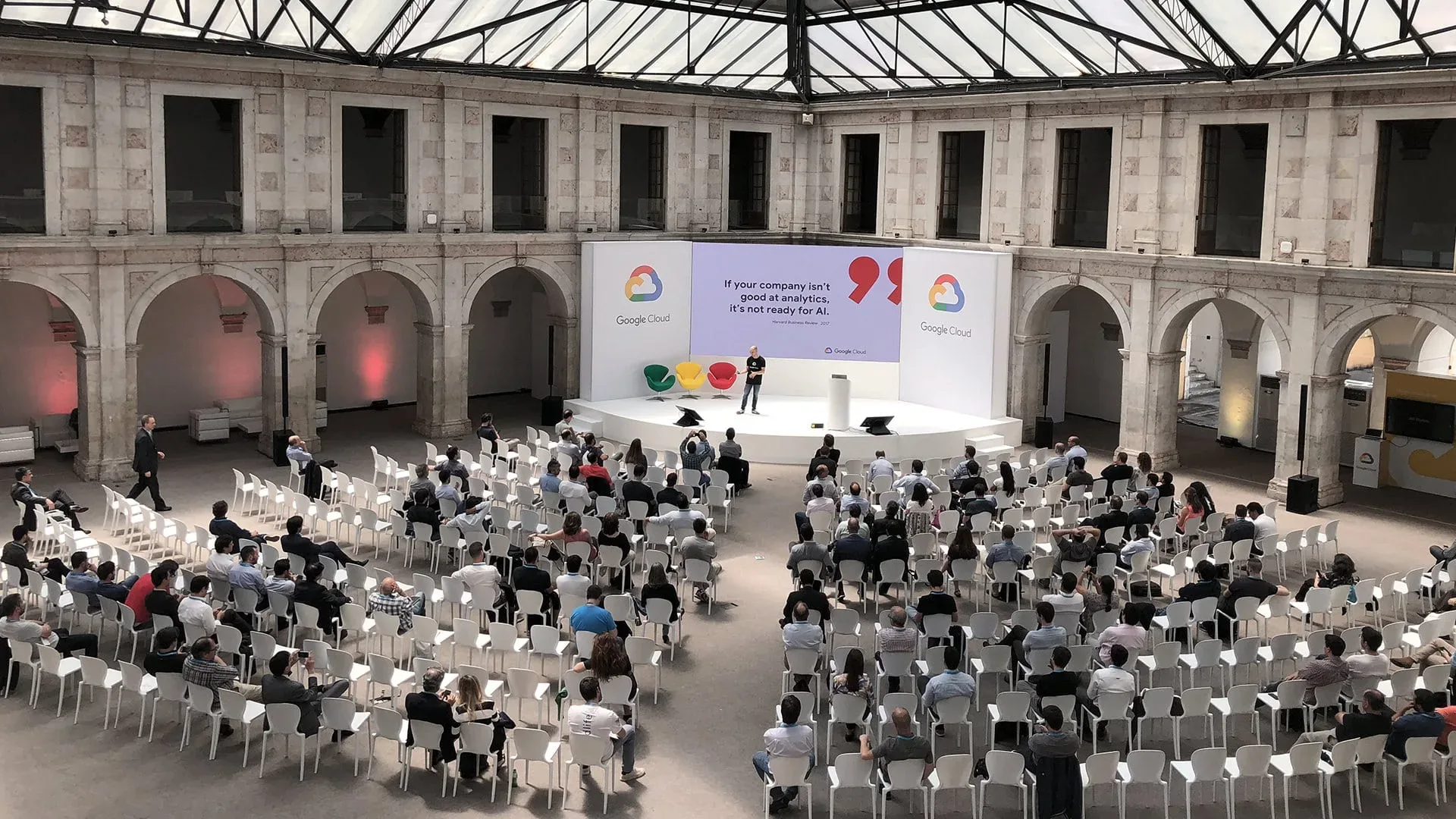
Google chose to hold Google Cloud Day in the magnificent 15th-century palace of Convento do Beato, a space that never fails to impress with its majestic architecture and history. The team behind the organisation, from the welcome desk to guest support, was competent and well organised, and everything ran very smoothly. The agenda was kept to the scheduled times and the catering deserves full marks. Thank you, Google.
The welcome was given by Jorge Reto (Head of Google Cloud Portugal), who then moved on to the theme of the event: Google Cloud.
Testimonial and round table
Google invited EDP to take part as a case study, to give evidence of the performance and security gains achieved by deploying their website on Google Cloud. One of the points raised that stood out was that at a certain moment they were expecting the system to collapse because of a spike in users and concurrent requests to the server (as would normally happen with any traditional hosting), and instead found that Google's Cloud service identifies these spikes that demand more CPU, memory or other capacity and delivers the resources needed so that the experience is always responsive and smooth on the user's side. This was followed by a round table with representatives from Cisco and SAP, moderated by Jorge Reto of Google, in which the participants explained how both companies had adopted Google Cloud to offer a clearly improved and differentiated service to their clients on a global scale.
About the theme of the event
Google Cloud Platform (GCP) – PaaS – Platform as a Service
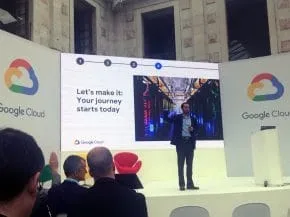
Starting with energy, Google announced that its data centres consume 50% less energy than the world's major server providers. As for the economics of the service, the model Google proposes runs counter to the global practice of its competitors, which is based on contracting resources up front. Google states that it charges only for what is used, with discounts of up to 57% for sustained usage, billing by the second and cheaper than the competition (https://cloud.google.com/pricing/). Google presented impressive figures on the scale, performance and security of its servers and data centres, placing it third among the largest data centres in the world, without, however, selling hosting.
How teams work
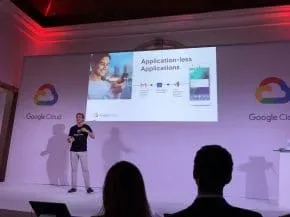
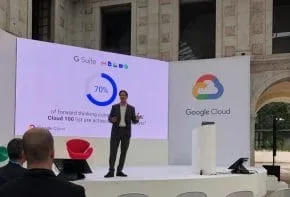
While "GCP 101 – your first week in the Cloud" was under way, the second room was covering teamwork, with the emphasis resting on 4 pillars.
1. Collaborative culture
2. Intelligent productivity
3. Connected knowledge
4. Simple, secure management
Collaborative culture was represented by the very real possibility of working collaboratively, in a cloud environment (remotely), on the same document, together with colleagues and in real time, with applications such as Google Documents or Google Sheets. On intelligent productivity, we were surprised by the possibility of, for example, the email programme (Gmail) suggesting replies suited to the conversation. Google Drive is the player when it comes to connected knowledge and, on simple, secure management, we're talking about Google Cloud, as opposed to obsolete security concepts such as limiting access to company information to the workplace (which is in fact a door to vulnerability).
Google Assistant – Google Chatbot
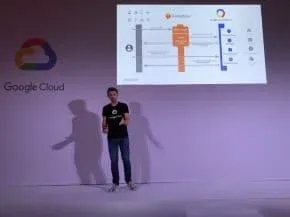
Chatbots are already a valid and visible reality in web browsing; typically (though not exclusively), they promote services that involve booking a medical appointment or a hair salon, for example. All of it in a natural (human), fluid conversation. It was in this context that Google presented "Dialog Flow", Google technology that helps create rich, natural conversational experiences. This technology, delivered as a service, benefits from important Google assets such as ML (Machine Learning), NLU (Natural Language Understanding Engines) and Search. With this, it promises to solve 4 of the 7 major shortcomings identified in bots and is available for use in chats such as Facebook Messenger, web chats, Twitter or, of course, Google Assistant itself.
1. Artificial intelligence is still not as accessible as one would like
2. Use cases are not that frequent
3. Some bots lack transparency
4. They don't understand context
5. They don't communicate with existing business systems
6. They try to handle too many things at once
7. A lack of genuinely adequate human escalation protocols
Google also offers ready-to-use models with vertical solutions, making go to market easier and faster. According to Google itself, it is expected that by 2021, 50% of companies will be spending more per year on bots and chatbots than on traditional mobile apps.
Managing Big Data
"If your company isn't good at analytics, it isn't ready for AI"
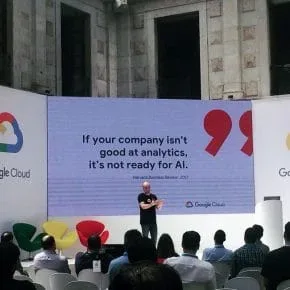
That was the opening line on the subject of big data, underlining how important analytical capability is in managing large volumes of data. Google presented its solutions, which support SQL2011, REST API, Web UI, CLI and others, on a "serverless and fast" basis. To give an idea of the performance level of Google Big Query, it can process 4.43TB in 32 seconds from a 6.3TB database.
Machine Learning
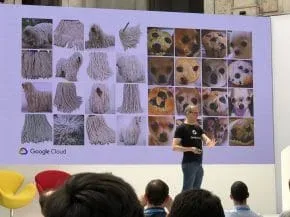
Machine learning was one of the most heavily featured topics throughout the event and, without a doubt, a technology that opens up a new path of possibilities when it comes to automating repetitive processes that can be handled by the machine. In Google's view, the ML development model should be democratised.
The Vision API allows you to
- Recognise objects
- Logos and facial sentiment
- Extract text
- Detect inappropriate content
It really is impressive technology and you can test it here: https://cloud.google.com/vision/
Conclusion
Twenty years ago, Larry Page and Sergey Brin founded Google with the stated mission of "organising the world's information and making it universally accessible and useful". There's no doubt this has been a resoundingly successful mission — so much so that universal access to the world's information is now considered a commodity.
At this Cloud Day, Google showed us what it has been working on to present itself today as the dominant player in a whole universe of solutions available in the cloud, delivered as a service (platform as a service), where a user with no programming knowledge can, for example, set up a bot on Messenger to chat with customers and manage bookings for their restaurant or hair salon.
This is a summary of the main topics covered at this major event, but there will be many more details and other topics of interest that aren't mentioned or properly developed here. If you're interested in going deeper into this area of Google's work, I'd recommend visiting the Google Cloud website (https://cloud.google.com/), where you'll find all the available solutions and technologies, plus relevant information presented in a structured way.
See you soon! Gonçalo JTNDZGl2JTIwY2xhc3MlM0QlMjJmYi1jb21tZW50cyUyMiUyMGRhdGEtaHJlZiUzRCUyMmh0dHBzJTNBJTJGJTJGd3d3LmplbGx5Y29kZS5wdCUyRmdvb2dsZS1jbG91ZC1kYXktbGlzYm9hJTJGJTIyJTIwZGF0YS13aWR0aCUzRCUyMjEwMCUyNSUyMiUyMGRhdGEtbnVtcG9zdHMlM0QlMjIxMCUyMiUzRSUzQyUyRmRpdiUzRQ==
Get what we write
No fixed calendar: only when there is something worth your time.

Gonçalo Malho Rodrigues
Fundador & CEO
Fundou a Jelly – Digital Agency em Portugal em 2010 e a Strivesync – AI-Native Systems no Dubai em 2026. Detém outras empresas, noutros setores, como a Stronddo – Online Art Galleryl, a Scallent – Human Talent. Gonçalo, criou a The Change Framework, que apoia líderes a gerar a mudança através da mobilização de equipas em torno de uma causa.