How to generate qualified leads with digital marketing

Alícia Coquim Social Media & Content Manager
Knowing how to generate qualified leads with digital marketing is now essential for any sales team. Many companies invest in traffic but still can't see the return, because the challenge isn't just attracting visitors — it's turning them into contacts with real buying potential.
Generating initial contacts can be simple. Generating leads with the right profile, intent and fit for the business takes strategy, the right tools and a well-structured sales funnel.
What makes a lead genuinely qualified
Lead vs. contact: where the difference lies
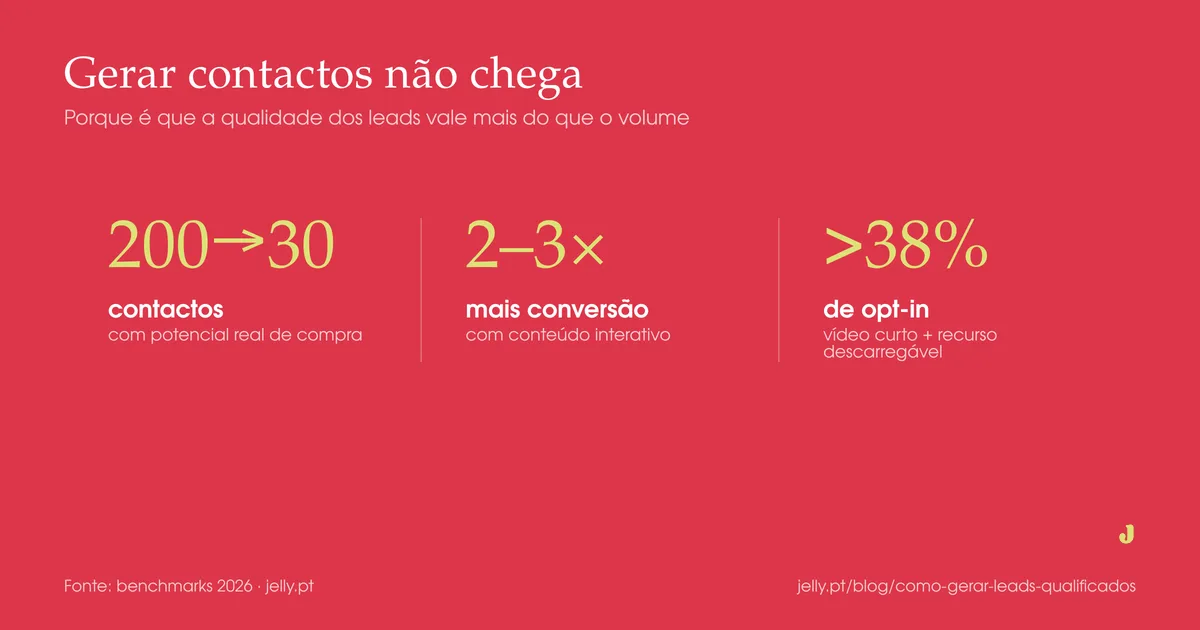
Not every contact you capture is a qualified lead. A visitor who fills in a form to download an ebook may simply be looking for free information, with no intention of buying. A qualified lead shows clear signs of interest and fits the company's ideal customer profile. A clinic receiving 200 contacts a month, for example, may find that only 30 have any real chance of becoming patients. Treating all 200 the same way is a direct waste of sales resources.
MQL vs. SQL: how to tell them apart along the funnel
A Marketing Qualified Lead (MQL) is a contact who has shown interest through measurable behaviours: downloads, repeat visits to the site, opening emails, engaging with content. A Sales Qualified Lead (SQL) is already ready for a sales conversation — they've asked for a quote, visited the pricing page several times or replied to a follow-up email. The distinction between MQL and SQL is what allows marketing and sales to align, so the sales team doesn't waste time on contacts still in the discovery stage.
Lead scoring: the logic behind automatic qualification
Lead scoring is a system that assigns a value to each interaction a lead has with the brand. Every download, product page visit or email open adds points. Once the lead reaches a certain score, they're automatically flagged to the sales team. Platforms such as HubSpot or ActiveCampaign automate this process, making it scalable and reducing the need for manual intervention. In practice, it's the mechanism that joins lead generation and marketing automation into a single coherent flow.
How to generate qualified leads for your company: the channels and strategies with the highest return SEO and content optimised for people who are already searching
SEO attracts traffic with search intent, which naturally results in more qualified leads. Creating content around long-tail keywords that reflect your ideal customer's real problems is one of the most effective ways to capture contacts who are already at an intermediate stage of the decision process.
In 2026, interactive content — calculators, quizzes and simulators — has been outperforming static articles on conversion rates. According to data from inbound marketing platforms, this kind of format can convert two to three times better than a simple downloadable PDF, precisely because it involves the user in an active response.
Inbound marketing, as a methodology, is the natural framework for this work: instead of interrupting the user with unsolicited messages, you create useful content that draws them in organically. Done well, inbound reduces CPL over time and improves the average quality of the leads generated.
Targeted ads to speed up lead capture
Google Ads and Meta Ads deliver more immediate results, particularly for businesses that can't wait for organic SEO cycles. On Meta, the logic has changed: in 2026, the creative is the new targeting. According to recommendations published by Meta for advertisers, the first three seconds of a video, or the image in a static ad, should filter the target audience before any configuration in the ads manager.
Who sees and clicks helps define the lead's profile. That's why the creative is the first qualification barrier.
Landing pages with no distractions: the heart of conversion
A well-built landing page is where all the traffic you generate converges, whether organic or paid. There are four elements you can't do without: a direct headline with a clear value proposition; a short form — name and email are enough to start; social proof with real testimonials or case studies; and a CTA with an explicit action verb.
Consistency between the ad or article that brought the visitor in and what the landing page promises is decisive. Any break in that message can undermine the conversion rate.
Lead magnets that attract the right contacts
What works best in a B2B context
In B2B, the highest-converting lead magnets are those that help the potential client make strategic decisions. ROI calculators, reports with exclusive sector data, short and practical webinars, digital maturity scorecards and buying guides are among the most effective formats. Interactive tools tend to outperform static downloads by two to three times on conversion rates.
In the Portuguese market, free personalised diagnostics and 30 to 45-minute consultations with a concrete analysis of the business are the formats that, across the campaigns we run, convert most consistently into qualified B2B meetings.
High-impact offers for B2C and e-commerce
In B2C the logic is different: the focus is on an immediate, tangible reward. First-purchase discounts, free delivery in exchange for an email sign-up, free trials and personalised assessments are among the highest-converting formats.
In e-commerce, a simple discount voucher revealed after the email is entered can build a highly qualified lead base at low cost. In the campaigns we manage, combining a short video with a downloadable resource such as a checklist or quick guide frequently reaches opt-in rates above 38%, especially when the offer solves a specific, immediate problem.
Automation and CRM: how to nurture leads until they're ready to buy
The tools most used in Portugal
The options most widely adopted by Portuguese companies include HubSpot, one of the most complete solutions for native integration between marketing and sales; ActiveCampaign, widely used by SMEs and known for its drag-and-drop workflow builder; RD Station, popular for its integration between marketing and CRM; and Mailchimp, an affordable option for companies just getting started.
E-goi stands out as a Portuguese-built tool, with native support for email, SMS and web push notifications. The choice should depend on the complexity of the business, the company's objectives and the level of integration needed between the marketing and sales teams.
How to set up a basic nurture flow
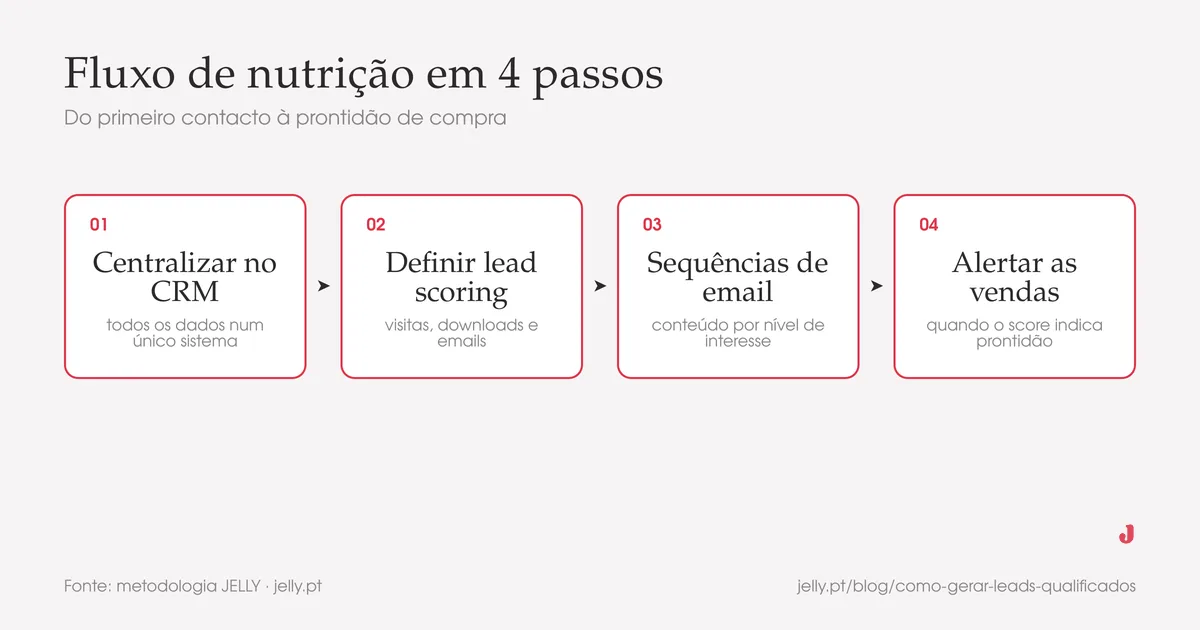
The process rests on four practical steps: centralise all data in the CRM; define lead scoring criteria based on page visits, downloads and email opens; create email sequences that deliver relevant content according to the level of interest; and set up automatic alerts to the sales team when a lead reaches a score indicating greater readiness to buy.
This flow lets you scale lead nurturing without growing the team, while keeping communication personalised at every stage of the funnel.
When to hand the lead over from automation to sales
Lead nurturing shouldn't go on forever. There comes a point when the lead should be handed to the sales team, identified by concrete signals: a high score, repeat visits to the pricing page, several consecutive email opens or a direct request for contact.
This alignment between marketing and sales shortens the sales cycle, stops the sales team from calling cold leads and consistently increases the final conversion rate.
The metrics that show whether the strategy is working
CPL, conversion rate and ROI: what to measure and how to read it
CPL (cost per lead) tells you how much the company pays for each new contact generated. The conversion rate measures the percentage of visitors who become leads. ROI assesses the return generated against total marketing investment.
Analysed together, these three metrics give a complete picture of how effective the funnel is. You can have a low CPL and poor ROI if the leads don't convert into customers, or a high CPL and excellent ROI if each lead has a high lifetime value.
CPL benchmarks by sector in Portugal
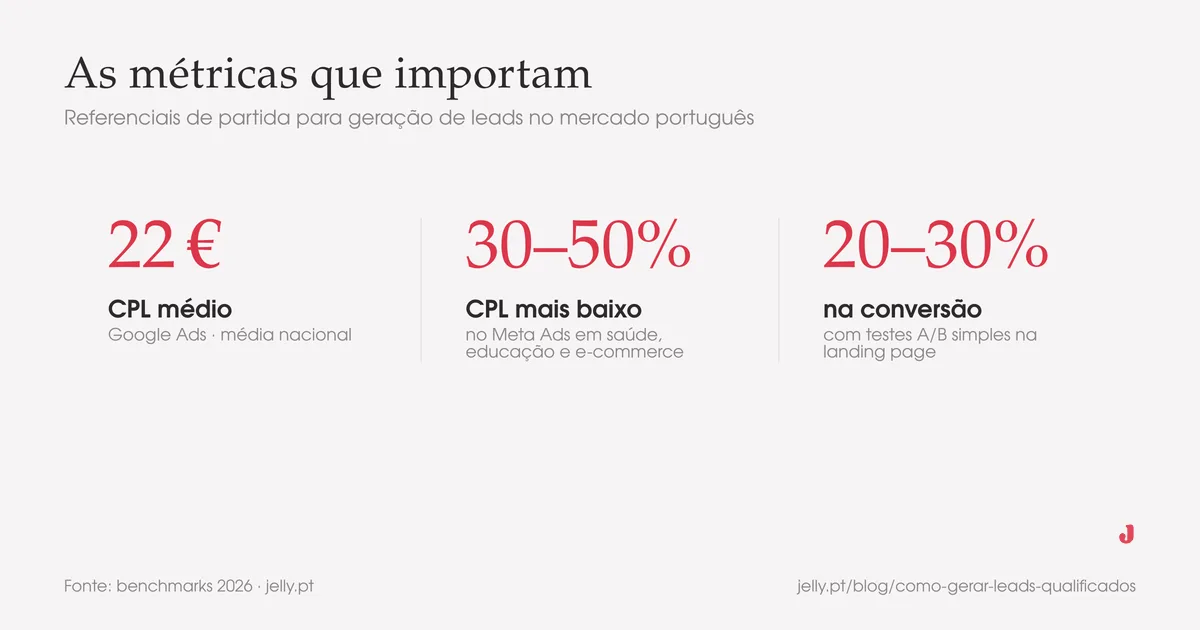
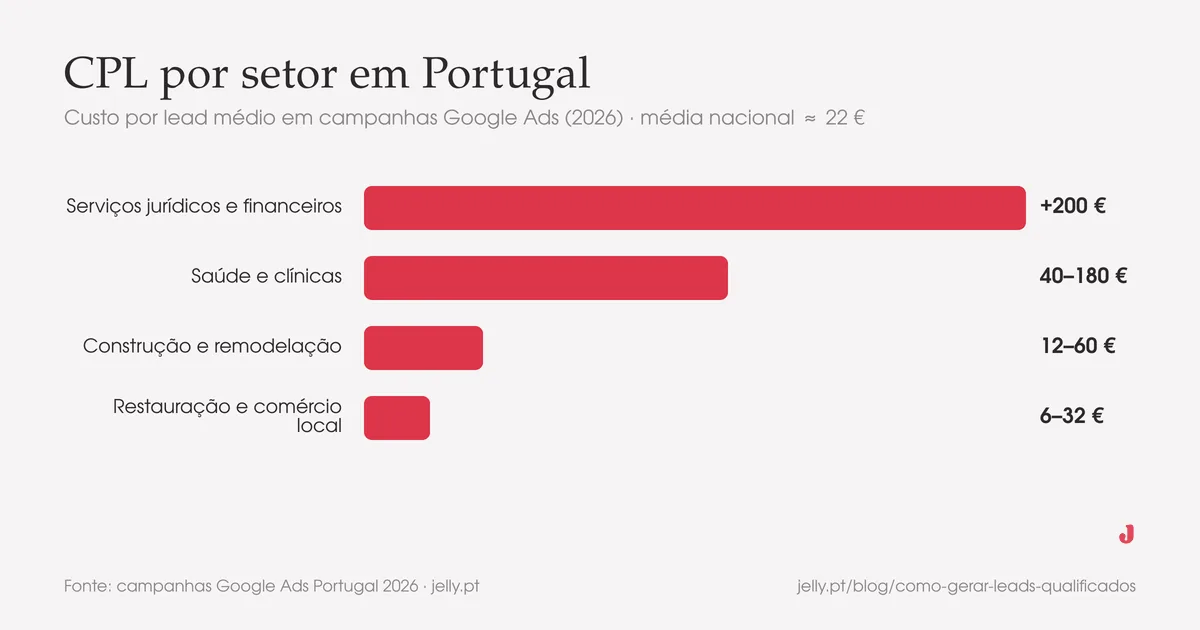
Based on Google Ads campaigns in Portugal in 2026, the average CPL sits at roughly 22 euros across the market as a whole, but the variation by sector is significant. Restaurants and local retail show a CPL between 6 and 32 euros; construction and refurbishment between 12 and 60 euros; healthcare and clinics between 40 and 180 euros; and legal and financial services can exceed 200 euros.
These ranges reflect estimates based on samples of active campaigns. The actual figure varies with the quality of the creative, auction competition and how specific the targeting is. Lisbon and Porto show higher CPC and CPL than the rest of the country, which should be factored into budget planning.
Meta Ads tends to deliver CPLs 30% to 50% lower than Google Ads in sectors such as healthcare, education and e-commerce.
A/B testing and continuous optimisation
Using digital marketing to generate qualified leads isn't a one-off setup; it's a process of continuous improvement. A/B tests on landing page headlines, CTAs and ad formats should run in short cycles, ideally weekly, to validate hypotheses with real data.
Tools such as Google Analytics 4 and the native dashboards in automation platforms make it quick to identify what's working and where the funnel is losing contacts.
Landing page optimisation studies consistently document variations of 20% to 30% in conversion rate from simple changes, such as the main headline or the colour of the CTA button.
Integrated conversion funnels: how Jelly turns visitors into qualified leads
The difference of having everything integrated within a single agency
Fragmentation across suppliers is one of the biggest obstacles to effective lead generation funnels. When one agency handles SEO, another runs the ads and a third sets up the automation, inconsistencies appear in the funnel and it becomes difficult to measure the real ROI of each action.
One of Jelly's missions is to remove exactly this problem, bringing branding, performance marketing, landing page development, marketing automation and CRM integration together in a coordinated, strategic approach geared towards measurable results.
What Jelly puts in place to generate qualified leads
Jelly's work on a lead generation project covers every component of the funnel: building landing pages optimised for conversion, setting up targeted paid traffic campaigns on Google and Meta, producing content for SEO and lead magnets, implementing automation flows and lead scoring on platforms such as HubSpot or ActiveCampaign, and integrating with the CRM to align marketing and sales. Added to this stack is the deployment of AI agents, able to qualify leads in real time, respond to enquiries immediately and automate tasks that previously relied on manual work. The approach is built on experience accumulated in the Portuguese market and guided by real conversion metrics. The aim is to turn fragmented processes into scalable funnels capable of generating leads with genuine commercial potential and a higher likelihood of converting.
To find out how this approach could be applied to your business, get in touch with Jelly.
Conclusion: how to generate qualified leads for your company using digital marketing
Lead quality matters far more than volume. A funnel with 50 highly qualified contacts generates more revenue than one with 500 contacts that have no profile or intention to buy. The right strategies vary by business and sector — a clinic in Lisbon has completely different needs and benchmarks from an e-commerce business scaling into foreign markets — and the approach should reflect that.
Automation and CRM turn a manual, fragmented process into a scalable funnel. CPL, conversion rate and ROI let you make decisions based on real data rather than gut feeling. The first step can be as simple as creating a dedicated landing page for the business's main offer and connecting it to a basic email flow with three automated messages.
If you want to learn how to generate qualified leads for your company using digital marketing, or you'd rather move forward with a specialist partner, JELLY is on hand to diagnose your current funnel and present a plan tailored to your business. Talk to us and start with a strategy designed to deliver measurable results.
Get what we write
No fixed calendar: only when there is something worth your time.