Super Agents: the new structure of marketing teams
Alícia Coquim Social Media & Content Manager
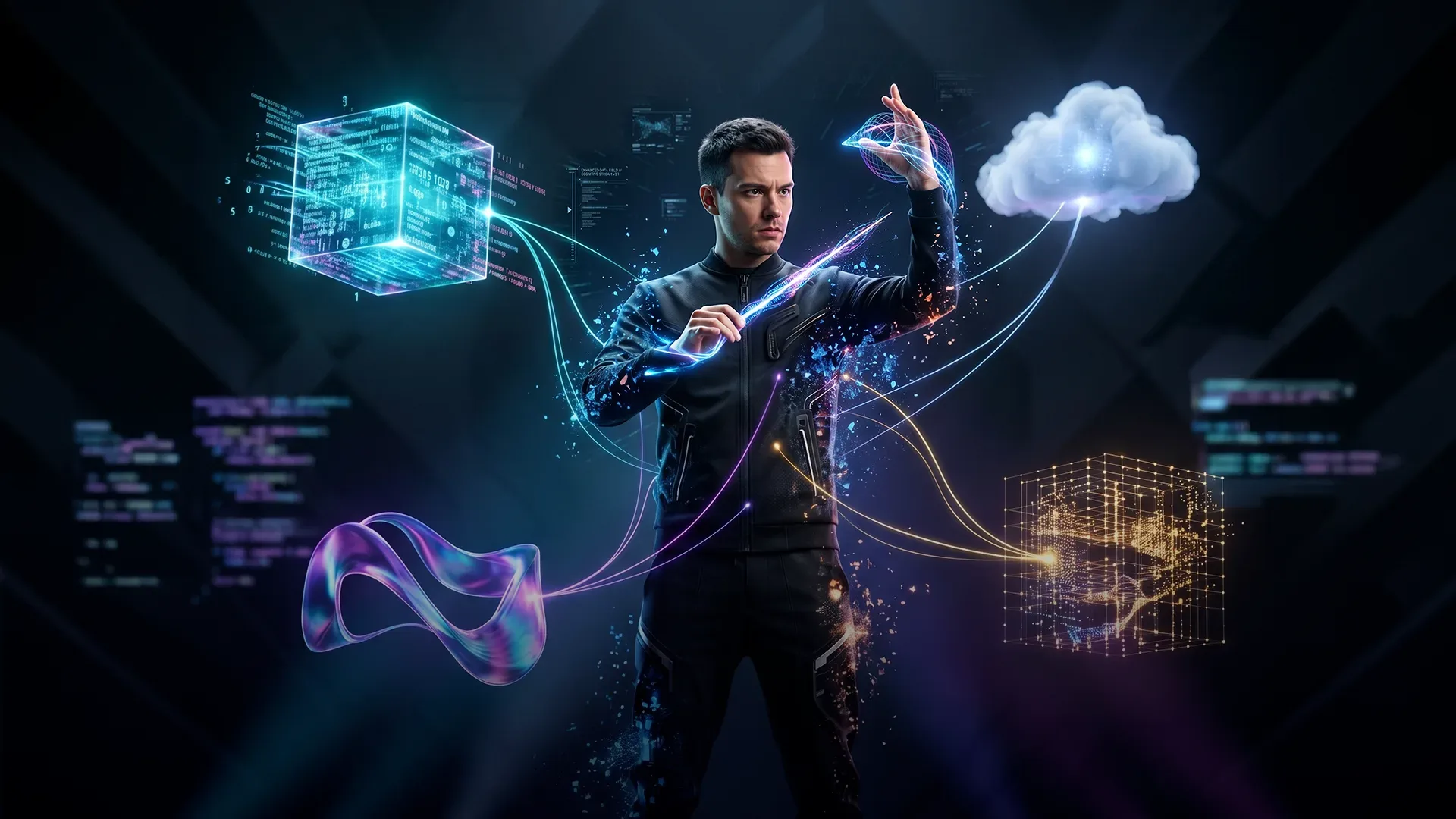
In 2026, AI (Artificial Intelligence) stopped being a support tool.
The new generation of autonomous agents is redefining who does what — and what it actually means to be a marketing professional.
For years, digital marketing was shaped by one simple premise: AI as an assistant. A tool that could suggest, summarise, generate. Fast, but always dependent on a human at the wheel. That premise is no longer enough to describe what is happening. In 2026, a new category of systems has emerged — Super Agents — which don't carry out isolated tasks but orchestrate complete marketing processes from end to end. Research, strategy, content production, publishing, optimisation. All at once. Coherently. At a speed no human team could match. This raises an urgent question for any marketing manager or business leader: what changes in the structure of my team? And what remains irreversibly human?
What are they?
From standalone tools to coordinated ecosystems
The distinction between traditional AI and Super Agents isn't just technical — it's structural. The AI tools we've known until now work in a linear way: you ask, the AI answers. Super Agents work in a radically different way. They receive a brief and orchestrate multiple specialised agents working in parallel, each responsible for a distinct layer of the process.
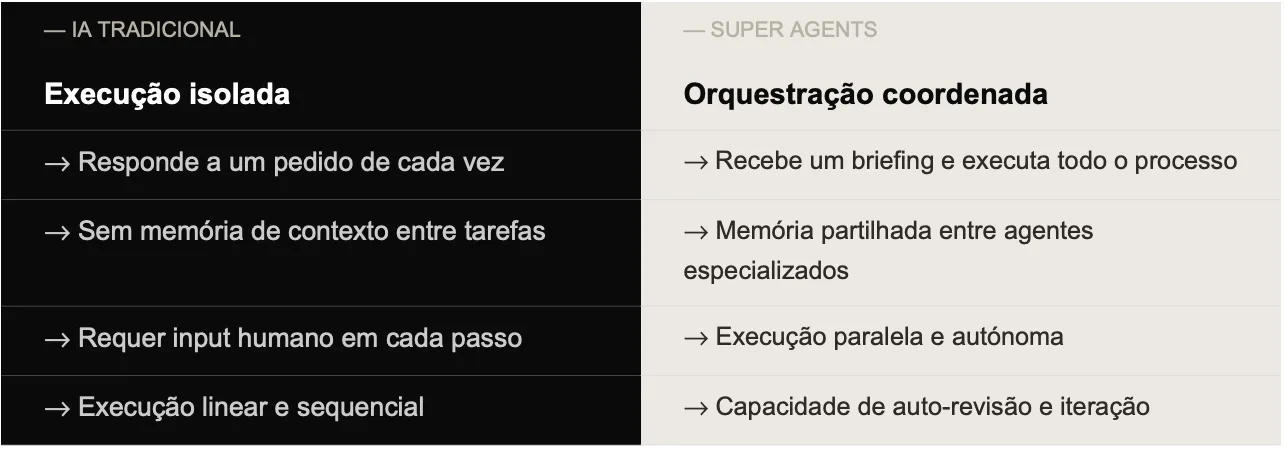
In practice, this means a process that once took a week of work, from brief to publication, can be compressed into hours or minutes.
Our view as a digital marketing agency is that AI is no longer imitating human work. AI is creating a new division of labour, and the marketers who grasp that first will have an enormous advantage.
The Data
What the numbers say about efficiency and adoption
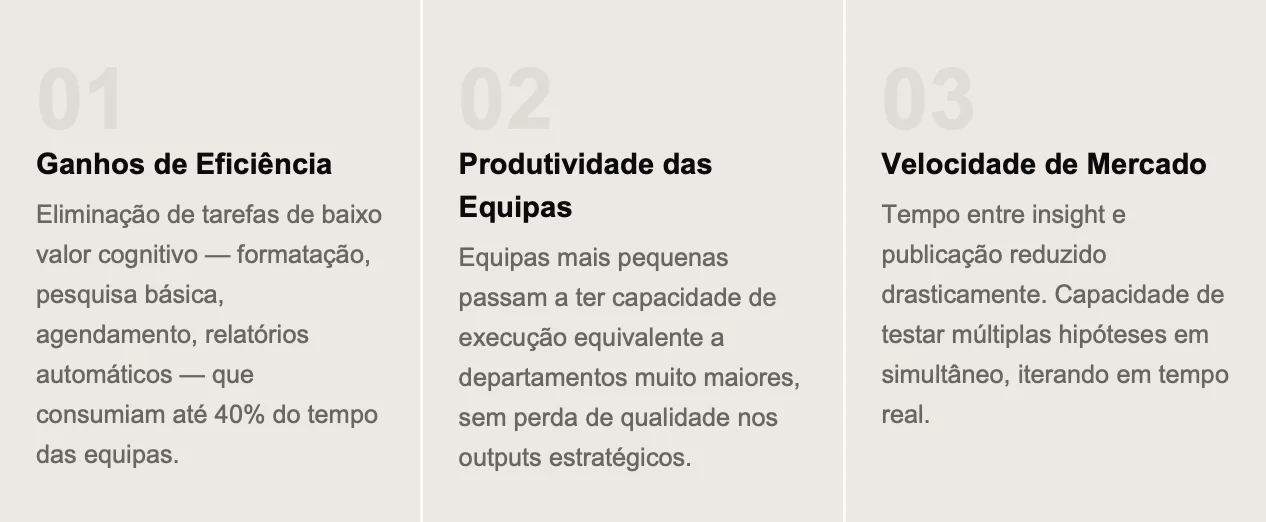
This isn't just speculation. Market data confirms a trend that is already irreversible. According to Neil Patel's study on AI Agents in marketing, professionals identify three areas where the impact is most significant and immediate:
The average productivity increase reported by teams that have adopted AI Agents in content and SEO workflows, according to Neil Patel.
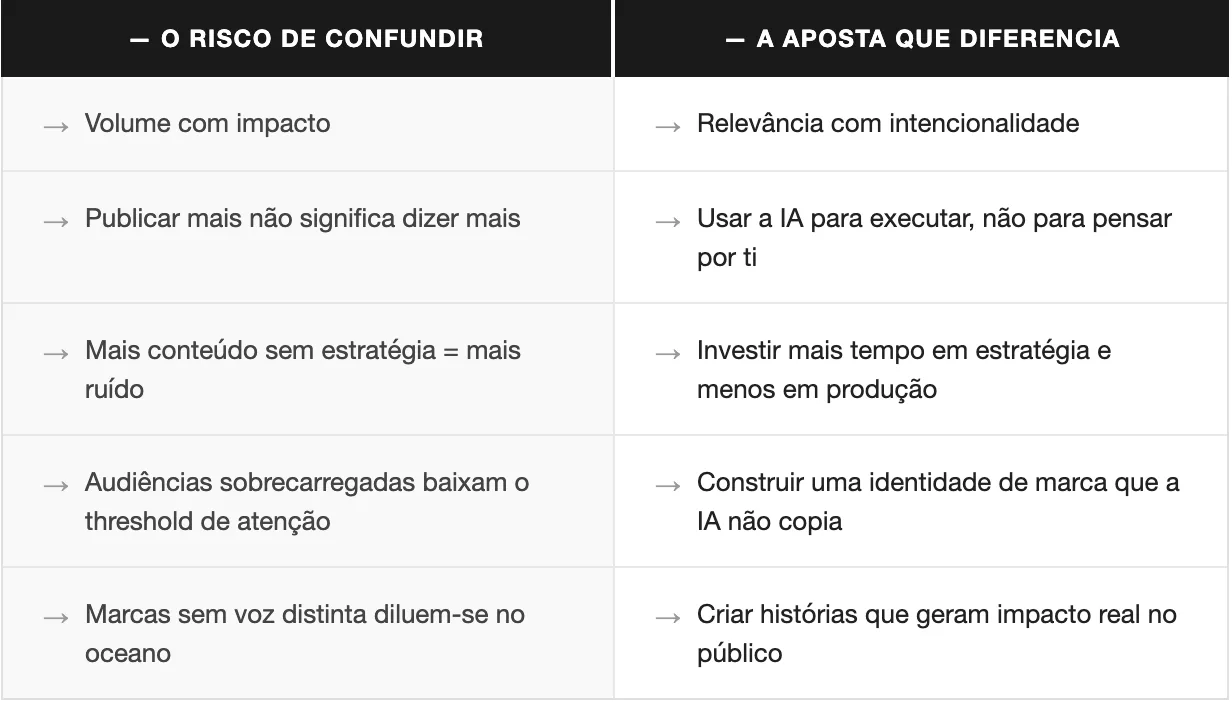
But the data has an important flip side: adoption without strategy produces noise, not results. And that noise has costs — in attention, in brand credibility, in wasted resources.
The new divide
The heavy lifting goes to AI, the decisive work stays with humans
The model now emerging isn't one of replacement, it's one of radical specialisation. AI takes on the operational layers; humans take on the layers that require judgement, context and genuine creativity.
What AI does better
There are tasks where AI is objectively superior: speed, consistency, scale and data processing. In marketing: market research, keyword analysis, outline generation, SEO optimisation, performance reporting, editorial calendars, A/B testing, personalisation at scale.
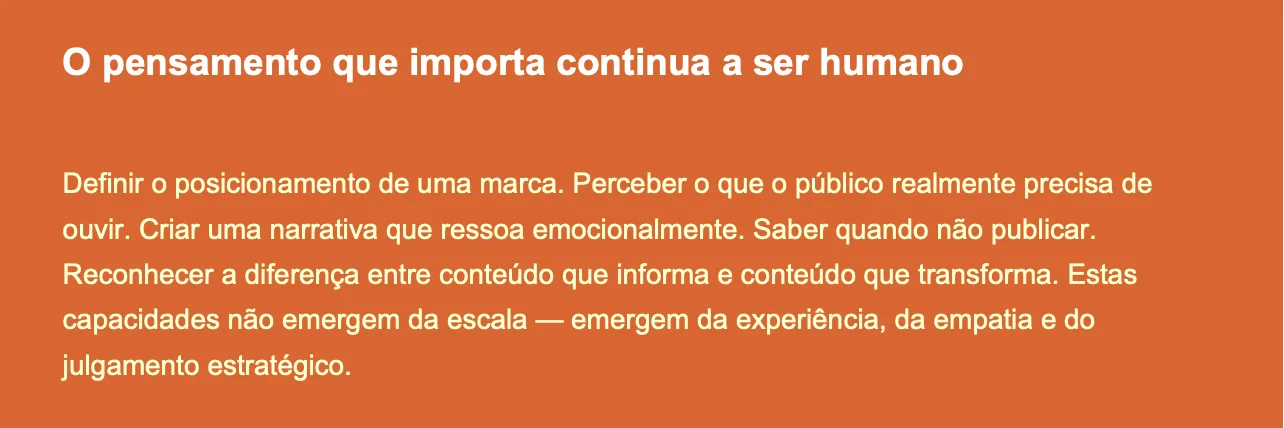
The great irony of this shift is that by automating operational work, AI doesn't diminish the value of good marketers — it amplifies it. Because the gap between an average professional and an excellent one is now more exposed than ever.
The real risk
The real risk isn't AI — it's mediocrity at scale
Here's the paradox few analyses address honestly: the easier it becomes to produce content, the harder it becomes to stand out. If any company can generate 50 articles a week with a Super Agent, volume stops being a competitive advantage. What sets you apart is no longer quantity — it's the quality of the thinking behind each piece.
The Future
What the marketing team will look like in two years
The marketing teams of the near future won't be bigger, they'll be smarter in how they combine human and artificial intelligence. The profiles set to gain relevance are those able to move fluidly between the two worlds:
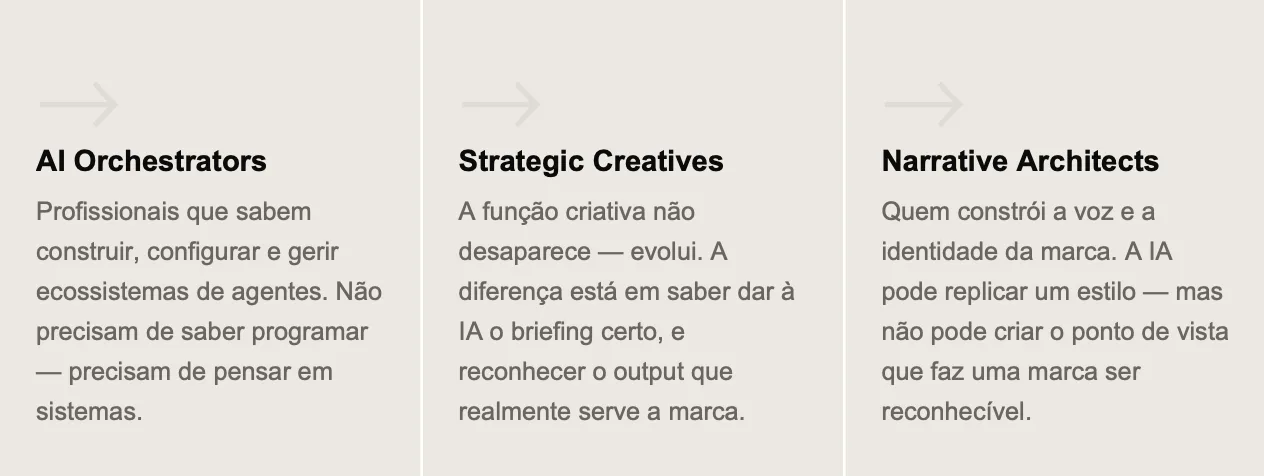
Production-focused departments will shrink. Those focused on vision, interpretation and strategic direction will grow — or at the very least, become more critical to the business.
The acceleration already under way
Some brands are already operating with active Super Agent ecosystems. They map keyword clusters in minutes. They generate complete content structures in hours. They test campaign variations simultaneously. They publish and optimise in real time. This isn't science fiction — it's the present for anyone who has decided to take AI integration in their marketing processes seriously.
Conclusion
What separates the brands that produce from the brands that make an impact
We're entering an era where the barrier to entry for content production is practically zero. Any company can publish more, any team can look more productive on paper. But the barrier to entry for quality strategic thinking — for the narrative that resonates, the positioning that differentiates, the message that lands when it matters — that barrier isn't coming down.
It's going up.
Because on an internet saturated with automated content, what becomes truly rare is a voice with a point of view. The brand that has something to say: the content that couldn't have been produced by anyone else.
Super Agents will change who does what. But the difference between mediocre brands and memorable brands will still be built by people — with intent, with strategy and with a clear vision of what they want to leave in the world.
And that is exactly the work Jelly does.

Get what we write
No fixed calendar: only when there is something worth your time.