TikTok: A fine line between entertainment and business
Gabriela Polidoro Lima – UX Designer & Content Writer - Writing about TikTok can seem a bit simplistic for anyone who isn't active on the platform (myself included). But since its launch in 2017, a lot has changed and it is increasingly being seen as an important (and essential) business tool.
I went looking for information on the subject so I could write about it, and I have to admit I was rather struck by the scale and reach it has achieved in such a short space of time.
Gabriela Polidoro Lima – UX Designer & Content Writer - Writing about TikTok can seem a bit simplistic for anyone who isn't active on the platform (myself included). But since its launch in 2017, a lot has changed and it is increasingly being seen as an important (and essential) business tool.
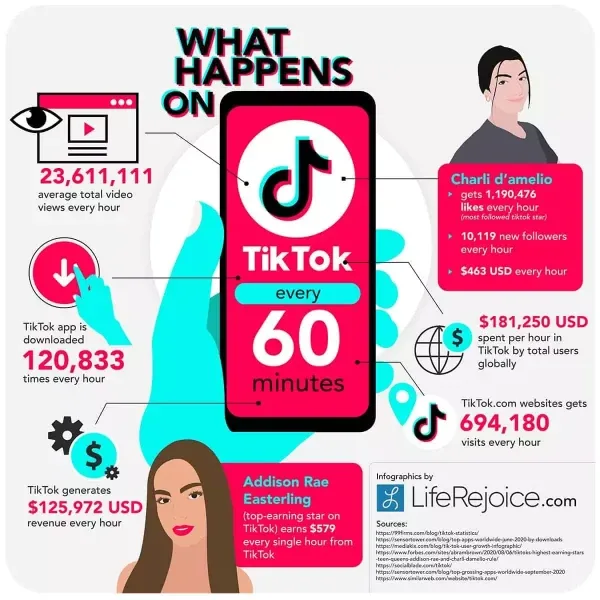
I went looking for information on the subject so I could write about it, and I have to admit I was rather struck by the scale and reach it has achieved in such a short space of time. Once known (or known by those who haven't kept up) as “the silly dancing app”, it has been on an extraordinary growth curve ever since it became available outside China, its country of origin, in 2018. During the pandemic it grew at a surprising rate, becoming the fastest-growing app in history. That's not a title just anyone can claim, especially at a time when everything is becoming more and more digital.
Source: Daily Infographic
Mission: to inspire creativity and bring joy
Simon Hofmeister, the brand's head of e-commerce, recently shared figures on the reach the platform has achieved, its growth and the important gap it has been filling between entertainment and business. Asked about the brand's mission and values, he says they “consider themselves an entertainment platform more than a social network”. And that “when people open the platform, they're looking for entertainment, for something to watch, not simply to check or confirm a piece of information.” On top of that, its huge success and popularity among more than 1 billion users comes from content shared with realism and naturalness. “It's made for real people, by real people, about real people.”
He also points out that bringing humanity into content makes the experience more real and connects with the viewer far more quickly and effectively. All the content is personal, which means people are instantly motivated because they recognise themselves in the content and in the people creating it. So talking about products and brands becomes simple and natural, and is seen as truthful and genuine by whoever is watching. It's like a chat between friends, one having a natter or passing on tips to the other, in a fun and positive way.
Simon noted that 73% of people feel more positive after watching authentic content, which reinforces the brand's values and hints at the reason for its runaway success.
TikTok For You: Real Joy
In a video created by the brand itself (see below), you can learn more about the authenticity of its content straight from its own creators. Talking about what they like most about the platform, they say that there people feel they aren't alone, because they form instant bonds with content creators. Everyone feels unique, because each person has their own authentic way of expressing and communicating. It's a space built by a diverse community where there is less judgement and more freedom, and everyone is accepted. Beyond the sense of belonging, they feel the audience is always up for a laugh, at anything, which makes creating and sharing content a much smoother process.
The brand's pillars — Authenticity, Happiness and Joy — come through clearly in what these creators say, as the video plainly shows. Figures released by the platform
To grasp the scale of what TikTok has pulled off, the Time Spent Well study by Kantar+TikTok published some genuinely impressive numbers:
– At just 4 years old it reached 3 billion downloads, a figure Facebook and Instagram took almost 10 years to hit;
– Bytedance, the company behind the app, was valued at 280 billion dollars in August 2021, making it the most valuable start-up in the world;
– It ended 2020 as one of the 10 most downloaded apps;
– 20.83% of the world's internet users use TikTok, while 22.33% of social media users are active on it, and 90% of those on the platform log in daily;
– The platform currently has 1 billion monthly active users and more than 1 billion views a day;
– It is available in more than 155 countries and 75 different languages;
– When it comes to engagement, it leads the field with an average session length of 10.85 minutes, double that of second-placed Pinterest, at 5.06 minutes;
– Since June 2020 the platform has allowed brand advertising, letting companies use e-commerce features such as shopping links, hashtag challenges and in-feed ads to turn likes into purchases.
While a 2020 study by Ofcom showed that 1/3 of our waking hours is spent watching television or online video content, Kantar, the research company that ran a study together with TikTok, found that 1/3 of people admitted to having cut down their hours watching television or streaming content because of TikTok. That same proportion also says it wants a more appealing and enjoyable shopping experience, according to GWI Connecting the Dots, in a report published in 2021. Put those findings together and the question arises: so why not offer that through a platform with entertainment in its DNA?
The purchase decision
And if the app has become far more than a second screen — a way of delivering a complete immersive experience — then it's clear there's a big (and undeniable) opportunity to use it as an e-commerce channel too, given that e-commerce in its more traditional form can sometimes make for a rather dull experience.
The brand's Research Department reported that 39% of users admitted the key to their purchase decision is content that lifts their spirits.
Although the video format is nothing new on the internet or in online retail, on TikTok 40% of users admit videos influence their purchasing decisions. And those who buy under that influence end up coming back to the platform to create content about the products and brands they've bought. This movement creates a new purchase journey, very different from the traditional one. The famous “word of mouth” has become “video to video”. Buying through ads, or even through advertising produced by influencers and brands in the traditional way, has no place and no effectiveness on TikTok.
The looping effect starts with these consumers, who while browsing the platform discover products and brands through algorithms that show them content they're interested in, based on their tastes and frequent searches. When they buy products, if the experience was a good one, they create more content to share with their followers, influencing more people to buy the same item. And then it all starts again.
The success of the short, fun, human video format is the key to the platform's review culture, borne out by the hashtag #TikTokmakemebuyit, used in more than 31 billion videos.
Deconstructing the traditional advertising format — which can feel like an intruder when it turns up while we're consuming completely unrelated content — consumers come to the platform precisely to consume advertising, because there it shows up in an entertaining way and the results end up appearing organically and naturally, driving purchases.
TikTok's secret formula is to empower its users by shifting their status over the course of their time on the platform and the way they interact with it. The dynamic is to turn consumers into active members of the community and influencers into content creators, through a conversational, non-intrusive message.
People build communities around the brands and products they like and create hashtags to discuss the subjects and themes they identify with, such as food – #foodtok, books – #booktok or the gym – “gymtok”. Content created naturally and organically turns ordinary participants on the platform into genuine influencers, even if they don't have a large following. This came from the brand itself which, when discussing how relevant its content is in promoting a product or brand, found it carried more influence and therefore delivered better results than content produced by the brand owner, with far bigger production budgets.
Users and content
When it comes to the user profile, a few things have changed since the app became available. The bulk of active users is still a young audience, but an older age bracket has been gaining ground, which also increases conversion potential (adults have more spending power). Over the last 18 months, adult take-up of the platform has increased fivefold, and they are creating content too, not just watching.
On gender, women predominate, at 59%. As for age brackets: 28% are up to 18 years old; 35% are in the 19 to 29 bracket; 18% are between 30 and 39, while only 19% are over 39.
But what is this whole audience looking for when they open TikTok? The Kantar+TikTok study found that 76% want to watch videos, 33% say their main activity is following content creators and 29% see the platform as a tool for learning new things. Proof of that is the hashtag #LearnonTikTok, one of the most popular among users. Another of the brand's success formulas: conveying credibility and knowledge through its content.
The short video format is another factor behind the platform's success. The message is short, so even if it isn't of interest to the user, they can quickly move on to the next piece of content. Loops and autoplay also make it easier to consume and keep the experience light and fun, as does personalisation. The For You tab serves up content based on each user's searches and interests. Even people with interests in common will have different tabs, which holds the audience for even longer, consuming and enjoying the platform. As well as the personalised experience, it offers the chance to meet people from all over the world and encounter different cultures, and it has a friendlier algorithm, which allows for more organic engagement.
Another driver of popularity and engagement is the sense of community, which sits at the heart of the brand's values. The same study showed that 71% of users watch alone but 67% share videos off the platform, since even people who haven't signed up can consume the content through other social networks, via simultaneous sharing on YouTube, Facebook, Instagram, Twitter and WhatsApp. In other words, most users socialise with friends and family and those who create content rope in help from friends or relatives, reinforcing that collective spirit even further.
For brands looking to get on board
Now that all this is on the table, brands wanting to make the most of TikTok's popularity and success should keep the following content creation tips in mind:
– Focus on niches – tap into the sense of community and look for groups that are a good fit with your brand or product;
– Create original, repeatable content – communicate genuinely and authentically to build connection, and use repetition so you're remembered and recognised more easily;
– Accessibility – don't forget to add captions to videos so you reach even more people;
– Information and entertainment – always bear in mind that the platform's main purpose is to entertain and amuse users, so it's essential to communicate in a way that delivers a fun, upbeat experience;
– Stay active – once the content is live, it's very important to interact with the community through comments and hashtags.
This data matters because it helps brands work out how to talk to their audience and what the possibilities are for reaching more and more people through the most popular app of the moment.

Get what we write
No fixed calendar: only when there is something worth your time.