Algorithmic Immunity: When a brand becomes unavoidable for search and AI tools

Alícia Coquim Social Media & Content Manager
For years, digital marketing chased an illusion: that you could build online visibility through isolated tactics, disconnected from the reality of the brand. Publishing optimised content, stacking up backlinks, tweaking meta descriptions — all of it seemed enough to secure positions on Google. In 2026, that illusion no longer holds up (in truth, it never was sustainable). Brands that rely exclusively on SEO techniques face constant volatility, unstable rankings and an endless race against algorithms that change without warning. Meanwhile, some brands seem immune to those swings. They publish content and it ranks. They create a new page and it appears at the top within days. They shift topic and keep their authority.
It isn't luck. It isn't just technique. It's what we call Algorithmic Immunity — and it's built outside the digital space.
What Algorithmic Immunity is
Algorithmic immunity is the state in which a brand reaches a level of authority so well established that its content ranks quickly and consistently, regardless of shifts in search algorithms or SEO trends.
It isn't about ignoring good technical practice; it's about building a foundation of trust and relevance so solid that technical optimisation becomes an enhancer rather than a deciding factor.
Brands with algorithmic immunity enjoy a compounding effect:
- Every new piece of content published inherits accumulated authority;
- The time between publication and ranking gets progressively shorter;
- People search for the brand name, not just the generic service;
- Algorithmic volatility has minimal impact on visibility.
This immunity can't be bought. It's built through consistent actions, both inside and outside the digital environment.
Authority isn't built on websites
The big shift in perspective is this: a brand's authority isn't born in the digital space. It only shows up there.
Search engines and AI (Artificial Intelligence) systems don't just assess what a brand says about itself on its own website. They assess what others say, what people search for, and how the brand behaves in real-world contexts.
Authority is built through:
- Product or service quality: brands that deliver consistent value generate organic recommendations. Those recommendations translate into mentions, spontaneous links and, above all, direct searches. When someone searches for “brand name + service” rather than just “service”, they're conferring authority.
- How it treats its customers: the experience a brand delivers sparks conversations. Conversations generate user-generated content (UGC): reviews, testimonials, mentions on social media, recommendations in forums. All of this feeds the perception of relevance and trust that algorithms pick up on.
- Keeping commitments: consistency between what's promised and what's delivered establishes credibility. That credibility doesn't stay confined to a single transaction — it spreads, through word-of-mouth, referrals and repeat business. And it repeats: where there's repetition, there's recurring demand. Where there's recurring demand, there are clear signals for search engines.
- Strategic partnerships: associations with other brands, institutions or events position the brand within a wider context. Co-branding, involvement in recognised initiatives, presence in respected publications — all of this creates context and external validation. And context is exactly what AI systems need in order to interpret relevance.
- Events, talks and physical presence: attending events, speaking at conferences, producing content that comes out of real contexts (not disconnected editorial calendars) creates substance. It generates media coverage, citations, contextual links. And the more a brand is mentioned in credible contexts, the more authority it accumulates.
All of this happens outside the direct control of SEO. But all of it feeds directly into the authority that search engines recognise.
When people search for the name, not the service.
One of the clearest indicators of algorithmic immunity is a shift in the type of search a brand generates.
Brands still building are found through generic searches: “digital marketing agency”, “brand consultancy”, “product photographer”. They're competing on intent, not on recognition.
Brands with established authority, on the other hand, are searched for directly: “Jelly marketing”, “working with Jelly”, “Jelly blog on branding”. The intent is clear, specific, and the competition is practically nil.
This transition doesn't happen by chance. It happens when:
- The brand becomes a reference point in a specific area;
- People trust it enough to recommend it by name;
- The content published is distinctive enough to create direct association.
And here's the compounding effect: when a brand accumulates searches for its own name, search engines read that as an unmistakable signal of authority. And when it publishes new content, that content benefits from the authority already built up. It ranks faster, appears in higher positions and stays stable.
Jelly and 15 years of Algorithmic Immunity
Jelly doesn't chase SEO trends. It never has. Since 2011, the strategy has been the same: create content that serves people, based on real work, accumulated experience and a clear position.
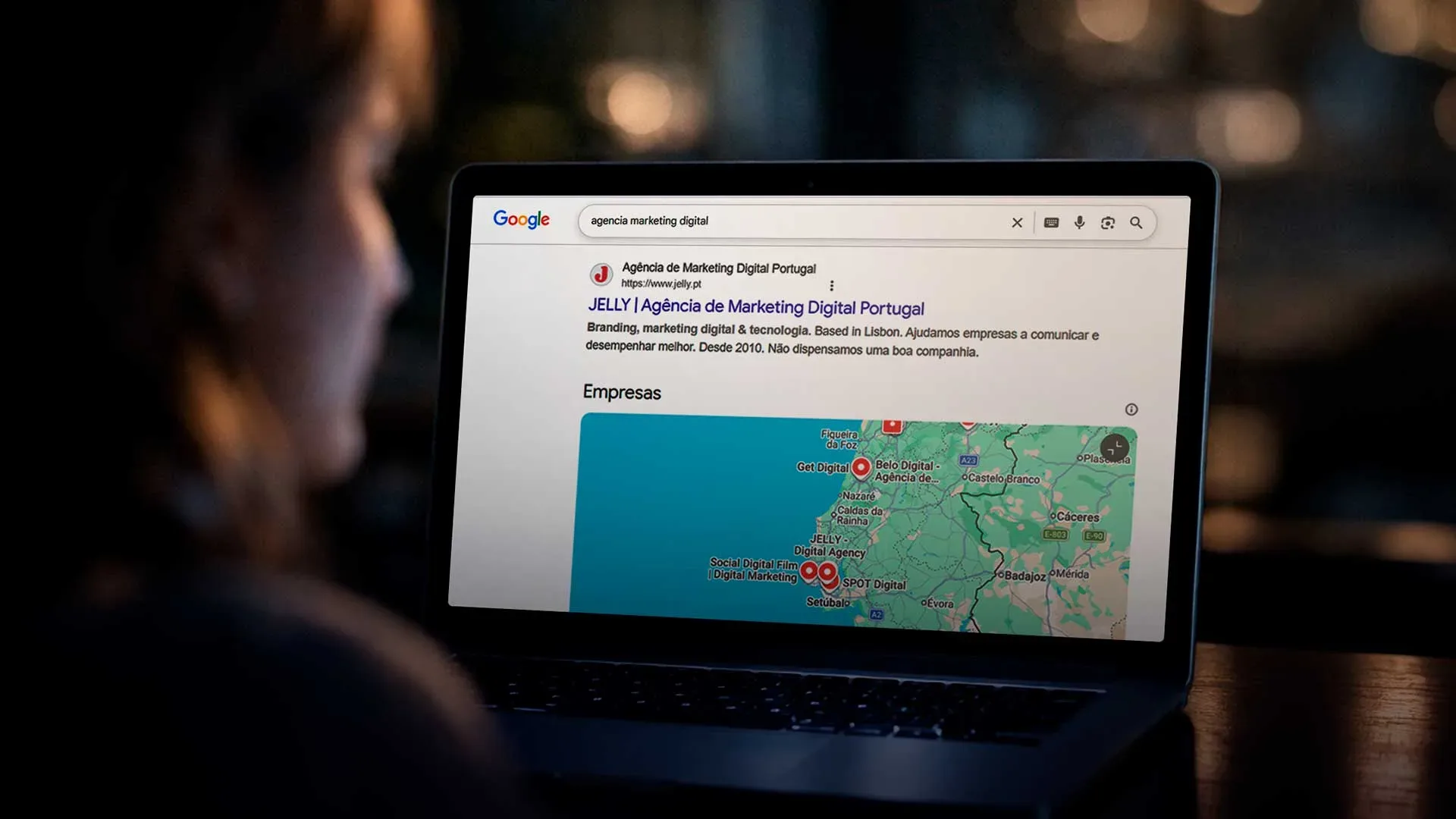
It's no coincidence that Jelly has stayed in the top 3 for searches related to digital marketing in Portugal for 15 consecutive years, through multiple Google updates, radical algorithm changes and the explosion of AI-generated content. That stability doesn't come from constantly tweaking meta tags or from an aggressive link building strategy. It comes from:
- Working with clients who generate visible, measurable results;
- Sharing real knowledge, not generic knowledge, based on concrete cases;
- Maintaining a presence at events, training sessions and contexts where credibility is put to the test;
- Publishing content that reflects a point of view of our own, not a round-up of other people's best practice.
Every well-executed project reinforces authority. Every satisfied client generates a mention, a recommendation, a direct search. Every piece of content published benefits from that foundation and ranks — not because it's optimised to the hilt, but because it comes from a source search engines recognise as credible.
This is Algorithmic Immunity in action.
Storytelling + structure: serving people and machines
Building authority doesn't do away with good technical practice. Quite the opposite: authority powers the technique, and the technique amplifies the authority.
On the human side, content needs:
- Clarity and ease of understanding;
- Relevance to the reader's context and moment;
- A narrative with a beginning, middle and end;
- Practical, actionable usefulness.
On the machine side, content needs:
- Logical, hierarchical structure (headings, subheadings, clear organisation);
- Semantic consistency and predictable formatting;
- Correct use of structured data (schema markup);
- Clarity in how topics are organised.
When a brand has authority, it doesn't have to choose between serving people and serving algorithms. It does both, naturally, because the focus is on clarity and usefulness — and that serves both audiences.
Schema markup, for example, doesn't create relevance. But it does ensure that existing relevance is interpreted correctly. Structure doesn't replace substance. It amplifies it.
Brands without authority can have every technical element right and still fail to rank. Brands with authority, even with basic technical structure, rank quickly because search engines already trust the source.
How to build Algorithmic Immunity
There are no shortcuts. But there is a clear path.
- Do work worth mentioning: before thinking about content, think about substance. Well-executed projects, satisfied clients, measurable results — all of this creates the base the content can spring from.
- Create content based on real experience: generic content is a commodity. Content based on real cases, decisions made, mistakes made and lessons applied is distinctive. And distinction creates authority.
- Maintain a presence in credible contexts: events, partnerships, collaborations, external publications — all of this positions the brand within a wider context and creates external validation. Authority isn't self-declared; it's recognised.
- Publish consistently: consistency doesn't mean volume. It means regularity, predictability and maintaining a standard of quality. A brand that publishes relevant content consistently trains both its audience and the algorithms to expect and value what it publishes.
- Structure it technically without sacrificing clarity: use good SEO practice, implement schema markup, organise information logically — but always in the service of clarity, never as a substitute for it.
- Measure authority, not just traffic: the most important indicator isn't how many visits a piece of content generates. It's how many of those visits come from direct searches for the brand name, how many external mentions the brand accumulates, and how quickly new content ranks.
The future belongs to those who build outside the digital space
Algorithms change, platforms evolve and SEO techniques become obsolete, but authority built through real work, consistent behaviour and value delivered endures.
Algorithmic Immunity isn't a technical objective. It's the natural consequence of building a brand that deserves trust — online and offline.
Brands that rely exclusively on digital tactics will always be vulnerable. Brands that build authority through concrete actions, that serve people before they serve algorithms, that create substance before they create content — those become immune to the swings.
Not because they ignore the algorithms. But because the algorithms start following them, not the other way round.
Jelly builds content strategies based on real authority, not isolated tactics.
Algorithmic Immunity is a philosophy coined by Gonçalo Malho Rodrigues, founder of Jelly, and comes out of nearly three decades working in brand strategy — with tactics that have survived every algorithm to date. Has your brand started building its own? Book a conversation here.
Get what we write
No fixed calendar: only when there is something worth your time.

Gonçalo Malho Rodrigues
Fundador & CEO
Fundou a Jelly – Digital Agency em Portugal em 2010 e a Strivesync – AI-Native Systems no Dubai em 2026. Detém outras empresas, noutros setores, como a Stronddo – Online Art Galleryl, a Scallent – Human Talent. Gonçalo, criou a The Change Framework, que apoia líderes a gerar a mudança através da mobilização de equipas em torno de uma causa.