Paid traffic for e-commerce: a practical guide to selling more

If you're wondering how to use paid traffic to increase your e-commerce sales, the answer is rarely in the budget. Plenty of shops with attractive products and competitive prices spend on paid advertising every month, and the results don't cover the investment. The problem is the lack of architecture behind the campaigns.
Paid traffic works when there's a defined structure: channel selection based on clear criteria, financial targets calculated before spending, tracking that reflects what's actually being sold, and creative aligned with the funnel. At Jelly, we've worked with online shops for years and the pattern we see repeat itself is always the same: the ones that scale sales don't necessarily have the biggest budget, they have the best structure.
This article covers the essential components of an effective paid advertising campaign for e-commerce: choosing platforms, calculating your minimum ROAS, setting up tracking, audience targeting, high-converting creative, and a case study with real numbers.
How to use paid traffic in e-commerce: Google Ads or Meta Ads (and when to use both) Capturing intent vs. creating demand: the fundamental difference
Google Ads and Meta Ads work in opposite ways. Google captures people who are already actively looking for a product: someone typing “women's running shoes” into a search engine is one click away from buying. Meta interrupts people who don't yet know they need the product, showing a catalogue ad to someone who follows fitness pages but has never searched for that specific item. For a deeper look at how customer behaviour shapes purchase decisions, see our analysis on consumer decision-making.
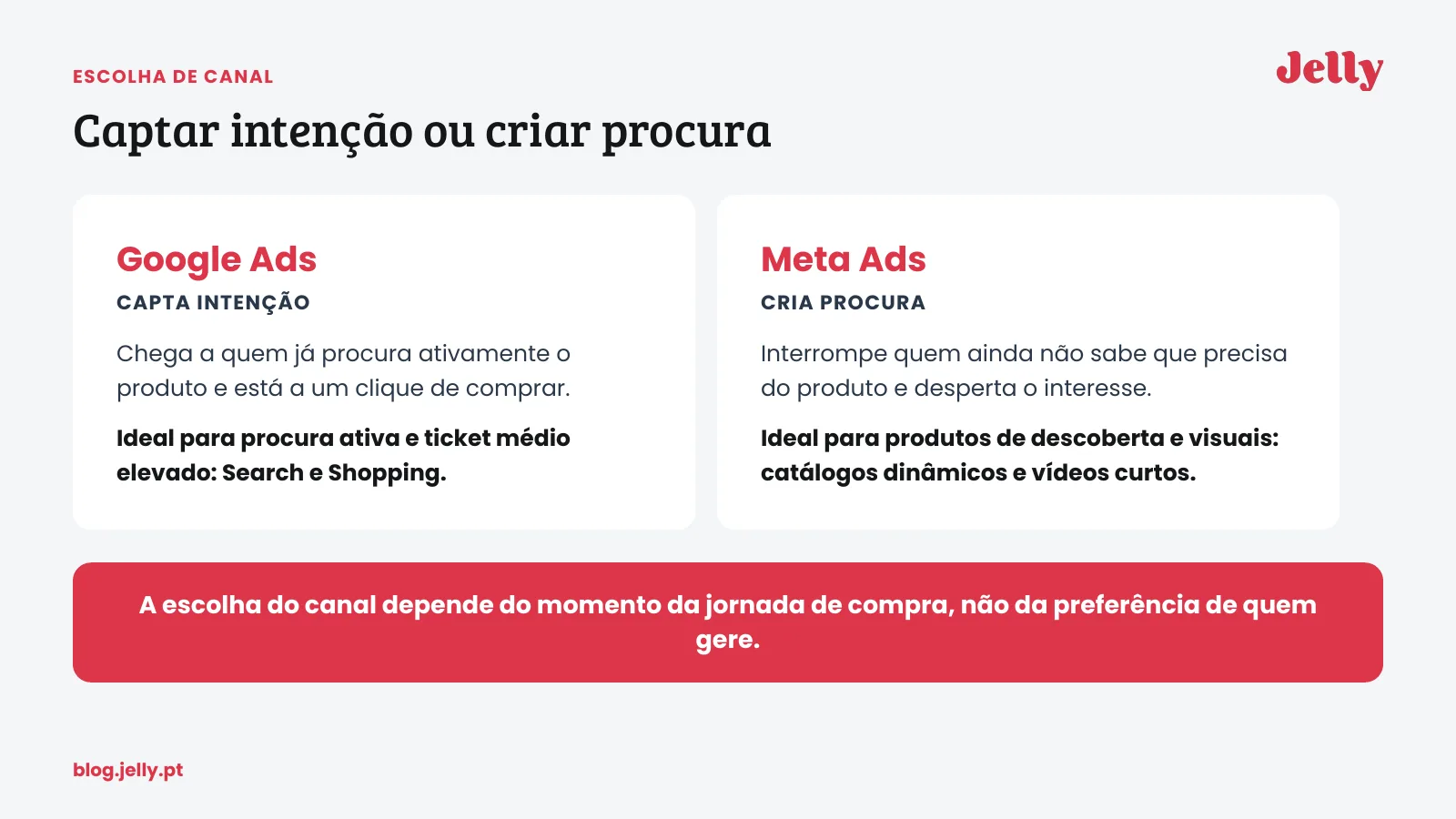
Channel choice depends on the stage of the buying journey, not on the manager's preference. Products with active demand and a high average order value are a better fit for Google Search and Shopping. Discovery products with a strong visual component gain more traction on Meta through dynamic catalogues and short videos.
The formats that actually work on each platform
On Google, Shopping and Performance Max campaigns are, in most cases, the most effective for shops with a catalogue, although Performance Max requires a longer learning phase and results vary by sector. For high-intent, high-value products, Search with specific keywords is a good complement. On Meta, dynamic catalogues and collection ads work well at the discovery stage, while dynamic remarketing brings back people who visited the shop and didn't complete the purchase.
For the Portuguese market, the minimum viable spend sits between €300 and €500 per month per platform in order to gather statistically meaningful data. Below that, the algorithm doesn't have enough information to optimise and the results are inconclusive.
When combining both channels makes sense
An integrated strategy covers the whole journey: Google captures people already searching, Meta re-engages people who visited and didn't buy. This combination maximises coverage without duplicating effort, because each platform acts at a different point in the purchase decision.
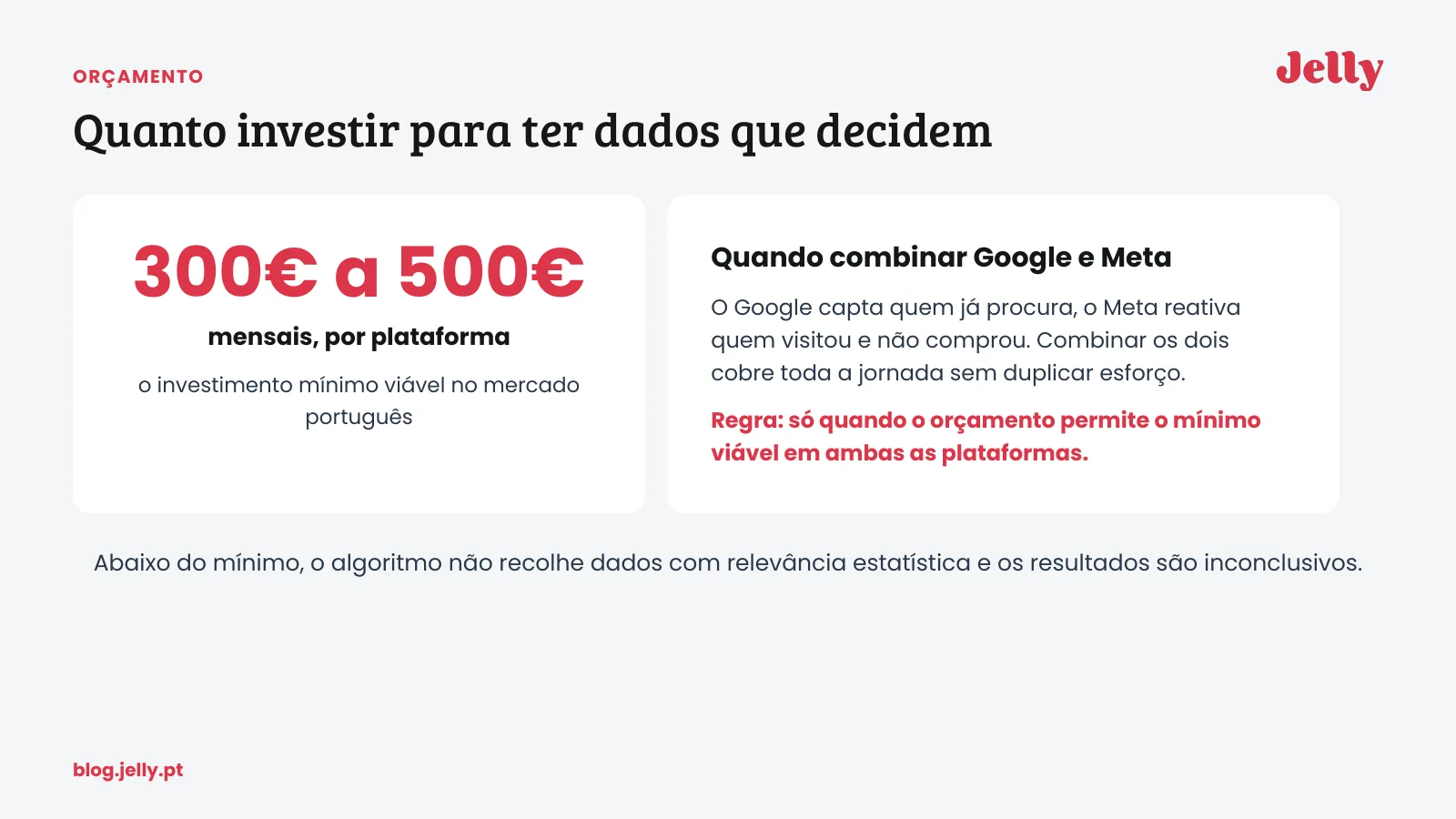
The decision criterion is simple: if the available budget allows you to spend the minimum viable amount on both platforms without splitting spend below the learning threshold, combining the two channels is the sounder decision.
How to set your budget and calculate your break-even ROAS
The break-even ROAS formula based on margin
Break-even ROAS is calculated by dividing 1 by your profit margin in decimal form. With a 25% margin, the minimum ROAS is 4 (1 ÷ 0.25). Any campaign with a ROAS below this figure is destroying margin, not creating revenue, even if the number looks positive at first glance.
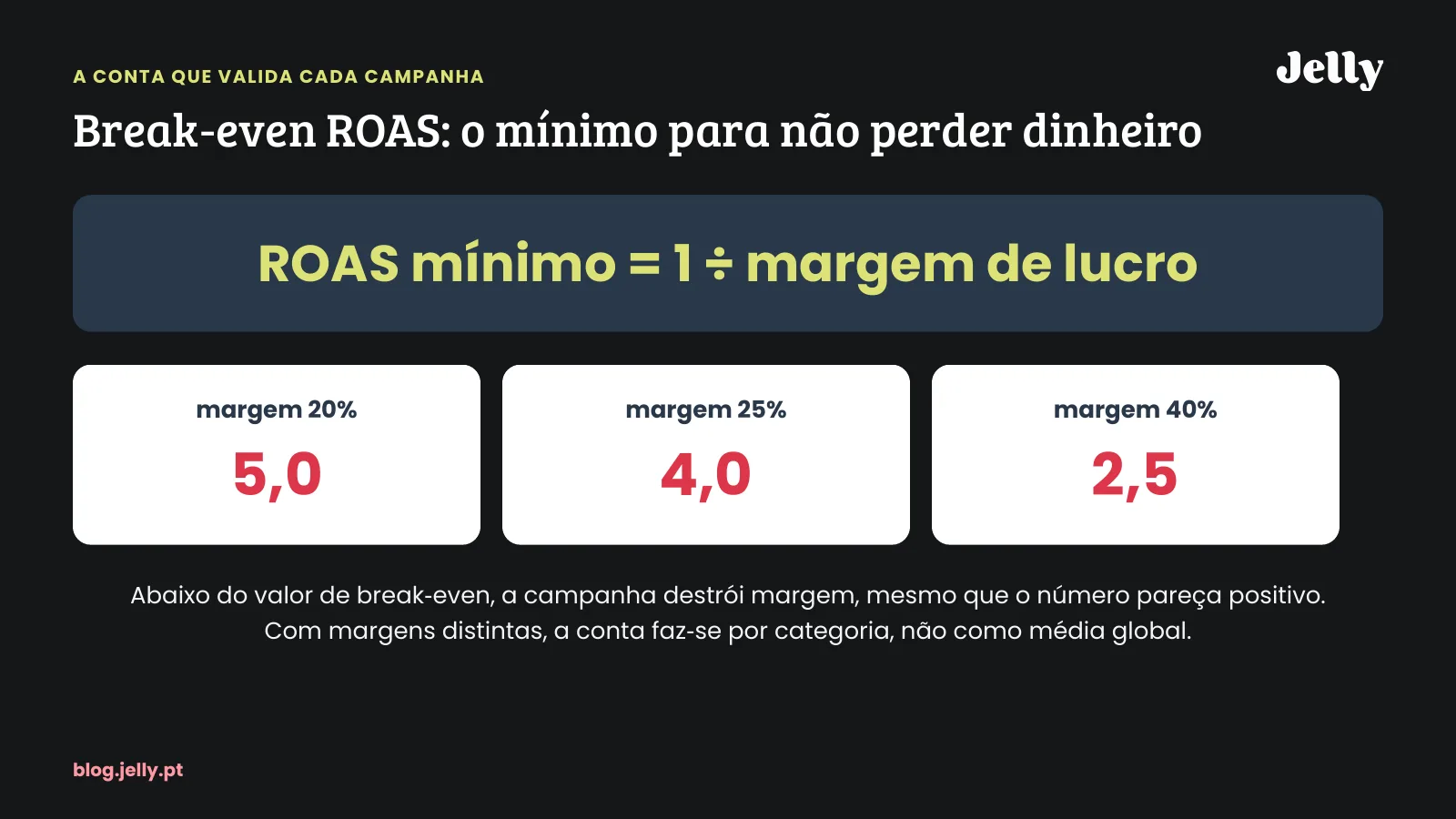
The most common mistake is comparing ROAS across campaigns without factoring in each product's margin. A shop with products on different margins needs to calculate break-even ROAS by category, not as an overall average, in order to make the right scaling decisions.
How to estimate your initial spend from your sales target
The most reliable method starts with your desired sales target. The process is straightforward: define the number of monthly sales you want, divide by the shop's conversion rate to get the traffic required, and multiply by the expected average CPC. With a target of 80 sales, a 2% conversion rate and an average CPC of €0.60, the estimated spend is €2,400 per month.
For shops in the early stages, with no historical data, the reference range sits between €800 and €1,500 per month. On Google Shopping in Portugal, average CPCs range from €0.30 to €1.50 depending on category and seasonality; categories such as electronics tend towards the upper end, while fashion and homeware sit in the middle band.
Maximum sustainable CPA: the number that sets the campaign's limits
Maximum CPA is the gross margin per sale at break-even, adjusted for the minimum profit you want. This figure should be set as the target in Google Ads bidding strategies (target CPA) and in Meta Ads so that the algorithm optimises within the real financial limits of the business, and not just according to the platforms' internal metrics.
Setting these limits before switching campaigns on is what separates those who scale sustainably from those who increase spend without knowing whether they're making or losing money. Factoring in customer LTV lets you calibrate maximum CPA even more precisely: a shop with repeat customers can accept a less profitable first purchase knowing the total value of the relationship makes up for it.
Tracking and pixel: the foundation that validates every euro spent
The essential e-commerce events on Google and Meta
The four indispensable events are ViewContent, AddToCart, InitiateCheckout and Purchase. The first three feed algorithm optimisation at the top and middle of the funnel; Purchase is the critical event that determines the ROAS the platforms report.
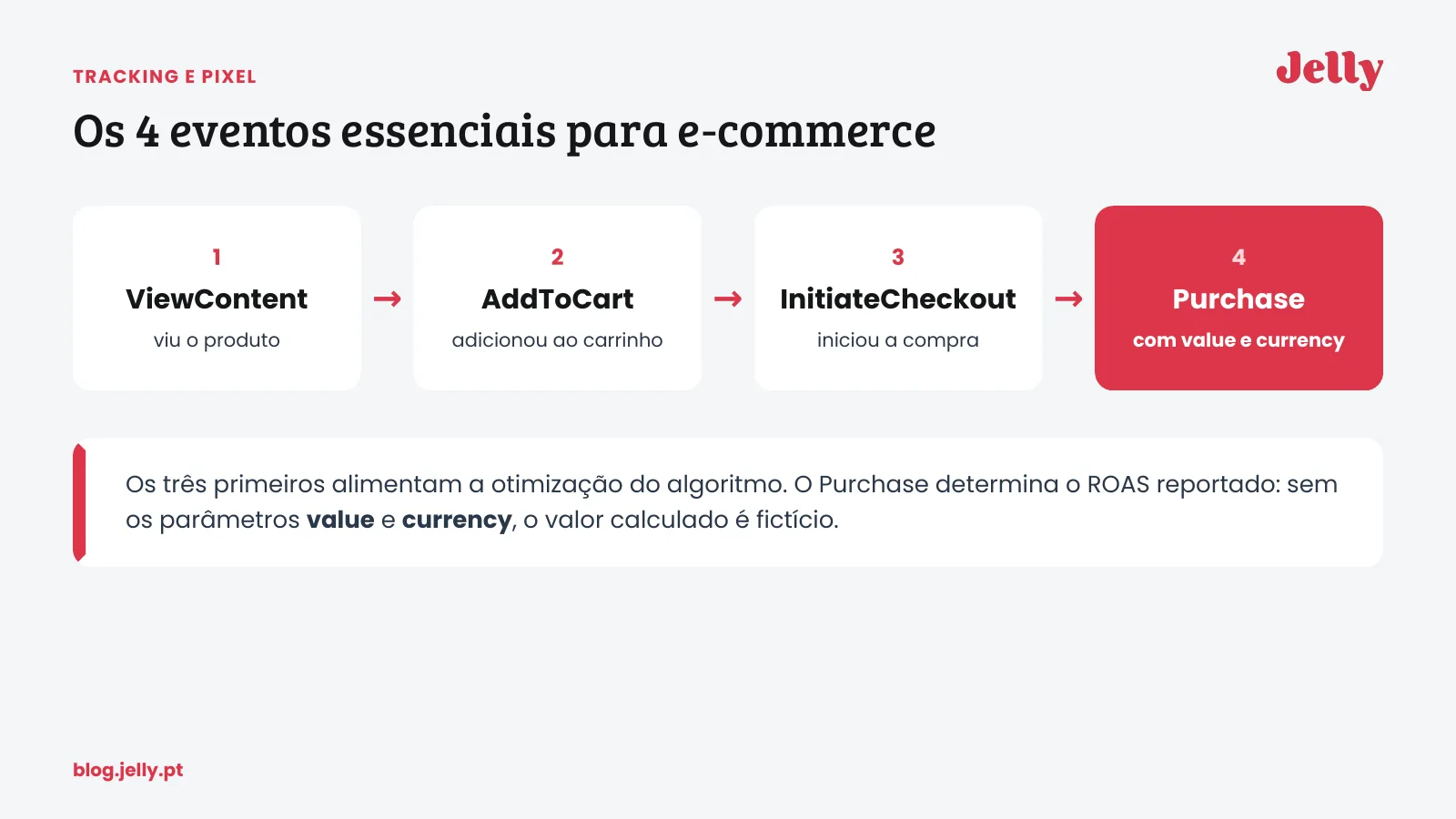
The Purchase event must include the value and currency parameters. Without them, the platform reports the number of conversions but not the revenue value, which makes the calculated ROAS fictitious. On Meta, Event Match Quality (EMQ) indicates the quality of your setup in the Events panel: the higher it is, the more accurate the attribution.
How to make sure Purchase records sales correctly
Via Google Tag Manager, the ecommerce.value, currency and items values should be pulled from the dataLayer into the purchase tag. The trigger should fire exclusively on the order confirmation page, not the payment page, to avoid duplicate conversions. Meta Pixel Helper and Google Tag Assistant let you validate that it's firing before switching on any campaign.
The role of the Conversions API in the post-cookie era
Cookie blockers and the restrictions introduced by iOS 14 have reduced the browser pixel's ability to capture every conversion. The Conversions API (CAPI) sends data directly from the shop's server to Meta, complementing the pixel and recovering sales that otherwise wouldn't be attributed.
Both Shopify and WooCommerce have native integrations or third-party apps, such as Elevar and Littledata, that simplify implementation without any technical development. Turning on CAPI is now strongly recommended for any shop that wants reliable attribution data; ignoring it means making budget decisions based on an incomplete picture of real sales. Integration with Marketing Automation and Programmatic Advertising solutions can also orchestrate this data for optimisation at scale.
Audiences that convert: targeting, lookalikes and dynamic remarketing
Dynamic remarketing for cart abandoners
Dynamic remarketing shows the user exactly the product they viewed or added to their basket, with no need to create individual ads per item. The catalogue connects to the campaign and the algorithm handles the rest. This type of campaign consistently records higher conversion rates than prospecting campaigns, because it targets people who have already shown clear purchase intent.
The recommended incentive strategy is to include free shipping or a time-limited discount in these ads. Removing the last barrier to the decision, the reason the purchase didn't happen on the previous visit, is often what turns an abandonment into revenue.
How to build lookalike audiences from your best customers
The quality of a lookalike depends on the quality of the seed. The ideal base is a list of customers who have bought more than once or whose average order value is above average, not every site visitor. Building lookalikes from generic traffic produces audiences of equally generic quality. For the seed to be statistically meaningful, a minimum of 1,000 to 2,000 records is recommended.
In Portugal, starting with a 1% lookalike is the recommended starting point for validating quality and CPA. Only once the results are confirmed does it make sense to expand to 2% or 3%, increasing reach at the cost of some similarity to the original seed.
Layered targeting to cut wasted budget
Spend should be split by stage of the journey: top of funnel with cold audiences (interests and lookalikes), middle of funnel with recent visitors, and bottom of funnel with cart abandoners. This structure stops the algorithm mixing different intents and diluting results.
Excluding customers who have already converted from prospecting audiences removes budget wasted on clicks from people who have already bought. On Google, RLSA lists (Remarketing Lists for Search Ads) let you raise bids when a previous visitor searches for the product again.
Creative and landing pages that lower CAC
What makes creative convert for an online shop
The first second of a video, or the first glance at a static visual, has to stop the scroll. In our experience, showing the product in real use tends to outperform white-background photography on both click-through and conversion rate. The recommended structure for a product video follows this sequence: a recognisable problem, a visual solution, social proof with real reviews and a direct CTA.
The volume of creative tested matters: shops that regularly test variations in angle, format and copy find the winning elements faster and reduce CPM over time. Testing creative isn't optional, it's the mechanism that improves budget efficiency without increasing spend. It's also one of the main conversion rate optimisation (CRO) levers available at no extra media cost.
Optimised landing pages: speed, focus and message match
The landing page should load in under 2 seconds on mobile; every additional second reduces the conversion rate measurably, according to web performance studies. Compressing images, enabling caching and using fast servers are technical measures with a direct impact on revenue.
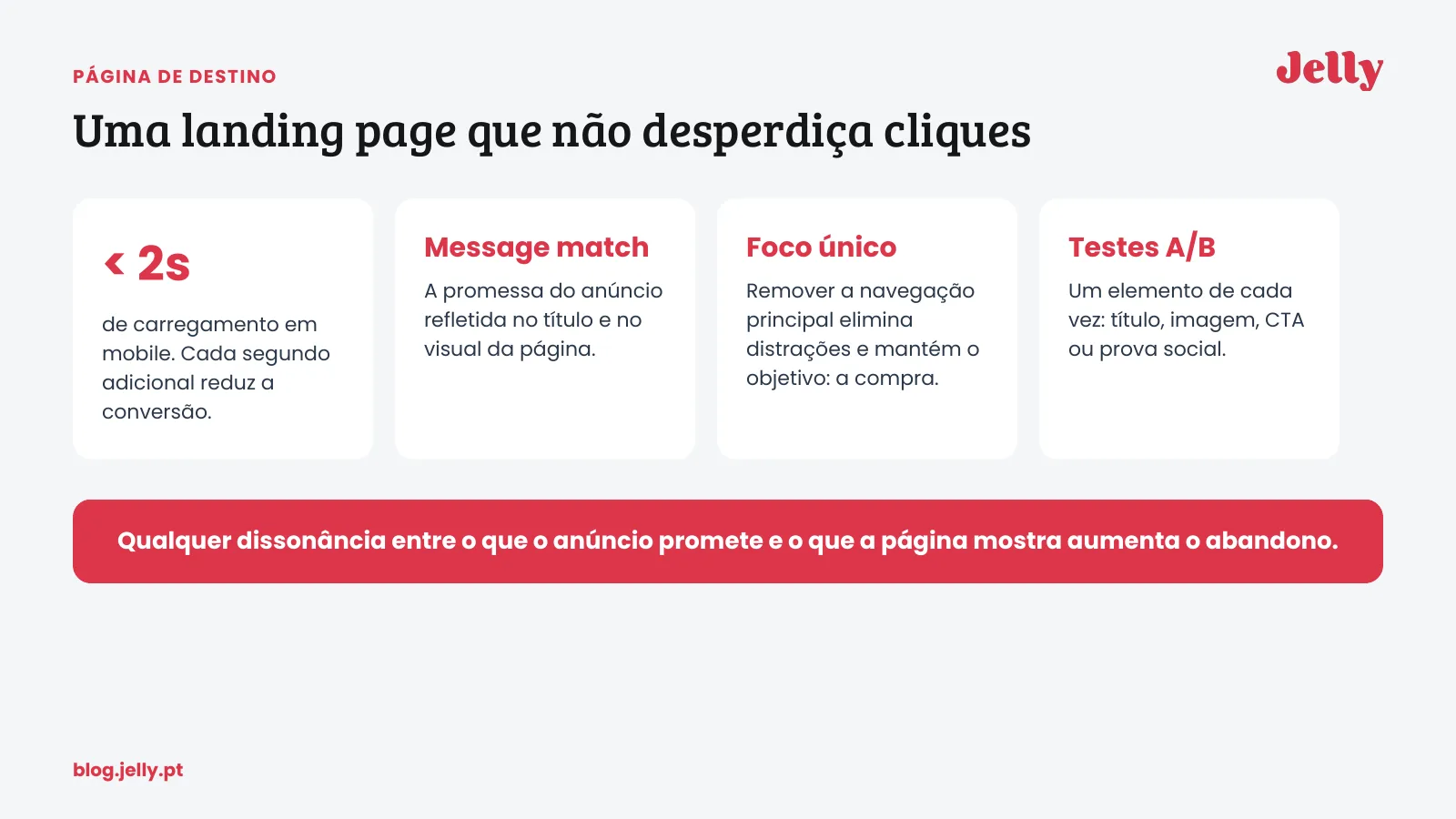
Message match is equally critical: the promise made in the ad has to be reflected immediately on the landing page, in the headline and the main visual. Any mismatch between what the ad promises and what the page shows increases the bounce rate. Removing the main navigation from the campaign page eliminates distractions and keeps the focus on the single objective: the purchase.
A/B testing: better results without increasing spend
Testing one element at a time is the basic rule: headline, main image, CTA or social proof. Testing everything at once makes it impossible to identify what caused the change in results. Before deciding what to test, tools such as heatmaps and session recordings, Hotjar or Microsoft Clarity for example, show where users stall or drop off, making your test hypotheses better grounded.
A 0.5% improvement in conversion rate can have the same financial impact as doubling the campaign budget, making it one of the most underrated levers in e-commerce optimisation.
Case study: from campaigns in the red to €8,400 in revenue in 90 days
A homeware accessories shop with a 120-product catalogue was spending €600 a month split between Google and Meta. The ROAS reported by the platforms was 1.8, but actual sales weren't covering operating costs. The problem was at the foundation: the Purchase event wasn't sending the transaction value, which made the reported ROAS fictitious, and the remarketing audiences were overlapping, causing internal cannibalisation between campaigns.
The work started with tracking. Fixing the Purchase event via Google Tag Manager, along with CAPI integration in Shopify, made the real ROAS visible for the first time. With reliable data, the decisions became clear: Google Shopping segmented by higher-margin categories, Meta focused on dynamic remarketing for cart abandoners, and a 1% lookalike built from the top 200 customers. The budget was redistributed to €350 for Google Shopping and €250 for Meta Remarketing, scaling gradually over 60 days.
Within 90 days, monthly revenue went from €1,200 to €8,400 (case anonymised). Real ROAS settled at 6.2 with a 28% margin, well above the break-even ROAS of 3.6. The deciding factor wasn't the budget: it was the structure. Jelly combined performance management with optimisation of the shopping experience, building a funnel that converts predictably, and scales.
Conclusion: how to use paid traffic to increase my e-commerce sales starts with structure
The pillars in this article form an interdependent system. Platform choice has to follow the buying journey. Minimum ROAS has to be calculated before the first euro is spent. Tracking has to reflect reality. Audiences have to be segmented by intent. And creative has to be aligned with the landing page. When one of these components fails, the others lose their effectiveness.
Using paid ads to increase e-commerce sales isn't a question of spending more, it's a question of structuring every component of the funnel properly, measuring what actually matters and optimising on real data. PPC done well is a multiplier; badly structured, it's a drain.

The next step is to audit the current structure of your campaigns: check whether the Purchase event sends the transaction value, calculate break-even ROAS based on your real margin, and assess whether your audiences are segmented by intent or mixed together with no clear logic. For anyone wanting to speed this up, Jelly analyses the shop's structure, identifies where revenue is being lost and defines the action plan, with no generic diagnostics. To understand what brands need to do to stay relevant in search engines, this is a good place to start.
Get what we write
No fixed calendar: only when there is something worth your time.