Marketing disconnected from the business isn't business. It's buzziness.

Gonçalo Malho Rodrigues Founder & CEO
Paid campaigns, content, data – none of it counts for anything if you don't know what's generating revenue. This is where Business Intelligence changes the game.
The question nobody wants to ask
How much of your marketing spend actually translates into sales? Not clicks. Not impressions. Real sales, with an impact on turnover.
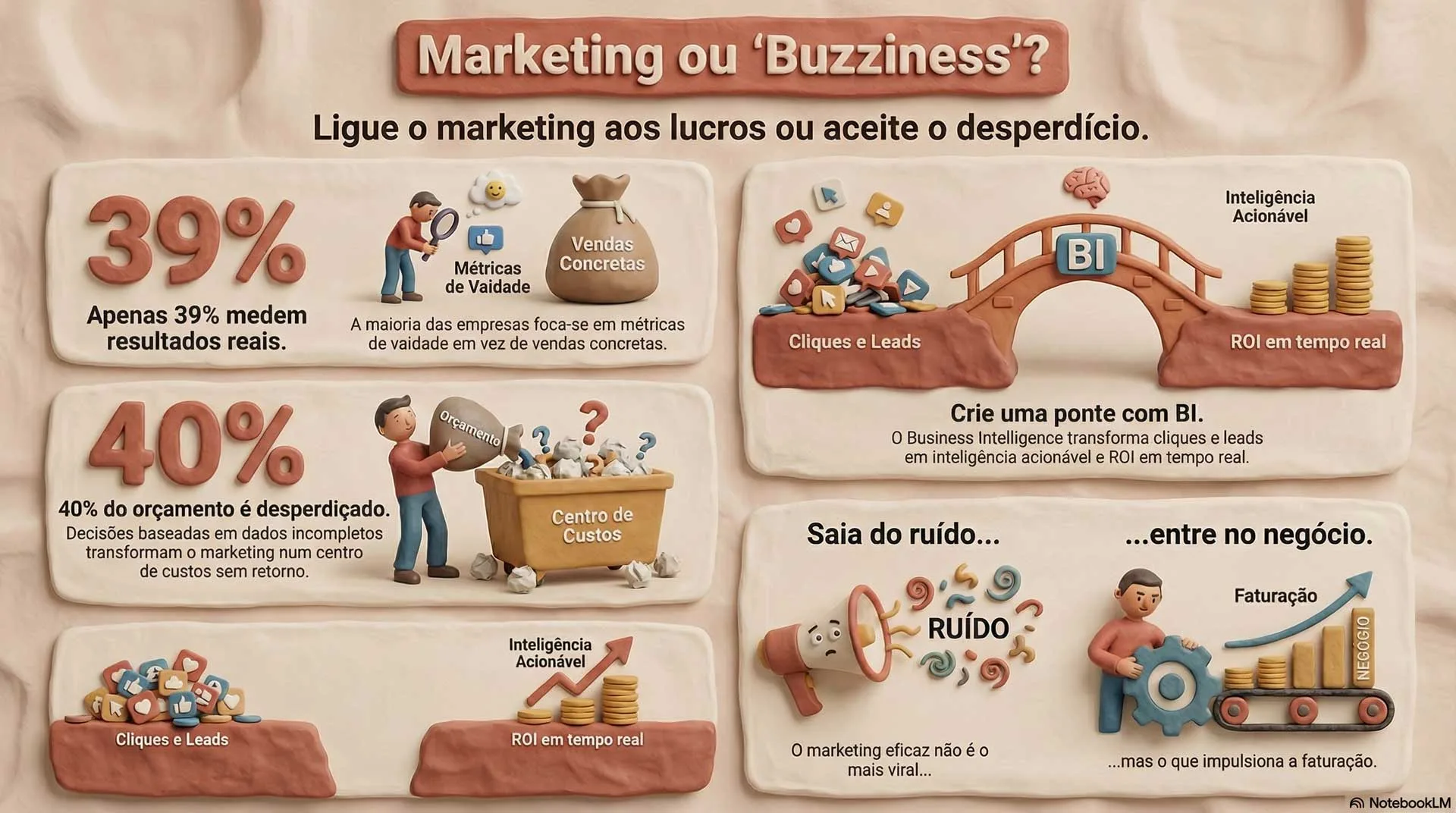
If you can't answer that question with hard numbers, you're not alone. According to Marketing Week's Language of Effectiveness Survey 2025, only 39% of marketers measure whether their work is genuinely delivering business results. Among SMEs, that number is even lower – fewer than 39% assess the real impact of their activity on company performance.
And yet the spending carries on. More campaigns, more content, more tools. But without a clear link between what goes out in marketing and what comes in as revenue, all of it is, essentially, noise.
Marketing that lives in a world of its own
In many Portuguese companies, marketing operates in a silo. There's a team, in-house or an agency, running campaigns, publishing content, analysing platform metrics. And then there's the business: turnover, margins, sales cycles, customer retention.
These two worlds rarely meet.
The marketing report talks about CTR, CPC and reach. The finance report talks about EBITDA, gross margin and acquisition cost. But who bridges the two? Who can turn to the CEO and say: “This euro spent on Google Ads generated three euros in sales”?
In most cases, nobody. And the outcome is predictable: marketing becomes a cost centre with no real accountability. The CEO is sceptical about the spend, but keeps signing off budgets because “we have to be online”. Meanwhile, the marketing team works blind – optimising campaigns for intermediate metrics without knowing whether they're actually moving the needle on the business.
Paid campaigns without intelligence: money down the drain
Google Ads and Meta Ads are data-generating machines. Every campaign produces hundreds of metrics: impressions, clicks, conversions, cost per lead, audiences, peak performance times, devices, locations.
But most companies only ever look at the platform's basic dashboard. Cost per click has come down, cue the celebration. Lead numbers are up, cue more celebration. And when someone asks “but did those leads convert into sales?”, silence falls.
The problem isn't a lack of data – it's the lack of any connection between campaign data and business data. A lead generated by Meta Ads lands in the CRM, but what happens next? Did it close? How long did it take? At what margin? Did they buy again?
Without that integrated view, optimising campaigns is like driving while staring only at the speedometer, with no idea whether you're on the right road. You might be going very fast – in the wrong direction.
And the numbers don't lie: according to recent data, up to 40% of marketing budgets are wasted because decisions are based on incomplete or misread data.
Not for want of investment, but for want of intelligence applied to that investment.
Content marketing: an asset, not an obligation
“We need to post on social media” – how many times have you heard that? For many SMEs, content marketing boils down to exactly that: posting. Blog articles nobody reads, Instagram posts with no strategy, newsletters with no segmentation.
But content marketing, done properly, is a strategic asset. It isn't “making posts”, it's building an ecosystem that creates value at every stage of the funnel. An SEO-optimised blog article attracts qualified traffic. A downloadable guide captures leads. An email sequence nurtures those leads until they're ready to buy. A case study removes objections at the point of decision.
Every piece of content should have a clear, measurable purpose. And that purpose should tie back to a business objective – not a vanity metric.
Content, like paid campaigns, generates valuable data: which topics attract the most traffic, which pages convert best, how long a lead takes to move through the funnel. Data that, when cross-referenced with commercial information, enables decisions that are infinitely smarter than gut feel or past experience.
The missing bridge: Business Intelligence (BI)
If marketing generates data and the business needs intelligence to make decisions, what's missing? The bridge. And that bridge is called Business Intelligence.
BI isn't just good-looking dashboards, it's the ability to turn scattered data (from campaigns, CRM, sales, operations) into structured information that lets you make decisions with confidence.
Imagine having the answers to these questions on a single screen:
Which campaign is generating leads that actually convert into customers? What's the real acquisition cost per channel, across the full sales cycle? Which type of content attracts the customers with the highest lifetime value? Where's the breaking point in the funnel, where are we losing opportunities? What's the real return on marketing investment, month by month, channel by channel?
This isn't fiction. It's what BI delivers when it's implemented rigorously: real-time ROI analysis, trend forecasting, continuous optimisation of spend based on data — not assumptions.
Maturity in this area develops in stages. It starts with descriptive analysis – what happened. It moves on to diagnostics, why. Then to predictive analysis – what's going to happen. And at the most advanced level, it reaches prescriptive analysis – what we should do. Each stage adds a layer of intelligence that transforms how the business makes decisions.
This is precisely the logic behind bringing complementary skills together. At Jelly, we generate data through performance campaigns, strategic content, automation and CRM. But turning that data into actionable intelligence calls for a different level of analytical expertise. That's why we work with partners like IMBS, an operational consultancy with a proven track record in implementing Business Intelligence solutions with Power BI. IMBS works with brands such as Grupo Brodheim, Delta Cafés, Riopele and Hoti Hotéis, developing commercial, operational and marketing dashboards that turn huge volumes of data into concrete decisions. At Grupo Brodheim, for instance, IMBS delivered the first structured consumer analysis in the group's history, integrating marketing data into a real business context.
The methodology follows an Agile Sprint approach, from initial diagnosis to data architecture, through to building the analytics solution and implementing it, which means visible results in short cycles. It's this kind of partnership, where the people generating the data and the people turning it into intelligence work side by side, that allows companies to break out of the cycle of spending without knowing and move into the cycle of investing with certainty.
The marketing that counts is the marketing you can account for
We live in an era with no shortage of tools, platforms, channels or data. What's in short supply, in many companies, is the nerve to join the dots and demand that marketing prove its worth, not with platform metrics, but with real business impact.
Marketing that works isn't the most creative, the most viral or the most visible. It's the marketing that's connected – connected to business objectives, connected to reliable data, connected to decisions that shift turnover. If your marketing can't answer the question “what did this earn us?”, it isn't marketing. It's noise. And noise, however loud, doesn't grow a company. The real question isn't whether you're doing enough marketing. It's whether the marketing you're doing is working for the business or just for itself.

Get what we write
No fixed calendar: only when there is something worth your time.
Gonçalo Malho Rodrigues
Fundador & CEO
Fundou a Jelly – Digital Agency em Portugal em 2010 e a Strivesync – AI-Native Systems no Dubai em 2026. Detém outras empresas, noutros setores, como a Stronddo – Online Art Galleryl, a Scallent – Human Talent. Gonçalo, criou a The Change Framework, que apoia líderes a gerar a mudança através da mobilização de equipas em torno de uma causa.