B2B marketing in practice: generating leads and closing contracts

Gonçalo Malho Rodrigues (Founder & CEO)
In B2C, a good campaign can generate sales within hours. In B2B marketing, the average sales cycle runs to around 84 days and involves between 5 and 10 decision-makers per deal — figures that change everything about how you plan, communicate and convert.
Gonçalo Malho Rodrigues (Founder & CEO)
In B2C, a good campaign can generate sales within hours. In B2B marketing, the average sales cycle runs to around 84 days and involves between 5 and 10 decision-makers per deal — figures that change everything about how you plan, communicate and convert.
In B2C, the decision is individual and largely emotional. In B2B, it is collective, rational and driven by return: finance, IT, procurement and operations jointly assess the risk and impact of every choice. This shared approval process profoundly changes the type of content and communication a brand needs to produce.
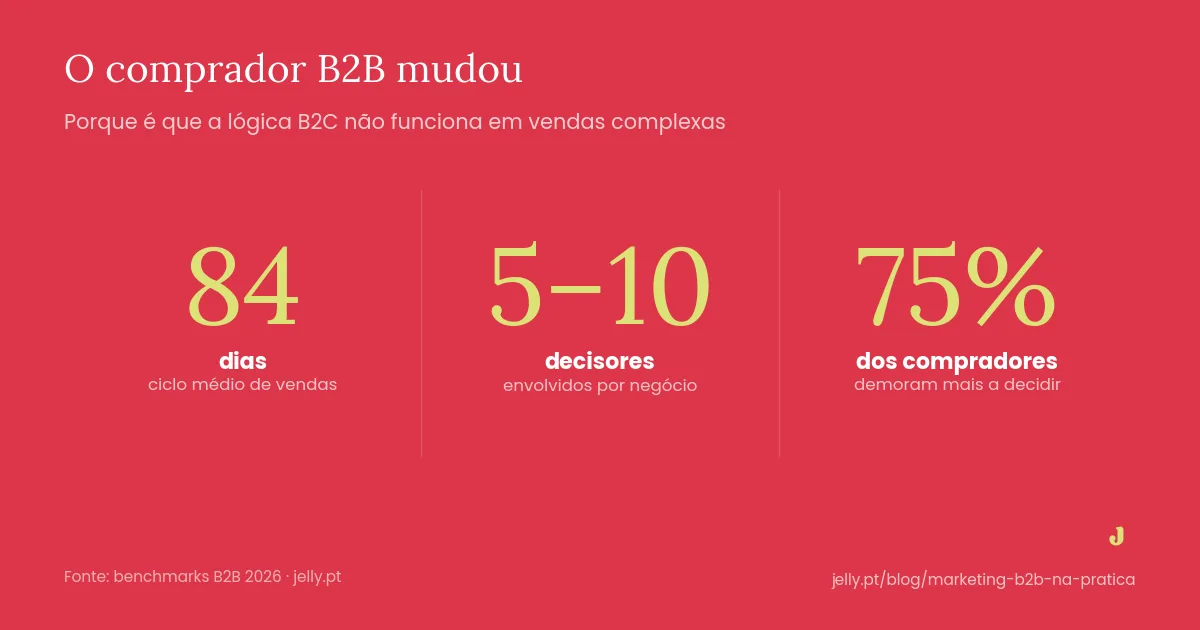
With an average cycle of 84 days, the journey calls for layered messaging, from awareness through to technical proof. According to 2026 benchmarks, 75 % of B2B buyers are taking longer to make decisions, which makes lead nurturing mandatory rather than optional. Without a consistent flow of communication, the opportunity goes cold before it ever reaches proposal stage.
The role of trust and brand authority
In B2B, the brand reduces the perceived risk for whoever signs off on the purchase, and that factor is often underestimated. Technical content, case studies and social proof act as silent salespeople during the evaluation phase, reinforcing credibility without requiring direct interaction from the sales team. Brand equity is built through presence and consistency over time, not through one-off campaigns.
B2B marketing channels with the best return for lead generation
1. LinkedIn and social selling before any pitch
LinkedIn leads on B2B organic reach, performing around 34 % better than other social channels in this segment. B2B social selling is not about publishing generic content; it is about building credibility with the right profiles and only then starting a sales conversation. In practice, optimised founder and director profiles generate more pipeline than company pages do. For a broader overview of the channels, see also the article Digital media and the B2B segment.
2. SEO and inbound that work 24/7
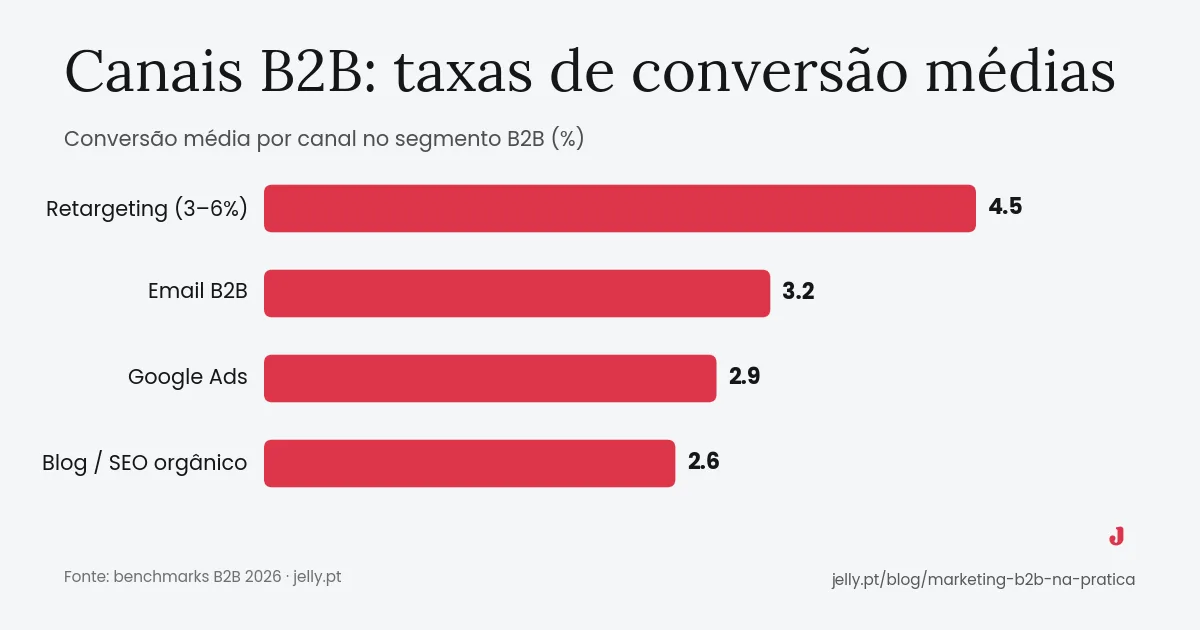
Active corporate blogs convert an average of 2.6 % of organic traffic. The key is structuring content across the three stages of the journey — TOFU to educate, MOFU to compare and BOFU to prove — capturing and qualifying demand that already exists before any sales contact.
3. One-to-few ABM with intent data
For strategic accounts, combining SEO with account-based marketing and intent data has delivered striking results. Programmes with integrated intent data cut the sales cycle by around 17 days on average, by focusing on 50 to 100 accounts with personalised messaging and coordinated actions across multiple channels.
4. Remarketing and capturing existing demand
Directing budget towards high-intent keywords and retargeting campaigns is one of the most efficient ways to monetise traffic you have already generated. Google Ads converts at an average of 2.86 % in this segment, and retargeting tends to perform between 3 % and 6 %, keeping the solution on the decision-maker's radar right up to the moment of choice.
Lead nurturing and automation in B2B marketing: how to shorten the sales cycle
5. A single CRM and AI-powered lead scoring
Without a CRM, predictability disappears: the pipeline ends up scattered across spreadsheets and in the team's heads, which makes any revenue forecast unreliable. According to 2026 benchmarks, 78 % of sales teams already use a CRM with AI scoring, and AI-assisted SDRs recorded CPL reductions of around 38 %. The choice of platform depends on the team's maturity: HubSpot suits SMEs well, Salesforce serves enterprise contexts, and ActiveCampaign is a solid option for smaller teams. For a practical view of B2B CRM, consult guides that help you choose the right tool. At JELLY, we support end-to-end integration in line with each client's stack and processes.
6. Personalised email sequences
B2B email converts at an average of 3.2 %, and personalisation increases engagement by up to 76 % compared with generic messages. An effective sequence combines educational content, a case study relevant to the sector, social proof and a clear invitation to talk — all spaced to match the natural rhythm of the buying cycle. Find out more about lead nurturing practices and how to structure sequences that work. At JELLY, we combine segmented content with automation to keep leads active without relying on constant manual prospecting.
7. Landing pages with social proof and a clear next step
Case studies, testimonials, client logos and direct comparisons all build confidence at the moment the decision-maker is assessing the solution. Always close the page with a low-friction CTA — booking an assessment in two clicks, for example — to reduce friction at the point of conversion.
8. Sales enablement for the commercial team
Segment-specific one-pagers, ROI calculators and battlecards turn recurring objections into structured arguments. When content is designed to help sell, it helps shorten negotiation time and improve the SQL-to-client conversion rate — an impact felt directly in the closing cycle.
9. Webinars and workshops for your ICP
Practical titles and live demos speed up trust-building with your ideal customer profile. Record the events, repurpose the content for inbound and trigger automatic follow-ups to convert attendees into booked meetings.
The right metrics and a 90-day B2B marketing plan
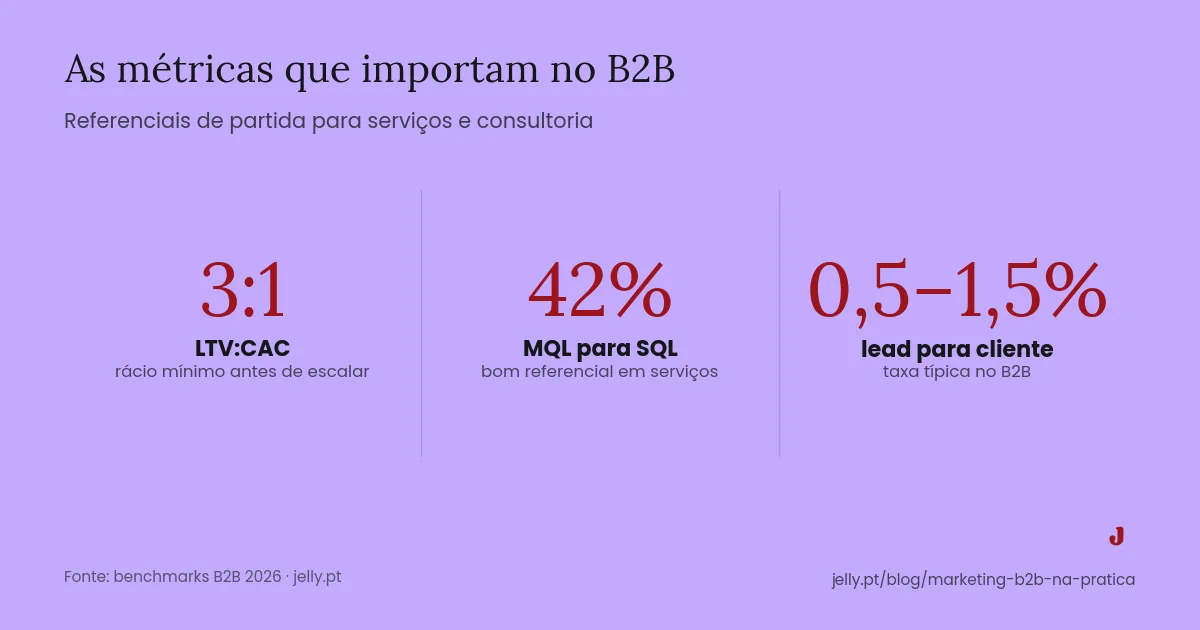
Avoid measuring "leads generated" alone. Track the MQL → SQL rate as an indicator of generation quality, average CAC (in B2B contexts, 2026 benchmarks frequently place it above $700 in services and technology), an LTV:CAC ratio above 3:1 and a lead-to-client rate of between 0.5 % and 1.5 %. In services and consultancy, an MQL → SQL rate of 42 % is a good starting benchmark.
Reading these metrics in the context of your own go-to-market is what separates informed decisions from blind adjustments. An LTV:CAC of 3:1 means that for every euro invested in acquisition, the company recovers three over the course of the commercial relationship. Below that ratio, it is worth reviewing channels, messaging and qualification criteria before scaling.
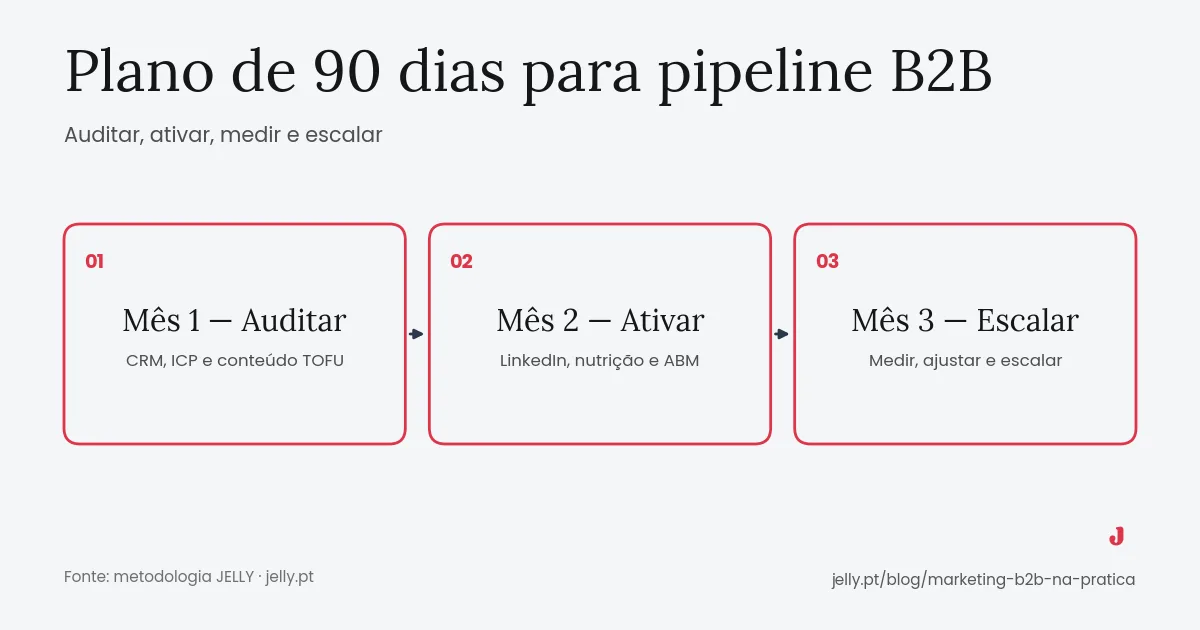
- Month 1: Channel audit, CRM and tracking set-up or review, ICP definition, and publication of two SEO-optimised TOFU pieces.
- Month 2: Activate LinkedIn on personal profiles and the company page, launch the first nurturing sequence, and build an initial list of 50 to 100 accounts for one-to-few ABM.
- Month 3: Analyse the MQL → SQL rate, adjust messaging based on sales feedback, activate remarketing, and scale the best-performing channels.
This plan works as a starting point. Timings and priorities should be adjusted to each company's commercial reality, but the sequence — audit, activate, measure and scale — holds true in most B2B contexts.
Conclusion
B2B marketing rewards those who play the long game: content that builds trust, automation that keeps the relationship alive, and processes that remove friction between marketing and sales. Combining SEO, social selling and automation shortens cycles, reduces CAC and increases close rates, with more predictable results over time.
If you want an integrated, executable plan, JELLY, Digital Marketing Agency brings together branding, content and technology to turn intent into real pipeline. Talk to us and design a B2B strategy that starts generating and qualifying leads within the next 90 days. Take a look, too, at our Digital Strategy and Sales Growth solution by Informa D&B.

Get what we write
No fixed calendar: only when there is something worth your time.

Gonçalo Malho Rodrigues
Fundador & CEO
Fundou a Jelly – Digital Agency em Portugal em 2010 e a Strivesync – AI-Native Systems no Dubai em 2026. Detém outras empresas, noutros setores, como a Stronddo – Online Art Galleryl, a Scallent – Human Talent. Gonçalo, criou a The Change Framework, que apoia líderes a gerar a mudança através da mobilização de equipas em torno de uma causa.