Antipersonas in UX
Gabriela Polidoro Lima UX Designer & Content Writer If you already work in tech, or you're familiar with the terms designers and other professionals in the field use, you've probably heard or read about “personas”. In this article we'll look at antipersonas, but before we get into what they are, it's worth clarifying what “personas” are, because the two terms are connected. In a market as competitive as today's, where knowing your audience better matters more and more, having both terms clearly defined during the User Experience Human-Centered Design process is essential.
Gabriela Polidoro Lima UX Designer & Content Writer If you already work in tech, or you're familiar with the terms designers and other professionals in the field use, you've probably heard or read about “personas”. In this article we'll look at antipersonas, but before we get into what they are, it's worth clarifying what “personas” are, because the two terms are connected. In a market as competitive as today's, where knowing your audience better matters more and more, having both terms clearly defined during the User Experience Human-Centered Design process is essential. What are Personas?
Personas are profiles of people who represent your users and who drive your product or service. Creating these profiles adds empathy and humanises (puts a face to) the people who will be using or consuming your product. It's a painstaking and highly strategic piece of work that should be done while a new product or service is being created. In the words of designer and programmer Alan Cooper: “Personas provide us with a precise way of thinking and communicating about how users behave, how they think, what they wish to accomplish, and why. They are composite archetypes based on behavioural data gathered from the many actual users encountered in ethnographic interviews.”
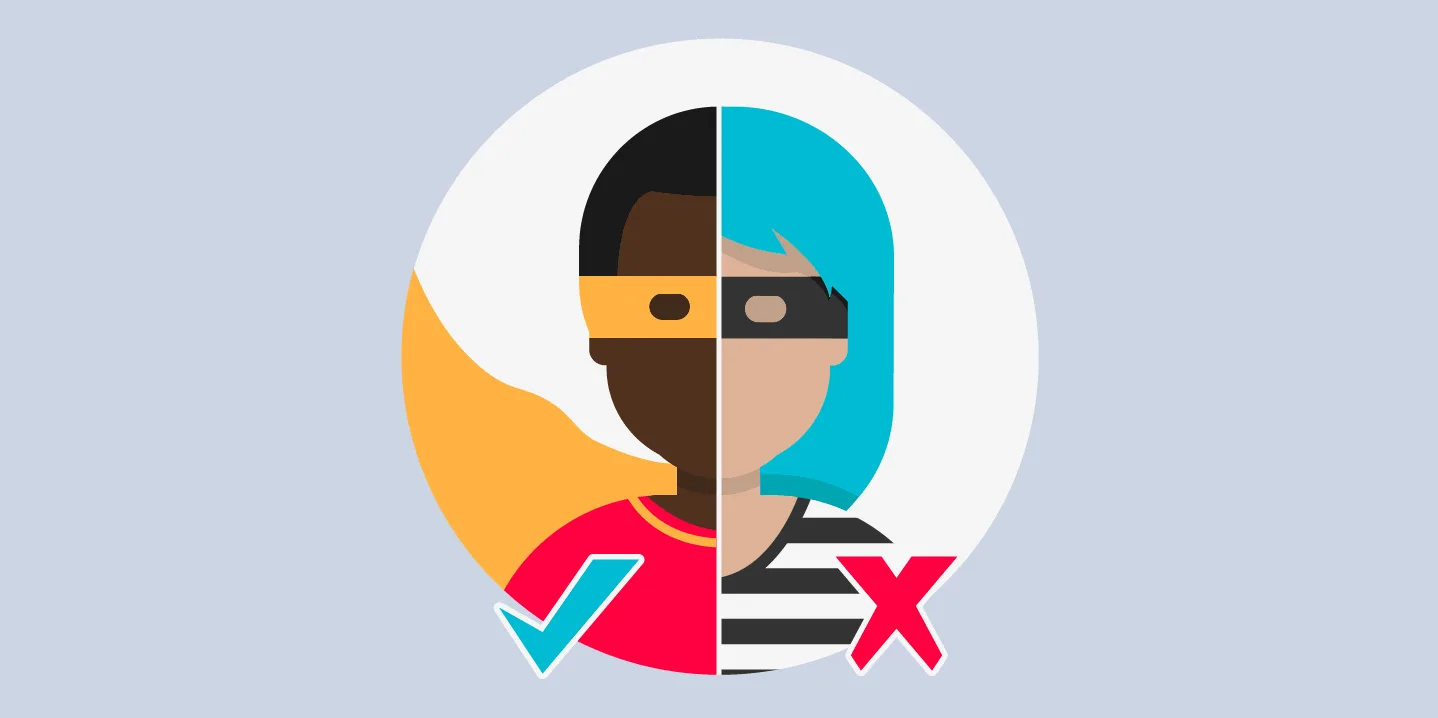
When it comes to antipersonas, you can probably already guess they deal with the less positive side of using a product. Usually, when a Design Thinking flow is mapped out, what gets created is the happy path — the journey almost 100% of people are expected to follow when they use the product. But to design that interface more effectively, you need to think about every detail, including the risks of a journey that isn't so positive. That's where the antipersona comes in.
Understanding how it works within the process, and asking whether creating this kind of profile is necessary for what you're building, can minimise or even prevent misuse of the product.
What are Antipersonas?
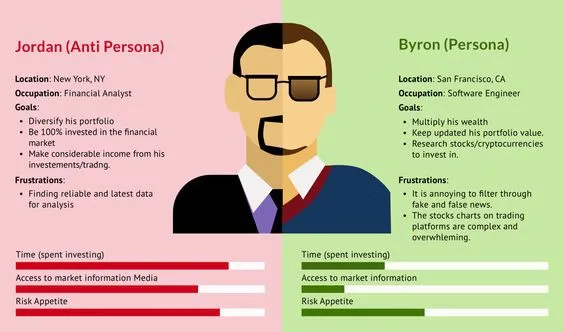
Antipersonas represent a group of users who may misuse the product in ways that negatively affect your target audience and your business. Studying these profiles gives you an understanding of the risks the design team needs to avoid, or at least mitigate, clearing the way for a positive experience for the users you actually want to reach.
To better understand how this tool is applied, consider the following scenarios:
The safety scenario
Companies and designers who develop products have a responsibility to make those products as safe as possible, without stopping them from doing their job for users. But in certain situations, a product used improperly can be harmful to your health — for example, products made for adults being consumed by children. Medicine manufacturers, knowing that some tablets can look like sweets, need to create packaging that stops children easily getting hold of them. In this situation, the child antipersona is prevented from accessing the product, so it still fulfils its purpose of delivering medication to adults only.
The security scenario
This scenario matters especially when you're handling confidential data. If your service collects customer information — contact details, addresses or preferences — criminals may try to obtain it for other purposes. For example, companies that build social networks have to do everything they can to limit unauthorised access; after all, more and more personal information is being shared, leaving people vulnerable to data breaches and even to threats to their safety.
The unintended customer scenario
This scenario may seem less dangerous, but it should be taken into account because it can create dissatisfaction among the audience you're trying to reach, through the spread of negative reviews. Here, someone buys a product or service when that solution isn't right for them — for instance, someone who buys running shoes when what they actually need is something for playing sport, or a luxury service marketed to customers looking for affordable prices. To prevent this scenario, and the frustration of a user consuming a product that isn't right for them, your communication needs to be clear and honest. Creating an FAQ section is a good way to attract users with potential and put off those who aren't a good fit.
When does it make sense to create an Antipersona?
If developing these profiles helps you anticipate and reduce threats to safety, security, trust and loyalty — and even to the retention of your regular users — then creating an antipersona makes sense whenever your product or service could pose some kind of threat, whether physical, emotional or moral, as a direct result of misuse. Fraud, identity theft, harassment or illegal content can all be consequences of confidential information being improperly exposed, and they can harm users or the organisation itself. When it comes to physical threats, injuries or even death can be prevented by creating antipersonas.
If there's any chance at all of such harm occurring, however small, it's very important to weigh up the likelihood of misuse against its consequences to decide whether creating an antipersona is worthwhile. Even if the odds are very low, if the consequences are extreme, an antipersona should be created to represent that specific risk.
In the digital sphere, these concerns can also show up as aggressive social media posts and negative reviews. Failing to anticipate this leaves the door open for public posts to put off the very people you're trying to reach. Customer reviews are therefore often a good place to spot antipersonas. Negative feedback from people who tried to use your product can reveal why it may not be right for them.
Creating Antipersonas
Working from the persona research, designers and researchers are responsible for creating the antipersonas, and they should involve partners and other stakeholders in the process to increase the chances of buy-in and adoption.
An easy way to start is to first identify the critical, highest-consequence threats and then adapt them to your product's context.
Some common threats to use as a starting point:
- The thief
There are two common types of theft to anticipate: information theft — which applies to any product handling confidential information — and physical theft, which applies to any product that can be physically stolen;
- The creator or sharer of illegal content or disinformation
If your product lets people communicate freely, you may see the emergence of people spreading disinformation, as well as all kinds of illegal content such as hate speech, child sexual abuse material (CSAM) and content showing or promoting extreme violence, all of which can also seriously damage the experience of your target user.
- The child
Ask yourself whether misuse of your product could harm a child physically (think products with chemical ingredients, or knives) or emotionally (for example, sexually explicit and violent content).
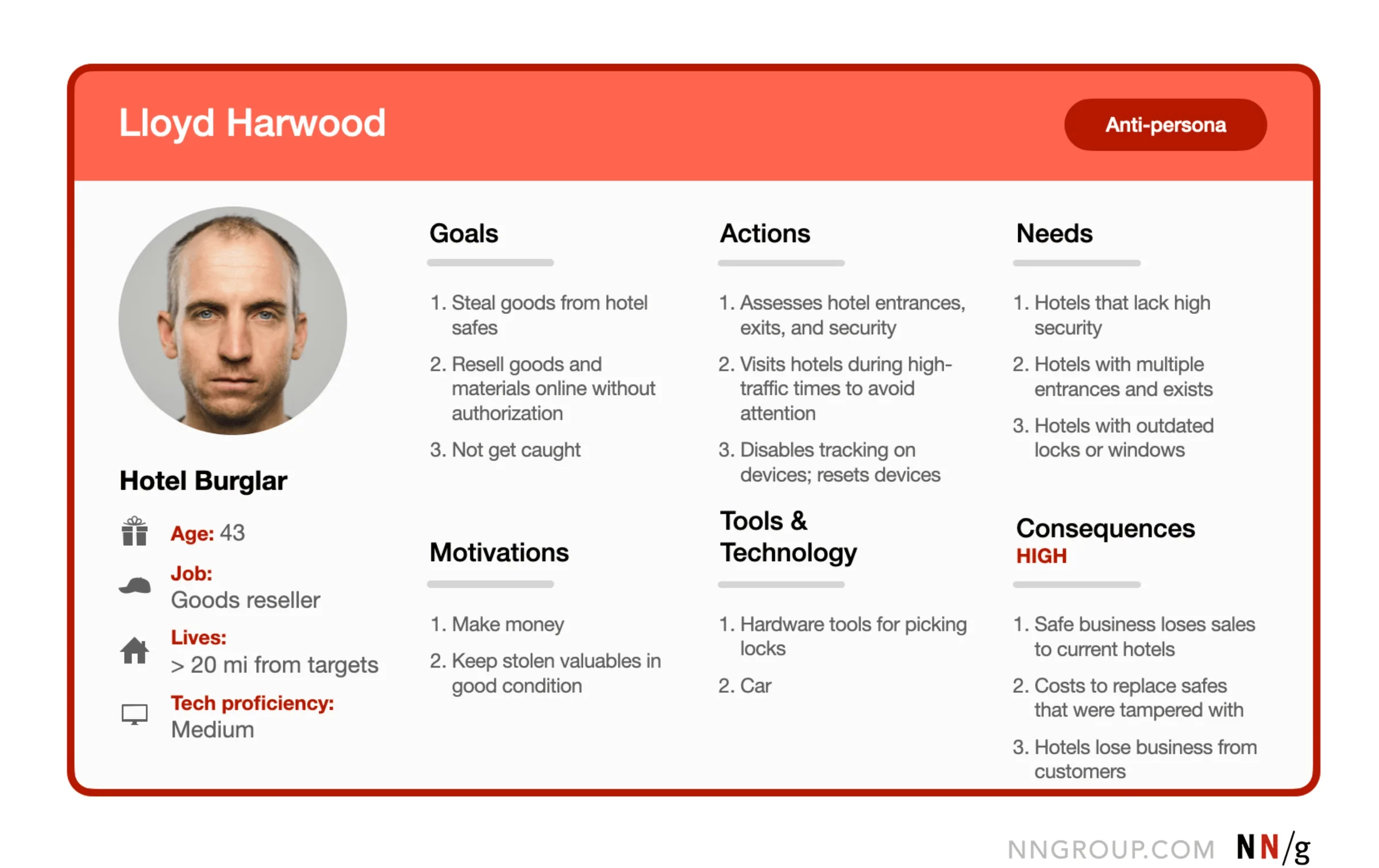
The second step is to describe the 8 essential aspects that structure each profile and will help the design team mitigate the possible risks:
1 and 2. Name and face: giving the threat a name and a face humanises it and helps everyone keep this persona in mind throughout the creation process;
3. Goals: define the threat itself, what it wants and how it could damage the product's usability;
4. Motivations: what drives it to achieve its goal;
5. Actions: describe the steps it will take in order to achieve its goal. This point is important for understanding where to intervene so it doesn't get what it wants;
6. Tools: what the antipersona uses to achieve its goal. These may be tools, skills or technologies;
7. Needs: what it needs in order to reach the end goal — in other words, which protective measures aren't being considered or anticipated that could allow it to get all the way there;
8. Consequences: finally, it's important to map and describe in detail what the consequences would be if it did achieve its goal. From the likely to the most unlikely.
Once you're done, you can create a kind of board or visual overview (like the example below) with all the information, name and image, and share it with the whole team. That way everyone can refer to it whenever they need to during the design process, making sure everyone is aware of the risks and increasing the chances that they can take the decisions needed to prevent, mitigate or even stop those risks from materialising.
How do you validate your antipersona?
Wherever possible, you should carry out research with people similar to the antipersonas you've defined, because the true likelihood of misuse and its consequences probably won't be fully uncovered without real research.
Even if you don't have access to the people your antipersonas represent, you can consult experts on those behaviours — for example, lawyers or social workers who may have access to criminals; or mothers, when it comes to child antipersonas. Another example, in the security scenario, would be gathering data from a professional hacker who is paid to find vulnerabilities in websites, given how hard it would be to interview a real hacker acting criminally. In short, it's always important to validate your information with people who resemble the profile, or someone close to it.
Other benefits
To wrap up, here are some other benefits that creating antipersonas offers:
Faster customer service
Antipersonas may be customers who are less likely to use your product, but that doesn't mean they won't interact with the brand. So once you've identified them, you can create specific content for them that points them towards what they're actually looking for.
A sharper approach
Knowing where antipersonas spend most of their time helps you focus your communication on the channels that best match their behaviour, and be more effective as a result.
Avoiding complaints
In the “unintended customer” scenario, if someone is using a product that wasn't made for them, it can easily become a bad experience that leads to complaints on social media, spreading a message that isn't necessarily true for everyone.
Reducing risk
Identifying potential usability flaws and gaps in the experience allows you to distribute your design effort better and avoid journeys that are prone to errors.
In conclusion, establishing antipersona profiles can be just as important as creating personas, and ignoring this can have serious consequences for the user and for the brand. Reviewing the profiles regularly and designing with their needs in mind are important practices for keeping your product or service clear of risk and misuse.

Get what we write
No fixed calendar: only when there is something worth your time.