Artificial Intelligence in the job market: a risk or a revolution?
Jelly – Digital Agency
Artificial intelligence is rapidly transforming tasks, skills and ways of working. Faced with this accelerated change, one question arises: is it a threat to human employment or an opportunity to evolve?
As artificial intelligence redefines tasks and skills, the future of human work reaches a crossroads: replacement or evolution? The growing integration of artificial intelligence (AI) across different sectors of the economy has sparked an intense debate: is it a risk to human employment, or a revolution that could reshape working dynamics for the better?
This article examines that duality, drawing on scientific studies and specialist reports, and aims to offer a balanced view of the potential and the challenges of this transition.
The current picture: between automation and transformation
The advance of AI and practical examples
At first glance it seems obvious: if a brand reacts quickly to a trend, it will automatically get more engagement. But AI has been applied to repetitive tasks, to processing large volumes of data and to decision support in sectors such as healthcare, finance and marketing.
In manufacturing, its uses range from internal logistics to predictive maintenance and process control. Systematic studies do stress, however, that despite the efficiency gains, social and environmental risks persist, as do cybersecurity challenges (Nelson, Biddle & Shapira, 2023, arXiv).
Occupations exposed to risk or to complementarity
Not all occupations face the same risk of being replaced. The Policy Paper by the Fundação Francisco Manuel dos Santos (2025) sorts occupations into four groups: “collapsing occupations” (28.9%), “rising occupations” (22.5%), “human territory” (35.7%) and “machine territory” (12.9%) (FFMS, 2025).
Internationally, Ozgul et al. (2024) show that even highly skilled workers in non-routine tasks face automation risk, although the impact on pay varies from occupation to occupation (Ozgul et al., 2024, arXiv). Xu, He & Du (2022), meanwhile, propose a neural network-based model to identify the occupations most likely to be automated, reinforcing earlier estimates that put almost 50% of jobs at risk (Xu et al., 2022, arXiv).
The risk perspective
Job destruction and structural unemployment
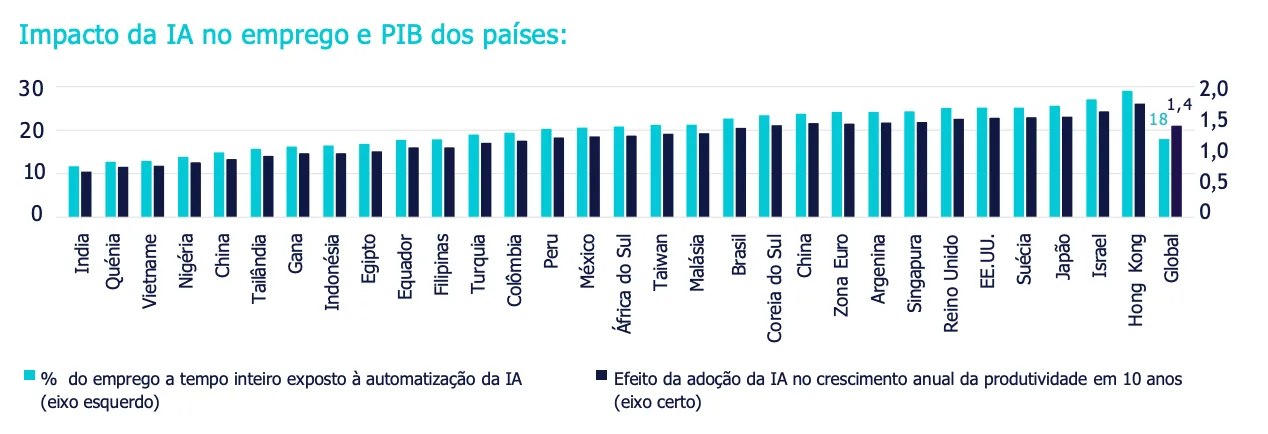
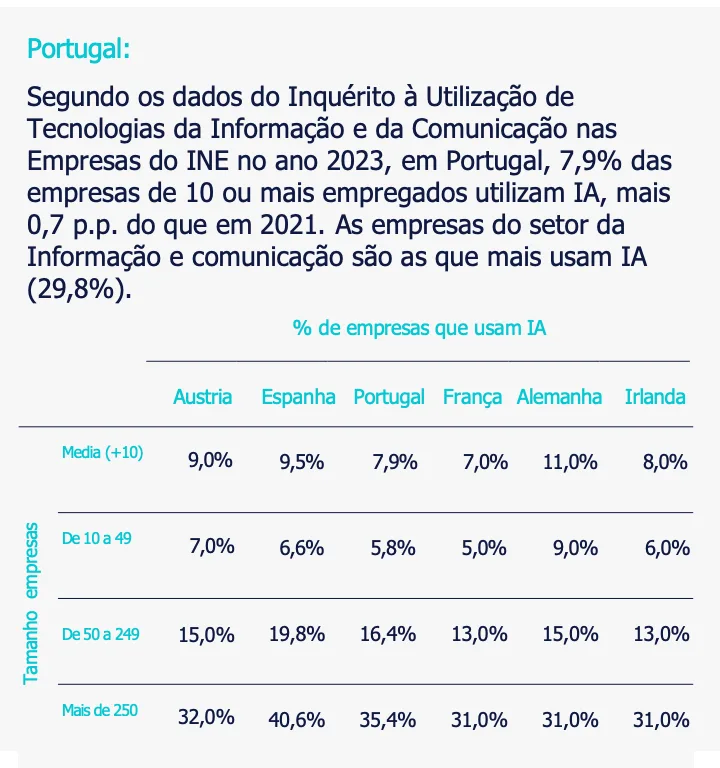
Globally, the Future of Jobs 2023 report (data cited by Randstad Research) projects that 23% of jobs will be affected by AI over the next five years, with 69 million roles created and 83 million eliminated, leaving a net loss of 14 million jobs (Randstad Research, 2023). These figures reflect the global trend, but the impact varies from country to country. In Portugal, the same report shows that only 7.9% of companies with more than 10 employees were using AI in 2023, suggesting the effects may be more gradual in the short term. Even so, the FFMS study (2025) points out that almost 30% of national employment is concentrated in highly vulnerable occupations.
Rising inequality and wage polarisation
Automation tends to favour highly specialised occupations, but it can weaken lower-skilled ones. Ozgul et al. (2024) show that the relationship between automation and pay is not linear: some routine occupations may see wages rise, while analytical tasks may lose value (Ozgul et al., 2024).
The Estado da Nação 2024 report by the Fundação José Neves adds a gender dimension: 52% of jobs held by women are at high risk of automation>, compared with 42% among men, suggesting that the technological transition could deepen inequalities (Fundação José Neves, 2024). Issues such as algorithmic transparency, accountability for automated decisions and algorithmic discrimination call for solid regulation. Without coordinated action between governments, businesses and educational institutions, the technological transition could deepen structural inequalities that already exist. RHmagazine (2023) stresses that the European AI Act will be decisive in defining employment and corporate responsibilities (RHmagazine, 2023).
The revolutionary perspective
New fields and hybrid jobs
According to the FFMS (2025), 22.5% of jobs in Portugal already fall into “rising” occupations, well placed to benefit from the integration of AI. New fields include algorithmic ethics, oversight of intelligent systems and the development of responsible AI solutions (FFMS, 2025). But there is another side to this: opportunity. The same technology that automates can also create new roles and emerging markets.
Higher productivity and value creation
Adopting AI may not only replace tasks but also multiply productivity and create additional economic value. Nelson, Biddle & Shapira (2023) point out that the biggest gains come when AI complements human work rather than replacing it (Nelson et al., 2023, arXiv).
Strengthening human skills
The Pessoas2030 report (2025) recommends investing in skills such as digital literacy, critical thinking and continuous learning, all essential to prevent workers from being left out of the digital transition (Pessoas2030, 2025). These skills do not compete with AI, they complement it, reinforcing the human dimension that no machine can replace.
Between risk and revolution
The truth is that AI in the job market is not simply a risk, nor simply a revolution: it is an ambivalent process. On the one hand, reports such as Future of Jobs 2023 warn of real losses worldwide; on the other, national programmes such as Pessoas2030 point to concrete ways of turning the technology into a driver of inclusion.
The outcome will depend on policy choices, on regulation and, above all, on how well workers and companies adapt. Portugal has one advantage: it is at an early stage of adoption, which allows it to prepare a fairer, more strategic transition – a revolution in which the human and the technological coexist.
“The AI revolution will not replace human work – it will transform what it means to work.”
Get what we write
No fixed calendar: only when there is something worth your time.