Campaigns targeted by experiences and behaviours are more effective
Pauliny Zito – Planner, copywriter and copy editor –
Did you know that targeting by life experiences and behaviours (rather than age) makes campaigns up to 4 times more effective?
According to the Kantar IBOPE Media study — Beyond Age 2022, which surveyed more than 24,000 consumers, no age bracket is a homogeneous group. Nor does age reflect behaviour.
Data such as gender, age and education level are still valid, but they don't reflect people's life circumstances and the shifts in consumer behaviour that come with them.
That's why campaign targeting needs to be adjusted to take consumers' habits, attitudes and behaviours into account.

But how do you do that?
Pauliny Zito – Planner, copywriter and copy editor –
Did you know that targeting by life experiences and behaviours (rather than age) makes campaigns up to 4 times more effective?
According to the Kantar IBOPE Media study — Beyond Age 2022, which surveyed more than 24,000 consumers, no age bracket is a homogeneous group. Nor does age reflect behaviour.
Data such as gender, age and education level are still valid, but they don't reflect people's life circumstances and the shifts in consumer behaviour that come with them.
That's why campaign targeting needs to be adjusted to take consumers' habits, attitudes and behaviours into account.
But how do you do that? Source: Freepik “Analyses with age-based targets such as ‘Generation X’ or ‘Millennials’ – are usually sweeping, and they dig into generational groups that are often poorly understood. They often become shortcuts for segmenting millions of consumers, which can lead to one-dimensional and sometimes short-sighted analyses (think of Millennials who love a latte or Boomers who own plenty of property, for example).” – Eduardo Alves, Head of Go-To-Market and Field Marketing, Kantar IBOPE Media
Highlights from the Kantar IBOPE Media study
Getting people aged 65 to 75 online
In Brazil, there has been striking growth in the number of people aged 65 to 75 going online. Between 2015 and 2022, on Instagram alone, this group grew by 4,937%. On YouTube, growth reached 886% over the same period.
On Facebook, for every additional user aged 12 to 19, there are 7.4 additional users over 65. On WhatsApp, it's 8.5 older users for every young one. On YouTube the ratio is 9.1 to one. And on Instagram, 21.7 to one.
Everyday attitudes
The “Arc of Life” analysis highlights the events people have experienced and those most likely to happen within a 12-month period for particular generations.
In Brazil, changing jobs is more common in the 20 to 24 and 25 to 34 age brackets, while buying a property is more likely among those aged 35 to 44 and 45 to 54.
E-commerce
Data from Target Group Index Brazil shows that, although a good share of purchases are normally made offline, almost 45% of Millennials and almost 40% of Generation Z who buy home appliances and electronics do so online – compared with just 21% of Baby Boomers.
Nappy buyers
Data from Target Group Index Europe shows that, while adults aged 25 to 44 have the strongest affinity with ‘nappy buyers’, only 12% of that age bracket actually buy nappies, and 30% of ‘nappy buyers’ are not aged 25 to 44.
The online population across 35 major global markets
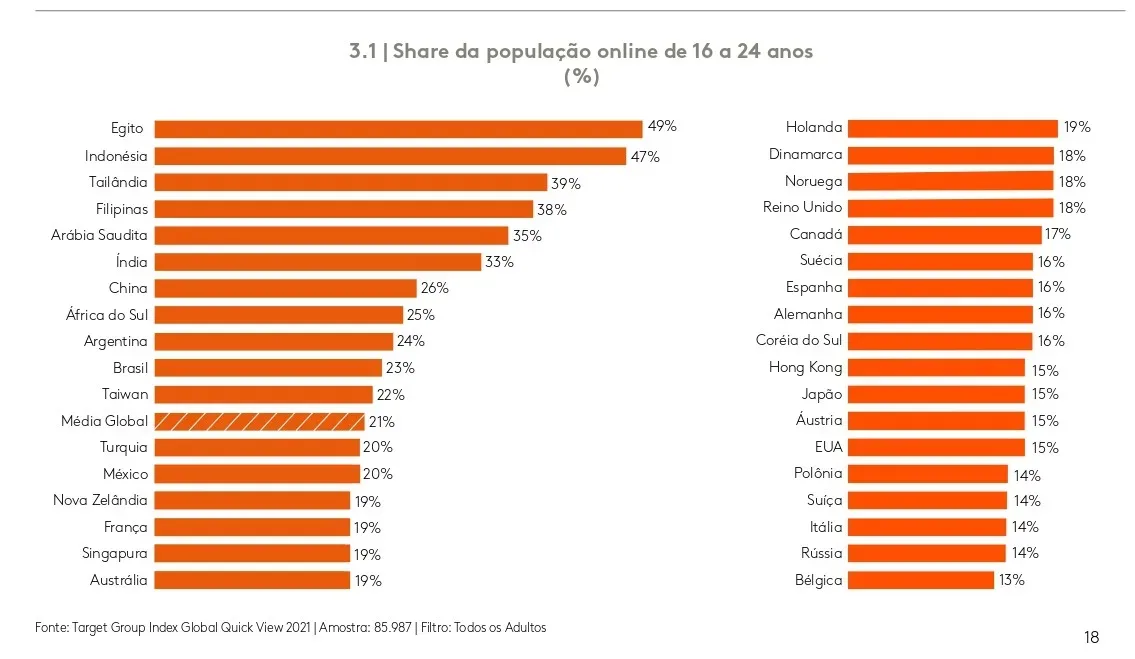
Data from Target Group Index Global highlights big differences in the make-up of online populations across 35 major global markets.
For example, in Egypt, 49% of weekly internet users are aged 16 to 24, compared with 26% in China, 23% in Brazil, 19% in France and just 16% in Spain and Germany, 15% in the US and 14% in Italy. The global average is 21%.
Age as a good measure of differences in attitude
The study concluded that, in both Brazil and the global market, age is a good differentiator of opinions and attitudes when it comes to:
- People become more risk-averse over time.
- People place more value on the latest trends and on their careers when they are younger.
Differences between countries within the same age bracket
In the 16 to 24 age bracket, there is a big cultural difference in the appetite for risk.
Africa tops the ranking, with young people agreeing with the statement “I like to take risks”, while Japan comes last, as young people in that same age bracket disagree with it.
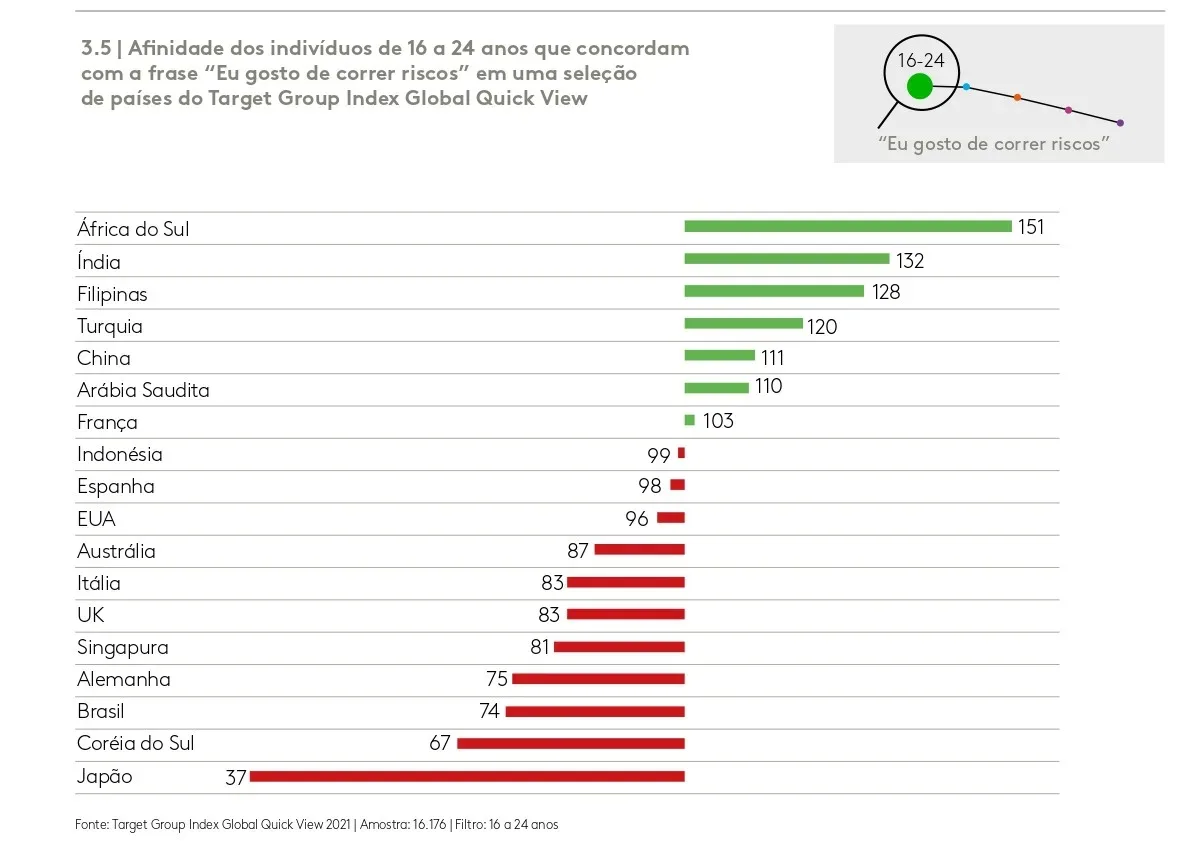
Source: Chart from the Kantar IBOPE Media 2022 study: 3.5 | Affinity of 16 to 24 year olds who agree with the statement “I like to take risks” across a selection of countries from Target Group Index Global Quick View (page 21)
Diversity between generations
Generational groups – Baby Boomers (born between 1946 and 1964), Generation X (born between 1965 and 1980), Millennials (born between 1981 and 1996) and Generation Z (born from 1997 onwards) – are widely used by marketers, but they represent a sweeping view of consumers.
In Brazil, the largest generation is the Millennials (27.8 million). They are the ones earning the most, with an average personal income 11% higher than the national adult average.
However, Millennials are below the population average in agreeing with the statement “I am perfectly happy with my standard of living”.
Levels of spending
Across 26 different categories, from home appliances to electronics and food, Millennials spend above average in 12 of them (the highest number of any generation); they spend 11% more than the Brazilian average on computers/laptops, 10% more on perfume and 9% more on watches.
Millennials are 15% more likely to have a credit card than the average Brazilian; 39% more likely to hold financial investments; and 58% more likely to have made payments by digital means.
Life stages
In many respects, the family stage people are going through is far more decisive for their purchasing power, and therefore their affinity with the target, than their age alone.
For example, Millennials who are “Working Singles” have higher incomes, but they are also among those least likely to agree that they feel financially secure.
Media habits
Millennials in “Families with School-age Children” spend the most time consuming media, especially TV, radio and cinema.
Millennials in “Families with Pre-school Children”, meanwhile, have a stronger affinity for the internet, social media, online video and music streaming.
The “Couples Without Children” group is more likely to consume online newspapers and magazines, while “Families with Children of Different Ages” are more likely to consume radio and the internet at the same time.

6 behaviour and technology trends for brands in 2023 (and beyond)
According to a study produced by Bits to Brands in partnership with WGSN, six trends are shaping content, consumption, behaviour and the way we relate to each other and to technology in 2023.
And because your campaign targeting needs to take behaviour into account to be more effective, here is a brief description of those trends.
1) Artificial Creativity
The first trend is Artificial Creativity, through the use of Generative Artificial Intelligence, an area of AI that gets computers to create all kinds of original content – images, poems, music, text, video, interactions and even programming code.
Thanks to its ability to generate content, its personalisation and its scalability, on top of the growing interest in AI technologies, ChatGPT, for example (among other virtual and artificial intelligence assistants), is one of the big trends for 2023.
As a result, AI is becoming more and more a part of people's daily lives and creative processes, reaching every market and changing the way we shop, create and relate to one another.
“In 2023, we will leave the information age behind and enter the imagination age, a time when AI will expand our creativity, open up more storytelling possibilities, democratise the creative market and broaden the scope of what marketers do. On the other hand, AI tools will raise legal questions around intellectual property and copyright.” – WGSN
2) Branding and Performance
Branding that performs, performance that brands.
For the consumer, branding and performance are all the same brand. It makes no difference whether they see an ad on Instagram, a TV commercial or a video on TikTok. Positive brand building complements and boosts conversion ads, and vice versa.
3) Comfort Culture
Nostalgia dominates culture, communication and fashion. Because people are looking for the safety of the familiar and the simple. And because nostalgic references create an emotional connection.
So consumers seek relief and a sense of lightness and ease through: the comfort of knowing how it ends (rewatching old films and series, for example); the comfort of simpler times; the comfort of not having to think.
There is no doubt that nostalgia is driving consumption behaviour and reshaping consumer profiles in 2023. Generation Z itself is bringing back low-rise trousers, printed jackets, coloured glasses and hair clips.
4) Influencers
The influencer as a production company creates value for brands not only through their role as media and their image, but also through their ability to create.
On the internet, and especially on social media, we are all creators and writers; to be an influencer, though, you have to create relevant, creative content that resonates with the audience and that is part of your own values and narratives — in short, what you genuinely believe in.
If, on one hand, the Creator Economy is a huge opportunity, on the other, de-influencing is emerging as a trend, as consumers have been shopping more consciously, showing anti-materialist and anti-capitalist beliefs. So users share advice and tips on viral products NOT to buy.
5) Not-so-social networks
The fifth trend is social networks becoming less social and more about entertainment, search and closed groups.
Whereas users used to see more content from people they knew and/or liked following, over the past year it was short, dynamic entertainment content in video format, from whoever, that jumped out.
Which, on the other hand, has also left consumers weary, given the flood of information. So bear in mind that authenticity, craft and slow content are still very much alive.
Another clear trend is Social SEO. Research by Hootsuite showed that people aged 16 to 24 use social media to search for brands more than they use search engines.
Google itself acknowledged this when an executive said that “studies show that almost 40% of young people, when they're looking for a place to have lunch, don't go to Google Maps or search. They go to TikTok or Instagram”.
According to social data from WGSN, niche is set to become the norm, with conversations mentioning the term ‘niche’ up 6.3% in 2022.
On top of that, a study by Horizon Media with 18 to 25 year olds in the US found that 91% believe mainstream pop culture no longer exists.
6) Digital Nutrition
If, not so long ago, the answer was to disconnect from time to time, going through a kind of digital detox, today the talk is about less excess and more quality in the content we consume, over the long term.
“Digital nutrition is the theory that links different types of content with the emotions they trigger. And it puts balance at the centre of the conversation – just like a food diet.” – Bits to Brands
The limitations of age
Age has its limitations and needs to be explored further on basically three points:
1) People dynamics
Life situation, or personal and family circumstances, can have a greater influence on purchase decisions and consumer behaviour than age does.
2) Media dynamics
Get a better understanding of the changes in media consumption.
3) Country dynamics
Understand how a market's cultural and social landscape will shape the impact of global campaigns planned by age alone.
Far beyond age
Limiting a marketing campaign's target by age leads to stereotyped analyses and conclusions, and stops you from building richer, sharper audiences.
This figure from the Kantar IBOPE Media study makes it clear: in the disposable nappies category, people aged 20 to 34 are 60% more likely to use them, but the index is almost 700% higher for those who have had a child born in the past 12 months.
That's why it is crucial to be able to target on the basis of real values and experiences, going beyond age and bringing in consumers' behaviours, attitudes and life events, to get more out of the campaign and achieve better results.

Get what we write
No fixed calendar: only when there is something worth your time.