Consumer decision-making: how customer behaviour influences the purchase decision

Inês Tito – Copywriter –
Have you ever thought about how many decisions you make in a day?
What to wear to work, where to go for lunch, which route to take to avoid the traffic at the end of the day…
Inês Tito – Copywriter –
Have you ever thought about how many decisions you make in a day?
What to wear to work, where to go for lunch, which route to take to avoid the traffic at the end of the day…
Without realising it, we are constantly making decisions. Most of them are simple and have little influence on our future. Others, however, are more complex and demand more attention.
As consumers, we are constantly looking for what we believe to be the best product or service. Even when we buy on impulse.
So how does a consumer decide to buy product A instead of product B? That is exactly what we are going to look at in this article.

Consumer psychology in the service of marketing
Globalisation, technological growth and the spread of internet access have transformed the way we take in new information. There is always something happening somewhere, and we can't afford to miss a thing.
This relentless urge to keep up with everything that is going on — what the English call fear of missing out — in a world where everything changes so fast, can drive anyone to despair.
Every marketer, anxious to understand their target audience, has fallen into this trap at some point. That is why consumer psychology matters so much.
Consumer psychology tells us what consumers think, what their behavioural patterns are, and what their preferences and habits look like. How? Through market analysis and research into consumer attitudes and behaviours, it is possible to obtain highly detailed information.
By understanding exactly which factors influence the purchase decision, the marketer holds the master key to building a successful strategy.
How does psychology affect the purchase decision?
Let's take a look at one of the leading theories in psychology: Maslow's Hierarchy of Needs.
The American psychologist Abraham Maslow set out human needs in a hierarchical order, in which basic survival needs (eating or sleeping, for example) sit at the base of the pyramid. Next come the needs for safety, love, esteem and self-actualisation. The latter forms the top of the pyramid. This means that in order to reach self-actualisation, we must first meet all the other needs. Makes sense?
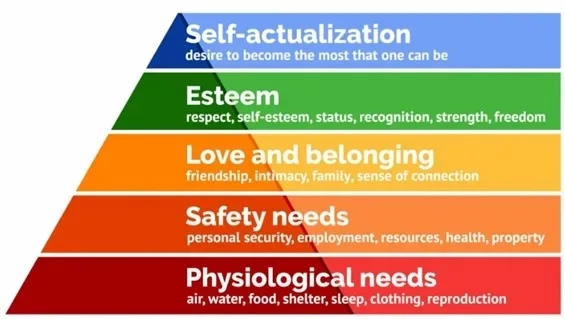
Right then — taking what Maslow taught us, when we decide to buy something, which need are we trying to satisfy?
This helps us understand why we buy a better car than the one we already had. Our motivation goes beyond the need to get from A to B. We've already sorted that. Now we want a better, more comfortable car.
This is just one example to help us understand the consumer decision-making process. It isn't enough on its own, though.
Within social psychology and consumer culture theory, there are various approaches to interpreting the decision-making process.
On top of that, the consumer's personality, their involvement with the product or service, their perception of risk and even the influence of friends and family all affect the final decision.
Types of consumer
Knowing your customer is half the battle for any brand. But to meet their needs, you need to know exactly what type of customer you are dealing with.

Initiator
As the name suggests, this consumer is the one who sets the whole process in motion. Essentially, this is the person who comes up with the idea of buying. If your son asks you for a bike, he is the one who started the process.
Influencer
The influencer consumer has the power to sway someone else's purchase decision. It might be a friend recommending a restaurant, or even an influencer suggesting a particular perfume. In recent years, the impact of the influencer consumer has grown — so much so that it has given rise to a whole new branch of marketing: influencer marketing.
Decider
This is the consumer with decision-making power over the purchase. Back to the example of your son asking for a bike. In this case, the decider is you, the reader! You are the one who decides where, when and how much to spend on the bike.
Buyer
The buyer is the person responsible for actually purchasing the product or service. Imagine your son wants to go and buy the bike after school. Unfortunately, you can't take him and you ask his grandfather instead. By delegating that task, the grandfather becomes the buyer.
User
The name leaves no room for doubt: this is the person who uses the product or service. Now your son can finally make use of that long-awaited bike!
Type of behaviour
Consumer behaviour at the moment of decision is heavily influenced by the type of product or service. Generally speaking, the more complex the purchase, the longer the period of reflection.
Complex purchase
We don't buy a house or a car every day. These are expensive products that we buy only rarely. Our involvement is high, which leads us to weigh up every option available on the market. This complex buying behaviour arises when the risk of buying the wrong product is high.
Dissonance-reducing buying behaviour
In this type of behaviour, the consumer is highly involved in the buying process but struggles to identify differences between brands. Dissonance sets in when the consumer is left wondering whether they made the right choice.
Say we're buying a pair of running shoes. We see there's little difference between the brands and that even the prices are similar. We end up choosing the model we like most within our budget, and afterwards we're left wondering whether we made the right decision. Once we've bought it, we tend to look for information to validate our choice.
Habitual purchase
Habitual purchasing is associated with low consumer involvement with the brand. In other words, the customer doesn't waste time considering which brand to buy. The best example of this is a trip to the supermarket. We tend to buy the same kind of rice, from the same brand, without giving it much thought. We buy out of habit.
Variety seeking
Involvement with the brand is low and the difference between products is small. In this case, the consumer buys products from different brands not out of dissatisfaction, but because they are looking for variety.
Which factors influence consumer behaviour?
Whether we're buying the same kind of rice or looking to validate our running shoe purchase, there are several factors that influence our buying decision.

A well-structured marketing campaign is one of the biggest influences on the purchase decision. The power of an effective message, delivered at the right moment in the customer journey, can convince someone to buy a different brand or even a more expensive product.
As we already know, a consumer's purchasing power and financial situation is a predictor of their buying decision. Unless you've won the EuroMillions, you're very likely to consider the budget you have available before buying anything at all.
On the other hand, a climate of economic prosperity is highly favourable to buying products above the customer's purchasing power. Factors such as the consumer confidence index or the ease of paying on credit are the ones that most influence decision-making, especially for complex purchases.
And of course, we can't forget personal preferences and the influence of society.
Customer behaviour is shaped by a range of personal factors, from priorities to moral values and preferences. However powerful advertising may be, someone whose priority is paying off a loan certainly won't be buying on impulse.
Social pressure is another factor to consider. Whether we like it or not, the opinions of those around us matter to us. That's why decisions about what we wear or which restaurant we eat at are deeply tied to what is socially accepted.
How do you put all this information to use?
Knowing your type of consumer, their behavioural patterns and what drives the purchase decision is essential to building a marketing strategy focused on customer needs.
With that in mind, customer segmentation is the way forward. So it's important to consider the following:
- The benefits the customer is looking for;
- The occasion that prompts the purchase;
- The product usage rate;
- Brand loyalty;
- The type of user;
- The stage of the buying journey the consumer is at.
Aligning your marketing strategy with a deep understanding of your consumer type and their buying patterns allows you to increase conversions, build a highly targeted strategy and spot opportunities to improve the customer experience.

Get what we write
No fixed calendar: only when there is something worth your time.