Content for people, not (just) for Googlebot
Marta Peral Ribeiro – Communications Consultant –
SEO is what allows a brand to position itself online without paid advertising. The problem is that, in the frantic race to meet the requirements of Google's algorithms, priority often ends up going to whatever the machine says, and the human factor gets lost. So how can brands create content that's genuinely for people?
Marta Peral Ribeiro – Communications Consultant –
SEO is what allows a brand to position itself online without paid advertising. The problem is that, in the frantic race to meet the requirements of Google's algorithms, priority often ends up going to whatever the machine says, and the human factor gets lost. So how can brands create content that's genuinely for people?
What is SEO?
SEO, short for search engine optimisation, is a well-known part of the digital marketing world. In short, it's a set of techniques for optimising a website or a piece of text to make sure it appears among the first results Google shows, without paid advertising.
In practice, it comes down to the structure and presentation of the content: whether the website is easy to navigate, whether the content is broken up with headings and subheadings, whether keywords and descriptions are used, whether there are images that aid reading, whether those images also contain keywords, whether other links are included, and so on.
SEO today
Meanwhile, with the shifts in consumer behaviour over recent years, particularly in the digital space, the sharpest brands have started to recognise the need to optimise the user experience as a whole — and that inevitably requires an SEO rethink.
There's now an even greater concern with bringing the brand closer to the consumer, involving them and repaying their trust. And that means picking up on their needs (not just their search intent) so that products and services can be optimised too.
So following an SEO recipe isn't enough. It's essential to create content relevant enough to help your target audience recognise the value of the brand itself, beyond the information it puts out. Through that relationship, an exchange emerges in which both sides benefit: the consumer finds what they need, and the brand can use the interaction to work out how to improve its product.
That said, SEO isn't always focused on people, for reasons such as:
The algorithm
Google's algorithm is constantly changing. We're referring specifically to Google because, according to Statista data, it's the search engine of choice worldwide by an overwhelming margin. Given how unpredictable it is, keeping up with its pace and its rules is genuinely difficult.
Black hat SEO: when SEO loses its transparency
When SEO techniques are twisted to make a website or piece of content look relevant to search engines even when it isn't, we're dealing with what's known as black hat SEO.
But this is definitely not good practice. Not only will visitors abandon the site as soon as they realise it doesn't match their search intent, the algorithms will eventually detect these bad SEO practices and penalise the site.
The essentials of SEO built for people
It's perfectly reasonable for brands to work from SEO fundamentals — and keeping an eye on the algorithm really is worthwhile. As long as they stay focused on what matters most: people.
I'd say it's precisely the combination of the two sides, people and "machine", that makes for an effective SEO strategy.
Teamwork is decisive here, because it involves people from technology, user experience (UX) and, of course, communications and marketing.
Here are the 10 main things to consider in this strategy:
Mobile, mobile
Having a properly optimised mobile version of the brand's site, or even a dedicated app, is hugely important. Because we increasingly search from mobile devices, and we expect an experience as intuitive as the one we get on the web. In fact, the algorithm gives priority to websites that optimise their mobile version, indexing and ranking them in the SERPs:
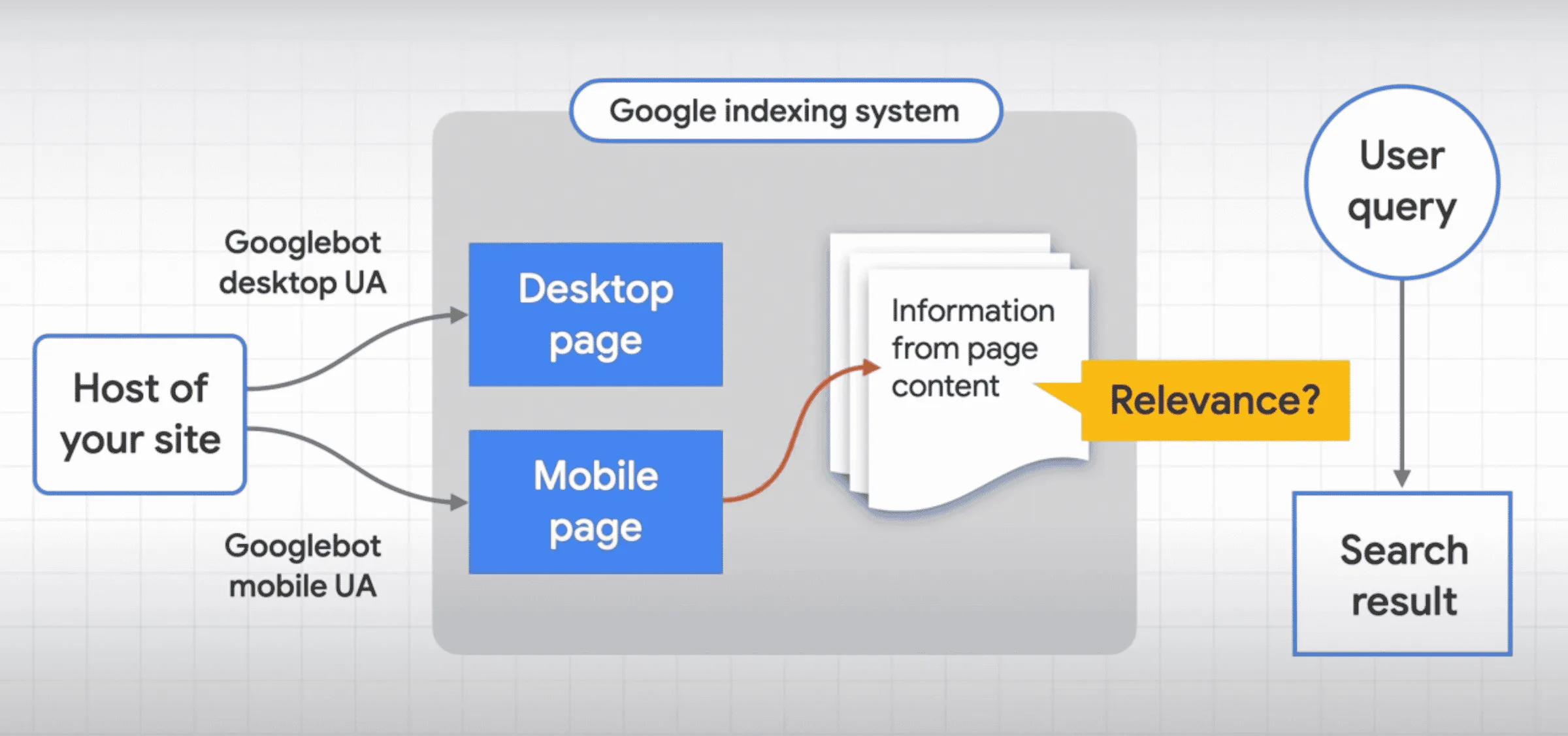
Indexing: Google gives priority to mobile devices
A page that performs well
How long can you wait for a site to show you the information you're after? Probably no more than a few seconds. And that's true for most people. Pages that throw up errors or other technical obstacles that slow the experience down are hard to tolerate.
Googlebot also judges a page by its loading speed. The PageSpeed Insights tool lets you analyse your website's speed.
Digital accessibility
Many users struggle to browse the internet because of physical or motor limitations. When a brand's digital experience is inclusive, more people can find it and value it, which drives more traffic to the site and, as a result, better rankings on Google.
More specific keywords (long-tail keywords)
Reportedly, 91.8% of search terms are long-tail keywords, which means the user's search intent is specific.
With long keywords, the chances of a user quickly finding the answer to their question or search on a single website or article are very high.
Although they don't carry as much weight in search volume, there's less competition, and that builds the brand's authority.
Engagement
An empathetic perspective allows us to develop content that's useful to the audience, because it will meet their expectations — and that's an excellent way to capture their attention.
Through the interaction a brand creates with its audience (commonly called "engagement"), the relationship builds, because both sides recognise how important the other is. And that's how you win a loyal audience.
Command of the subject
Understanding the sector as a whole, along with your persona and the subject you want to tackle, contributes enormously to enriching the content you'll deliver to your audience.
The authority a brand builds around a given subject gives users the confidence they need, which, again, turns into loyalty.
Reflection and record-keeping
Just as a product should be created to meet a customer need, SEO exists to answer users' questions. Looking at them, what do they have in common? What do they value? What do they comment on? What questions do they share?
It's worth keeping a thorough record of these topics, so you can identify opportunities (including for products or services) and know what content to deliver.
A unique perspective
Following on from the previous point, the analysis you carry out will require you to research the subject in order to respond — and to live up to expectations.
In that process, it's very likely a different perspective will emerge, and that's where you can create content that's exclusive to your target audience.
Video and live content remain excellent ways to deliver content, so make sure they include proper descriptions (alt text). This article sets out some good practices.
Internal and external links (backlinks)
Links related to the topic at hand give articles and pages consistency. After all, a user who wants to go deeper into a topic will appreciate more information about it, made available through links on the site itself or to an external one. And Googlebot counts those backlinks too, indexing them.
Information and inspiration
As with everything in life, other people's experience can be an asset to us and to what we do.
You've probably already put together a list of benchmark brands and sites that have more knowledge and authority in certain areas. It's worth checking them first, to see how they approach the information you need to develop, examine the sources they use or the kind of images they choose.
The growing importance of user experience, together with advances in technology and constant changes to algorithmic rules, have pushed SEO to raise its game too.
In recent years, its scope has moved beyond a website's content and configuration, widening to include the brand's positioning as a whole and the way users relate to it. That makes cohesion between content, technology and media essential, so that content not only claims the podium in Google's results but, above all, connects with the audience.
Adding it all up, we reach one conclusion: it's the audience, precisely, that sets the rules in marketing. After all, the people who follow your brand and eventually become your customers aren't Google — they're flesh-and-blood human beings.

Get what we write
No fixed calendar: only when there is something worth your time.