Digital media and the B2B segment

Miguel Afonso Gonçalves – Copywriter and Travel Blogger – Understanding digital in a B2B environment Introductory note: This article draws on the research carried out for my master's dissertation, entitled “Communication and marketing channels in a business-to-business context”, submitted for the master's degree in Communication Sciences – Marketing and Advertising at Universidade Católica Portuguesa (defended in January 2021 and awarded a final grade of Very Good).
Ana Mendonça Morais – Marketing & Communication Strategist – Understanding digital in a B2B environment Introductory note: This article draws on the research carried out for my master's dissertation, entitled “Communication and marketing channels in a business-to-business context”, submitted for the master's degree in Communication Sciences – Marketing and Advertising at Universidade Católica Portuguesa (defended in January 2021 and awarded a final grade of Very Good). Digital communication and marketing channels are usually associated with brands operating mainly in the B2C segment, but what impact do they have on the B2B sector? How do brands in this sector use these tools? And which variables drive greater or lesser use of digital channels?
One thing is certain from the outset, though: the pandemic has allowed the B2B segment to develop a more assertive and immediate digital strategy, breaking down barriers once thought insurmountable. Being business-to-business
This term has been part of the business world's vocabulary for several decades, but it has never truly captured the attention of most marketing theorists. Because it is a segment defined above all by relationships between brands, companies, businesses, institutions and others, a formal and conservative environment developed early on, in which structural change is consequently slow and complex. Proof of this is that in 2019, at a time when the digital transition was already a given in the B2C segment, the adoption of different channels in B2B was still something to be discussed and studied (loom.ly/ZKRNw9U).
Business-to-business marketing has been built on a more traditional logic, in which closeness, personalisation and direct contact are essential criteria for the strategies drawn up — and which, at first sight, appear to be incompatible with, or at least harder to reconcile with, the digital transition.
However, brands and companies live above all through people — whether employees, suppliers or clients — which means that the players in the B2B sector are also key to the development of the B2C segment (business-to-consumer), where strategies and patterns are substantially different. What route is there towards this digital transition, knowing in advance that relationship marketing is central to this segment? The route to digital
We have always been used to hearing expressions linked to the business world — that is, to the B2B sector — such as “business meeting”, “business lunch”, “corporate events” and many others. Unsurprisingly, they all have something in common and all serve the three main pillars of business-to-business communication and marketing: closeness, personalisation and direct contact. Where do websites, webinars or social media fit in, and how can they take precedence over traditional media in this segment?
Although we have been witnessing growing global digitalisation for several decades — particularly since the Internet boom of the 1990s — it was only in 2020 that the business world was forced to redefine its communication and marketing strategies around an (almost) entirely digital logic, as a result of the restrictions imposed by the pandemic.
At this point, a number of questions arise that need answering. Are all companies and brands equally open to fully adopting these new channels? Which criteria for differentiation, or segmentation, can help to design more effective strategies? How do you know whether digital channels are right for your brand's communication and marketing in a business-to-business context? And which clients do digital mechanisms serve best?
Let's start by looking at this from a different angle — one of the main advantages of digital platforms is that they are available to everyone more quickly and more immediately, potentially with a lower financial cost attached.
In theory, then, any company or brand can use these tools as part of its B2B communication and marketing strategies. There is, however, a wide range of variables that must be analysed beforehand in order to build an effective digital communication and marketing plan. Which ones?
Unlike the B2C segment, the B2B market is characterised by brands surviving on fewer clients, each of higher individual financial value. Turnover between organisations is therefore one of the most relevant variables. But not the only one. Because it is a segment where change is typically slower, the type — or situation — of purchase also varies less frequently: purchasing tends to be more repetitive, so the processes involved are often less demanding. Let's look at each of them separately. Turnover: a key indicator
Before it's too late, and to head off any preconceived ideas, let's start with a disclaimer: every client matters to any company, business and brand. But, even if unconsciously, they are labelled to different degrees according to the financial weight they represent for a company.
With that in mind, and recalling the three pillars of B2B communication, we can see that traditional channels carry more weight in communication and marketing strategies aimed at clients representing higher turnover. Digital channels and strategies, on the other hand, help to consolidate communication with clients representing lower billing figures — which, in principle, will outnumber the former in total company count. Purchase situation
Let's remember that the business-to-business segment features distinct purchase situations — whether an entirely new type of purchase (“new task”), or repeat purchase situations that may or may not involve small changes compared with previous ones (“straight rebuy” or “modified rebuy”), as the leading theorists on the subject point out.
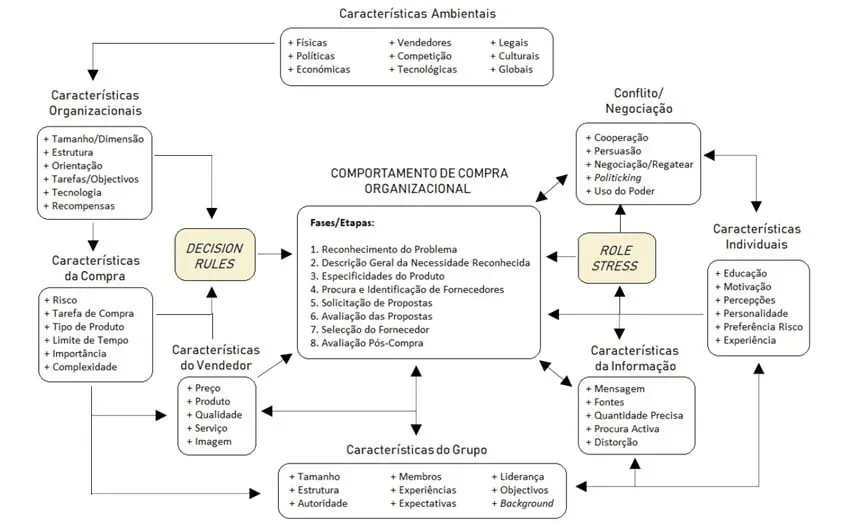
Because the purchase decision process in this sector is more complex, calculated and dynamic, any new purchase requires closer, more personalised and more direct contact, which makes traditional channels and strategies more relevant, offsetting the difficulties created by the complexity of the buying process (as illustrated in the image shown, inspired by the approach of Johnston and Lewin (1996)). If the purchase is similar to previous ones, however, not only do those involved know the procedure and requirements, but the process is also faster because several stages of the buying process are dropped. In these cases, digital media have a stage on which to shine and contribute to the communication and marketing efforts of organisations in the B2B sector. A world of variables
The table above sets out the wide range of variables capable of influencing organisational buying behaviour. Within each group of differentiating characteristics, opportunities to encourage the use of digital strategies will naturally arise. It could also be said, based on organisation size, that micro and small companies tend to take more risks and potentially rely more on digital tools — given the lower costs involved — than medium-sized and large companies. Even so, digital always emerges as a valuable complement to so-called traditional strategies.
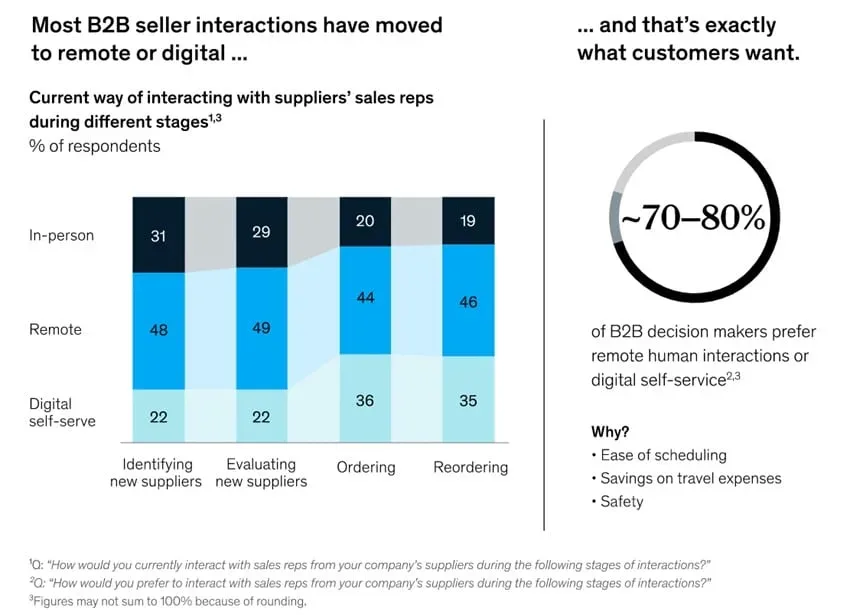
Geography, on the other hand, also influences the strategies applied. As seems obvious, the greater the geographical distance between the companies in question, the more pressing the use of digital channels becomes. And it is on this particular point that the pandemic has proved that the business-to-business segment also has room to invest more in digital — short geographical distance is less and less a factor that makes traditional channels compulsory! Source: McKinsey A recent McKinsey study shows that digital is taking on an increasingly prominent role, especially in the post-pandemic phase to come, where new reasons for turning to digital come into play — safety being one of them. The one certainty: that path is already being taken. Reflection
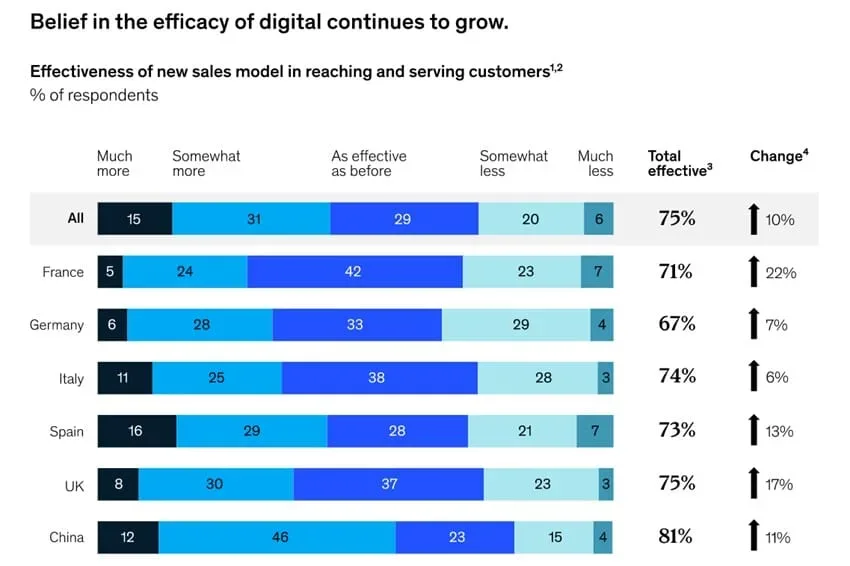
Talking about communication, marketing or business through digital channels in B2B means acknowledging that there are two distinct eras, and that 2020 is the year of transition. Until 2020, this clearly conservative and traditional segment was built on a strong complementarity between traditional and digital strategies, but one in which traditional tools — telemarketing, face-to-face meetings, events and others — still accounted for the largest share of B2B communication and marketing efforts.
Forced to change the way they operate, organisations adapted to a model that was — in some cases — 100% digital for months, if not years. Although the figures show that only around a third of companies do not believe in the digital route for this segment, the truth is that we need to look at all the variables already analysed (and the others that exist) and understand that in the business-to-business market, the way forward will unequivocally be one of complementarity between the two: traditional and digital.
The specific nature of the market shows us that each situation must be treated as unique, and that the choice of the best approach should be based on the characteristics of each company — both sender and receiver!

Get what we write
No fixed calendar: only when there is something worth your time.