Generative Artificial Intelligence (AI) in Google's products
Pauliny Zito – Planner, copywriter and copy editor – Google isn't about to be left behind in the Generative AI technology race. Which is why it has been announcing new features across its products that use Generative AI to save time, support decision-making, solve problems and boost users' creativity.

Pauliny Zito – Planner, copywriter and copy editor – Google isn't about to be left behind in the Generative AI technology race. Which is why it has been announcing new features across its products that use Generative AI to save time, support decision-making, solve problems and boost users' creativity. "Every business and organisation is thinking about how to drive transformation. That's why we're focused on helping others innovate through AI, by making it easy to access and scalable." – Sundar Pichai – CEO of Google Source: Freepik
But before we talk about Generative AI, what exactly is AI?
"AI is a broad term often used to describe all sorts of advanced computer systems. I prefer to talk more specifically about machine learning. Most of what we see in AI today is actually machine learning, that is: giving computer systems the ability to learn from examples. We call machines programmed to learn from examples 'neural networks'. One of the main ways they learn is by being fed lots of examples, such as knowing what's shown in an image – we call that classification." – Douglas Eck – Senior Director at Google Search
Language models
Language models are another type of neural network, which essentially predict which word comes next in a sequence of words, having been trained on huge volumes of text.
They're already at work in Smart Compose and Smart Reply in Gmail, for example, and they also power Bard, which runs on a large language model — a type of machine learning model that has become known for its ability to generate language that sounds natural.
Generative AI
A generative model draws on what it has learned from the examples it's been shown and creates something entirely new based on that information. Large language models (LLMs) are a type of Generative AI, because they generate new combinations of text in language that sounds natural.
Douglas Eck believes Generative AI holds enormous potential for the creative field: "think about removing some of the repetitive work in mundane tasks, such as producing drafts, rather than encroaching on your innate creativity".
How does Google approach machine learning development?
According to Douglas Eck:
"We are and have been taking our time to do this carefully. If we build a product, we want to be sure it can be useful and avoid harm. In 2018, we were among the first companies to develop and publish AI Principles and to put in place an internal governance structure to follow them. Our AI work today involves the responsible AI group at Google and many other groups focused on avoiding bias, toxicity and other harms while developing emerging technologies."
Google launches Bard to compete with OpenAI's ChatGPT and Microsoft's Bing Chat
In March 2023, Google launched the Bard chatbot with the aim of boosting productivity, creativity and curiosity — and, of course, strengthening its presence in the AI chatbot space while holding on to its dominance in the search engine market.
Powered by an LLM — a lightweight, optimised version of LaMDA — and designed as a complementary experience to Google Search, Bard lets users check its answers or explore sources on the web.
Bard is being rolled out initially in the US and the UK, before expanding to more countries.
Generative AI in Google's products
According to Google itself, thanks to Generative AI the company is reinventing all of its main products, with a bold and responsible approach.
Here's a look at AI across Google's products, including Search.
Gen App Builder
Gen App Builder lets developers build chat and search applications quickly and easily.
Generative AI support in Vertex AI
Generative AI support in Vertex AI extends Google's machine learning development platform with access to Google's foundation models and others, so you can build, customise and deploy language models.
Google Search
Google SGE
The new generative search experience will be available in Search Labs, on Chrome for desktop and in the Google app (for Android and iOS), for now only in the United States (in principle, in English only).
Google Search Generative Experience (SGE) adds generative AI capabilities to Google Search results.
This article published in Search Engine Journal in May 2023 examines how Google SGE handles search queries, prioritises publishers and reshapes the future of search and information discovery.
Creating ads on the Google Search network
Generative AI will make it possible to simplify the process of creating ads on the Google Search network.
By adding the company website's landing page, the AI will summarise the page, generating keywords, headlines, descriptions, images and other assets relevant to the advertising campaign. Once that's done, the user can review and edit the content before putting it live.
AI will also help create headlines that are more appealing to users, so ad performance should improve.
Custom copy, images and other assets can also be created with Generative AI through Performance Max. All the marketer has to do is provide the website URL for Google AI to start learning more about the brand and then build campaigns.
Google says it remains committed to transparency, so ads generated by Generative AI (Search Generative Experience, or SGE) will carry "sponsored" labels in bold black text to distinguish them from organic results.
For users, Generative AI makes Google's search tool better still, providing more information and context for their searches.
On top of that, shopping will be easier and simpler: when users search for a product, they'll see an instant rundown of the key things to consider and products within budget. And more besides: product descriptions, including relevant and up-to-date reviews, ratings, prices and product images. Google Cloud
Duet AI for Google Cloud helps cloud users with contextual code completion: it offers suggestions tailored to their codebase, generates entire functions in real time and helps with code reviews and inspections.
For developers who want to build Generative AI applications more simply and efficiently, Google has introduced new foundation models and features across its AI products.
Google Workspace
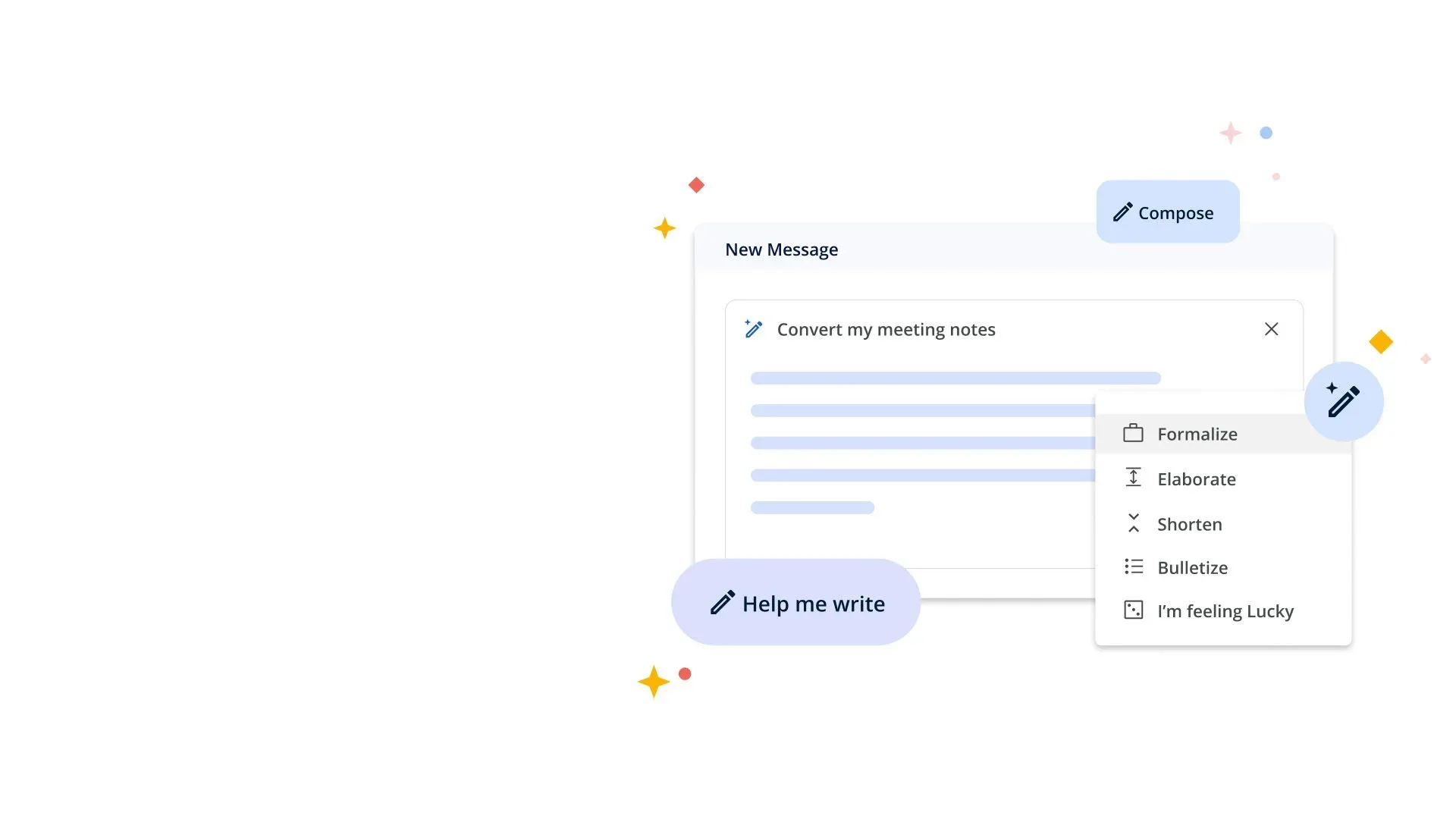
Google is also bringing new Generative AI features to trusted testers, via Workspace Labs, in its Google Workspace apps, such as:
- In Gmail and Google Docs: the ability to draft replies that take into account the context of an existing email thread, including on mobile devices. To use the "Help me write" feature, just type in what you want, click create and a full draft will appear.
- In Google Slides and Meet: Duet AI gives users tools to easily generate images from text descriptions. Custom images in slides can bring a story to life and, in Meet, they can be used to create custom backgrounds.
- In Google Sheets: automated data classification and custom template creation, helping users analyse and organise data more quickly.
Google Maps
Immersive View for routes is coming to Google Maps, with a launch expected in the next few months in Amsterdam, Berlin, Dublin, Florence, Las Vegas, London, Los Angeles, New York, Miami, Paris, Seattle, San Francisco, San Jose, Tokyo and Venice.
Google Maps is more visual than ever, with features like search with Live View and immersive view for places. Now, with Immersive View for routes, you'll be able to preview every stretch of a journey before you set off, whether by car, on foot or by bike. Users can also check air quality, traffic and the weather, and how they're changing over time.
There are also new features for developers to build immersive experiences on the platform. With the new Aerial View API, already available in preview, you can easily integrate a 3D panoramic video of any point of interest into your apps, giving users more visual information about a particular place.
And more: developers who want to build bespoke 3D maps can make use of the experimental launch of Photorealistic 3D Tiles, via the Map Tiles API, as Google is making the high-resolution 3D imagery behind Google Earth available for the first time.
Google Photos
If you could already search your photos for things like people, the sea and sunsets, with Magic Editor (due to launch later this year) you'll be able not only to remove unwanted elements but also to recreate parts of objects that don't appear in the original photo, reposition elements and improve the sky, adjusting the lighting across the rest of the photo consistently at the same time.
Security AI Workbench
In April 2023, Google introduced Security AI Workbench, an industry-first platform built on its new LLM security model, Sec-PaLM, which draws on Google's unique insights into the constantly evolving threat landscape and is fine-tuned for cybersecurity operations.
Does the present — and the future — belong to Generative AI?
Generative AI is proving to be a valuable resource for creating compelling content, synthesising and organising information, automating business processes and building impressive, smoother experiences for people.
With the world evolving constantly and ever faster, professionals who don't keep up with new technologies at the pace required — adapting and building them into their day-to-day work — will end up losing ground in an already (and increasingly) competitive market.
In that sense, these professionals won't lose their jobs to Generative AI, but to another professional who knows how to use it better.
The same logic applies to companies that fail to implement new technologies in their business models: they risk becoming obsolete, losing market share and even "disappearing".
Many more benefits of Generative AI will emerge through collaboration and experimentation over time. "Not riding this wave" isn't an option.

Get what we write
No fixed calendar: only when there is something worth your time.