Traditional chatbot vs. AI agent: which should you choose?

What's the difference between a traditional chatbot and an AI agent? The question sounds technical, but it's in practice that it hurts: the company installed a chatbot, trained the team to point customers towards it and, weeks later, the tickets keep coming in. The bot answers the FAQ questions well, but as soon as the customer phrases things slightly differently, the conversation can grind to a halt. The problem isn't the chatbot itself: it's the type of technology behind it.
There's a very concrete technical and operational difference between a rules-based bot and a conversational AI agent. That difference determines what the tool can do, where it fails and how much it costs to maintain. This is exactly the choice many companies face before going ahead with any implementation, and where an honest assessment saves time and money.
By the end of this article you'll have technical clarity on both approaches, real use cases and a practical checklist to decide which one makes sense in your context.
How each technology works under the bonnet
Traditional chatbot: how it works
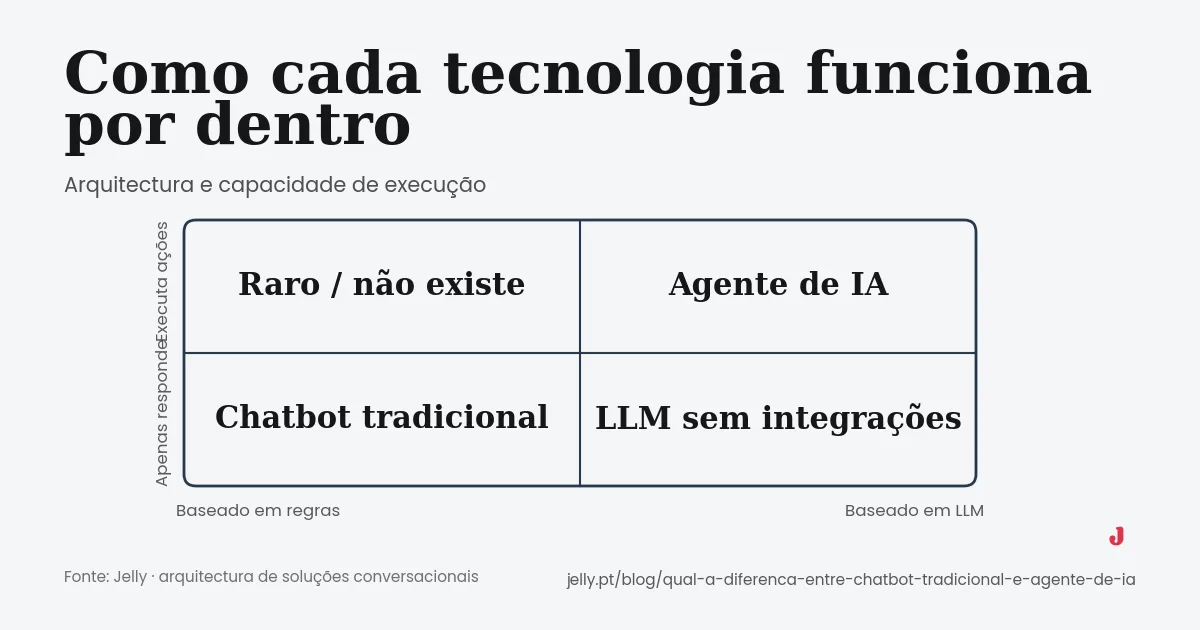
A rules-based chatbot follows a deterministic architecture: fixed if/then flows, decision trees and manually pre-defined intents. The responses are always pre-programmed, and any variation in the user's question breaks the flow or returns a generic message. It's a predictable tool, easy to audit and well suited to controlled environments where the questions are consistently the same.
LLM-based agent: how it works
An LLM-based agent works in a completely different way. It performs contextual inference, understands variations in language, ambiguity and implicit intent, and generates new responses based on context, history and the available data. When integrated with external systems and orchestrated with APIs and proper authentication, it can maintain conversational memory, make decisions and carry out actions — cancelling orders, updating records, reopening tickets. The distinction is straightforward: the chatbot answers, the agent resolves.
It's this ability to execute that separates simple conversational AI from a genuinely intelligent virtual assistant. And it's what justifies, or doesn't, the additional investment.
Real cases: where each technology belongs
A traditional chatbot is enough when the environment is predictable and the questions are repetitive. Customer service FAQs, basic order status, lead triage with simple fields, scheduling with a fixed flow and first-line technical support with standardised steps are all cases the bot handles well. No reasoning or deep context is required; predictability is the advantage.
The AI agent comes into play when complexity increases: billing disputes, cancellations with refunds, personalised service using CRM data, intelligent ticket routing by urgency and subject, or end-to-end automation in e-commerce covering returns and payment adjustments. Here, bot vs. AI agent stops being a matter of preference and becomes a matter of capability: the agent doesn't just look up information — it cancels, updates, notifies, reopens and reroutes. Without that ability to execute, cases tend to escalate to a human far more often.
Costs, integrations and what nobody explains up front
The figures below reflect market estimates for SMEs in Portugal in 2026, based on benchmarks from projects with different levels of integration:
- Traditional chatbot: implementation between €3,000 and €15,000; monthly maintenance between €200 and €1,000.
- AI agent: implementation from €20,000 and up to €40,000 or more on projects with full integrations; monthly maintenance between €1,000 and €5,000.
The higher cost of an agent doesn't come from the language model alone. It comes from the integrations, API usage, ongoing monitoring, governance and human review in critical cases.
The infrastructure requirements are also very different. A chatbot essentially needs:
- A messaging channel
- An FAQ base
- Optionally, a lightweight CRM
An AI agent requires a far denser layer:
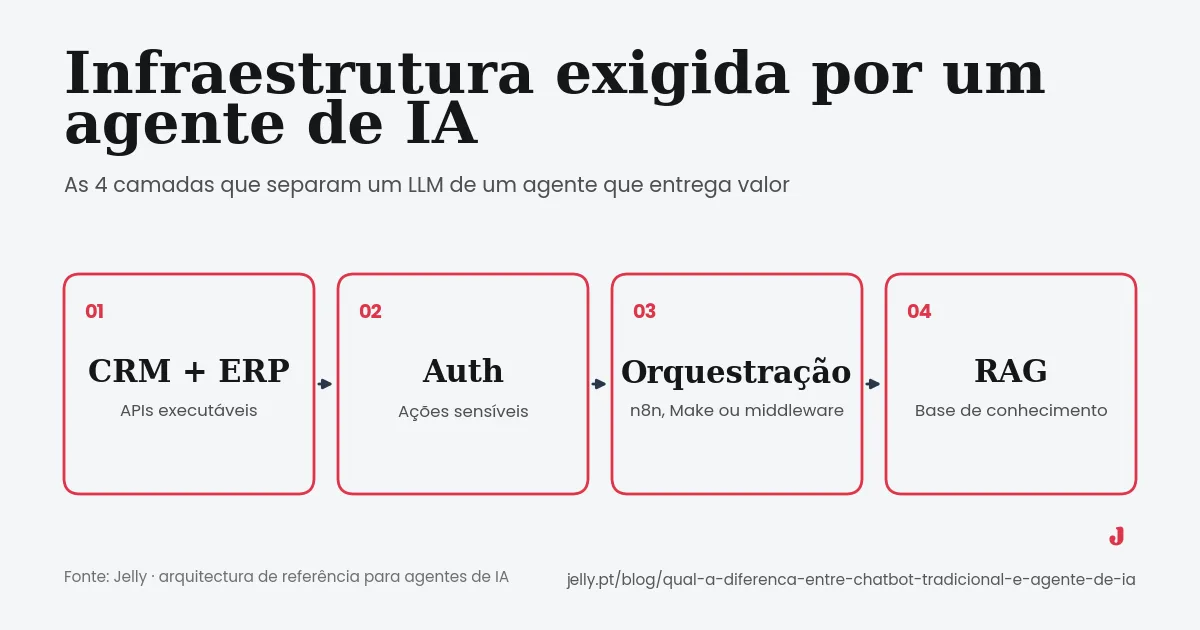
- CRM and ERP with executable APIs
- Strong authentication for sensitive actions
- Orchestration via n8n, Make or dedicated middleware
- A structured knowledge base with RAG
Without these integrations, the agent doesn't deliver the value promised. The architecture matters just as much as the model you choose.
What's the difference between a traditional chatbot and an AI agent in the metrics, and how JELLY approaches this transition
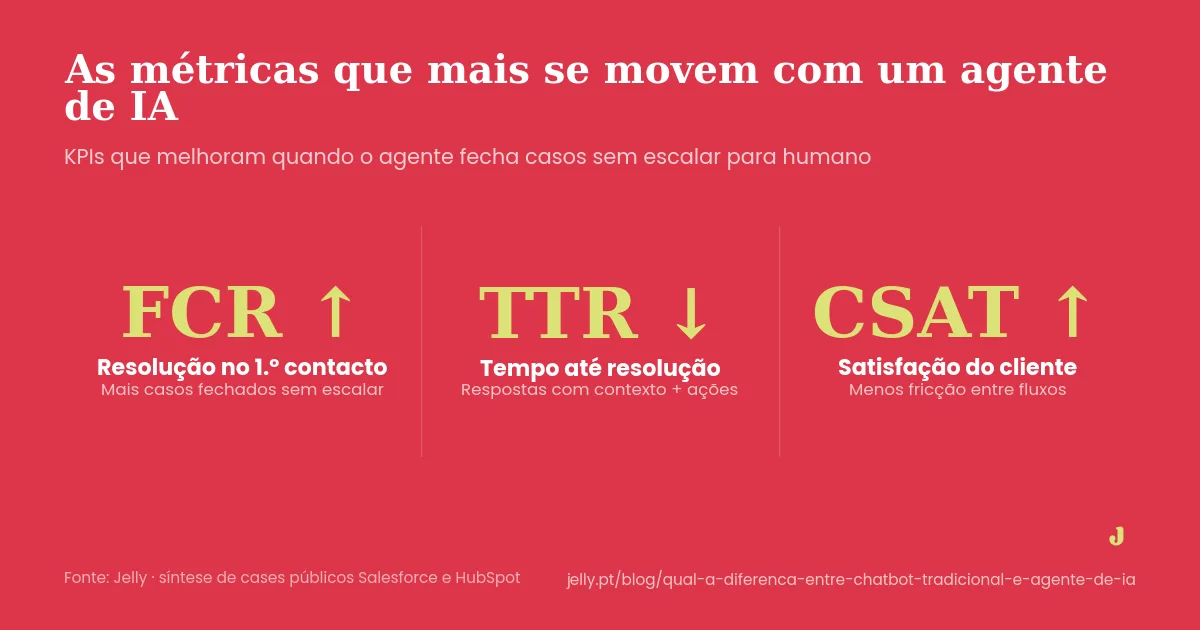
When a company replaces a rules-based bot with a well-integrated autonomous AI assistant, the metrics that shift most are FCR (first contact resolution), TTR (time to resolution) and CSAT (customer satisfaction). Public cases of AI agent implementations, including references from platforms such as Salesforce and HubSpot, document improvements in these areas when the integration is done properly. The improvement happens because the agent closes cases without escalating to a human, maintains context between interactions and personalises responses with real customer data. In commercial contexts, conversion and lead qualification also tend to improve: less drop-off, faster routing to sales and more immediate capture of purchase intent.
At JELLY, we support companies in Portugal through this transition, from auditing their current customer service to implementing autonomous agents integrated with CRM and support automations. The most consistent patterns we see come up in ticket containment, reduced response times and the experience of customers who are no longer bounced between flows without resolution. For SMEs, the starting point is almost always a pilot focused on a single critical use case: it reduces risk and lets you measure real impact before scaling.
Checklist: how to decide which technology is right for your business
Before choosing any tool, answer these five questions honestly:
- Do your interactions always follow the same flow, or do they vary a lot? If they vary, a rules-based bot will frustrate your customers.
- Does your customer service require actions in systems such as CRM, ERP or payments? If so, you need an agent with executable integrations, not a bot that only delivers canned answers.
- Do you have relevant customer history that should inform the responses? A traditional chatbot has limited memory and context; an agent can use history and context far more actively.
- Does your service volume justify the investment? An AI agent starts to make economic sense when the number of interactions is high enough to generate a return on the cost of implementation and maintenance.
- Do you have the in-house technical capacity to maintain integrations, or do you need a partner? AI agents without active maintenance can degrade — continuous monitoring, response review and updating integrations are not optional.
What's the difference between a traditional chatbot and an AI agent: summary
The choice isn't about which technology is “better” in the abstract. It's about which one solves the real problem you have with the resources available right now. A chatbot properly configured for the right case beats a badly integrated AI agent on any metric. Understanding the difference between a traditional chatbot and an AI agent, and knowing how to apply it to your specific context, is what separates a successful implementation from yet another project that fell short of expectations.
If you want to assess whether an AI agent makes sense in your context, JELLY carries out that analysis before any implementation. No obligation, no architecture designed to impress: just clarity on what actually solves your problem.
Get what we write
No fixed calendar: only when there is something worth your time.

Gonçalo Malho Rodrigues
Fundador & CEO
Fundou a Jelly – Digital Agency em Portugal em 2010 e a Strivesync – AI-Native Systems no Dubai em 2026. Detém outras empresas, noutros setores, como a Stronddo – Online Art Galleryl, a Scallent – Human Talent. Gonçalo, criou a The Change Framework, que apoia líderes a gerar a mudança através da mobilização de equipas em torno de uma causa.