Web3: a decentralised future

Pauliny Zito – Planner, copywriter and copydesk – Web3 is the third generation of the Internet, and it promises to reshape the way the web works. It is run through publicly accessible platforms that store users' data and transactions (Blockchain), letting users themselves choose which data centre stores their information. In short, Web3 is a decentralised, Blockchain-based Internet. But where exactly is this supposed next Internet revolution right now?

Pauliny Zito – Planner, copywriter and copydesk – Web3 is the third generation of the Internet, and it promises to reshape the way the web works. It is run through publicly accessible platforms that store users' data and transactions (Blockchain), letting users themselves choose which data centre stores their information. In short, Web3 is a decentralised, Blockchain-based Internet. But where exactly is this supposed next Internet revolution right now? Web3 “Web3 is a convenient shorthand for the project of rearchitecting the web, using Blockchain technology to change the way information is stored, shared and owned.” – Book: Web3: The Insights You Need From HBR (2023) – Harvard Business Review. Source: Freepik
The evolution of the web: Web1, Web2 and Web3
A new era of the Internet is coming, called Web3, driven by new technologies such as NFTs (Non-Fungible Tokens), Blockchain, cryptocurrencies and tokenisation.
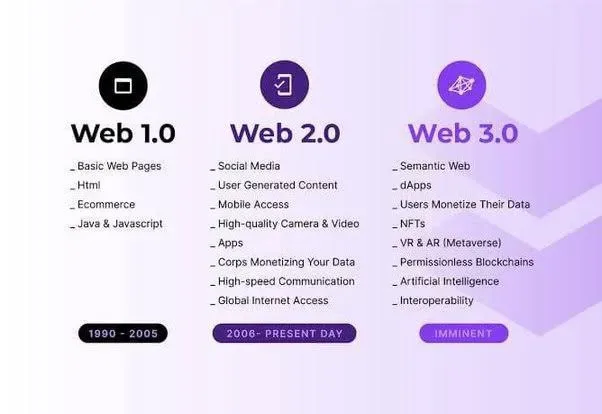
Web1: 1990 to 2005
Read-only Web: users moved between static pages thanks to HTML and URLs. It was a way of democratising access to knowledge.
Web2: 2006 to the present day
Read-Write Web: the Internet starts to become more interactive and collaborative, marked by three “eras”:
- The user-generated content (UGC) era: the experience of being online on social media; watching, learning, searching and communicating.
- The centralisation era: a handful of companies grow rich by collecting user data and selling targeted advertising.
- The sharing and influence economy era: ordinary people make money in new ways on and through the Internet — content creators, digital influencers and so on.
Web3: about to happen
Read-Write-Own Web: a decentralised, more transparent Internet in which users own their own identities and can exchange assets with each other securely. The user no longer as the product but as an owner would change a fundamental dynamic of today's web. It will be a deep overhaul.
“The most likely future scenario is several systems operating in an integrated way, sharing avatars, NFTs and other objects, all recorded on blockchains such as Ethereum, where the data is distributed across various servers around the world. We already have several platforms today, but they aren't integrated with one another.” – Edney “Interney” Souza – Lecturer, speaker and adviser on Innovation and Digital Marketing (Article: O metaverso e a Web 3.0, 25/05/2022, published on interney.net).
Web3, the metaverse and NFTs
“Web3, the metaverse and NFTs are key concepts shaping the future of the Internet, and they are strongly linked to one another. All of them point towards a more personalised and interactive Internet (Web3), where users can interact in immersive virtual spaces (the metaverse) with verifiable ownership of unique items and experiences (NFTs).” – Kenneth Corrêa – Specialist in New Technologies, Artificial Intelligence and the Metaverse, and MBA lecturer at Fundação Getúlio Vargas (FGV).
How Web3 affects your business
Web3 has the potential to be the next big disruptor in the business world, and it is being reinvented to offer a genuinely user-friendly experience.
In this new landscape, the web as we know it today will undergo profound changes: monopolies will be broken up, a new web will be created and established, and new products and services will emerge.
Web3 benefits and opportunities
NFTs
Artists, gamers and content creators can use NFTs to prove the authenticity and ownership of their creations, and also to monetise them directly, with no middlemen.
In the property sector, land registry records and title deeds can be represented as NFTs, which simplifies complex property processes.
Blockchain
Organisations can use Blockchain technology in supply chains, given the greater transparency and efficiency it allows. Smart contracts are executable Blockchain-based programs that make it possible to automate agreements and transactions.
Free and open source software
Programming and development professionals can contribute their expertise, since Web3 is being built on open source principles.
Metaverse
Investors can generate revenue from the metaverse and NFTs. The metaverse brings added value in areas such as decentralised finance and tokenisation.
Tokenisation of the economy
A new universe of entirely digital solutions in which users buy, sell or store assets more easily.
DAOs (Decentralised Autonomous Organisations)
Built on blockchains, they operate without a central authority and can be applied to anything from the governance of protocols and cryptocurrencies to the management of collaborative projects and investments.
Imagine a DAO that uses decentralised and cryptographic technology to fund scientific research to improve women's reproductive health. Can you picture it? Well, it already exists: AthenaDAO, one of whose founders is Portuguese, Inês Santos Silva.
Cryptocurrencies
Cryptocurrencies could serve as Web3's payment infrastructure.
New business models
New business models have been emerging across various industries, centred on user ownership, personalisation and immersive interaction — including the development of virtual, augmented and mixed reality technology, digital art curation, and more.
Faced with this imminent transformation, how can your business get ready for Web3?
What does Web3 actually mean for your business?
How do you use Web3 tools and integrate them strategically into your business model?
That's what we'll look at next.
How to capitalise on NFTs to grow your business
Get to grips with NFTs and the underlying blockchain technology by seeking expert guidance, and make sure you understand the legal and regulatory considerations.
Work out how NFTs can be applied in your sector, adding unique value, improving customer engagement, streamlining operations or creating new revenue streams.
Create NFTs that offer genuine benefits to your customers.
Build an ecosystem around NFTs: partnerships with NFT marketplaces, in-house NFT platforms and a community of NFT enthusiasts.
How to build decentralised finance (DeFi) into your financial strategies
Build your knowledge of DeFi and train your team.
Assess the risks associated with DeFi activities and develop risk management and compliance protocols.
Work out how DeFi can improve your business operations, whether by optimising liquidity management, accessing alternative funding sources or simplifying international payments.
Set up partnerships with DeFi projects to integrate DeFi solutions into your existing infrastructure.
Cyber security
Always invest in top-tier security infrastructure to maintain user trust.
Web3 challenges
- Creating new forms of regulation to protect users in a Blockchain-driven future is one of Web3's challenges. This requires close monitoring and involvement from the relevant authorities.
- Mitigating security risks in the Web3 space, which involves robust encryption, smart contract audits and adherence to cyber security best practice.
- Speeding up the development of the technology locally.
- Governance-related issues.
Source: Freepik
- Scalability and interoperability: handling the exponential growth of decentralised applications calls for Layer 2 solutions and sharding. Ensuring seamless communication and data exchange calls for cross-chain compatibility.
- Demand for user-friendly interfaces.
- Equal access.
- Distribution of digital wealth.
- Informing the general public about the potential of these new technologies.
“The general impression is that all Web3 has to offer is empty NFT drops and token projects.” – Thomas Euler, German founder of a blockchain platform that partners with Borussia Dortmund.
More than a strategic choice — a necessity
Web3 is still evolving and countless projects and initiatives are under way, but it already offers unprecedented economic opportunities for innovation, collaboration and growth.
Experts across every sector envisage a landscape defined by decentralisation, transparency and peer-to-peer interactions on a scale never seen before.
There is no doubt that Web3 is a dynamic, evolving technology ecosystem that will break traditional paradigms.
Companies need to adjust to this new reality, prioritising continuous learning and adaptation in order to survive and thrive in Web3 and keep pace with the world.
People can take part in Web3 by researching and using Web 3.0 platforms and applications, buying cryptocurrencies and tokens, supporting open source initiatives and learning more about blockchain and decentralised technology.
Are you ready for this future?!


Get what we write
No fixed calendar: only when there is something worth your time.