H2H Marketing: humanising a brand's communication

Inês Tito – Copywriter –
Technology was one of humanity's greatest creations. As well as making our daily lives easier, it has allowed us to reach the depths of the ocean, land on the Moon and set our sights on a colony on Mars.
Inês Tito – Copywriter –
Technology was one of humanity's greatest creations. As well as making our daily lives easier, it has allowed us to reach the depths of the ocean, land on the Moon and set our sights on a colony on Mars.
That said, technological progress has been frighteningly fast! For years, brands have invested in automating processes, from data handling to customer support.
And we, as customers, don't mind that at all! In fact, we're grateful when there's a self-checkout available at the supermarket on those days when we don't feel like talking to anyone.
However, when automation fails to do its job, and even makes simple tasks harder, that's when we miss human contact.
Have you ever tried to resolve a complaint using only chatbots or an automated phone line? I have… and, honestly, nothing beats having a human on the other end!

The emergence of a new paradigm
Human-to-human marketing (or simply H2H) is the newest marketing paradigm.
Unlike strategies centred on the end consumer (Business-to-Consumer) or on other businesses (Business-to-Business), H2H marketing focuses on humanising the way brands communicate with their audience.
The main goal is to build a solid relationship with the customer, encouraging loyalty and delivering a consistent experience throughout the entire journey.
In H2H marketing, people communicate with other people. No beating about the bush. No fancy wording. Brands that adopt an H2H strategy communicate empathetically with their audience, own up to their mistakes and, above all, are authentic!
Why H2H marketing matters
Consumer behaviour has changed in recent years.
Between the constant shadow of the “next” financial crisis, a global pandemic and what could turn into a Third World War, there are plenty of reasons why our perceptions as customers have shifted.
On top of that, there's another factor: we're getting older, and our needs and wants change.
Until recently, Baby Boomers and Millennials made up the largest consumer groups; now it's Generation Z. For those born between 1996 and 2010, buying habits are shaped by a brand's moral values, its authenticity and the way it communicates with its audience.
Essentially, what Generation Z is looking for is a more human, personalised service that's closer to their needs.
By adopting an H2H strategy, then, brands have the chance to build a lasting relationship with the customer, appealing to their emotions and influencing the decision-making process.
Brands that address their customers as people rather than “personas” create a sense of mutual respect and shared values that extends the customer lifecycle.
What are the benefits of H2H marketing?
Brands that successfully adopt a humanised marketing strategy stand out from the competition for all the right reasons. When a brand shows up stripped of technical jargon and the polish that makes it look perfect, the audience responds with empathy.
The relationship built from there encourages loyalty, creates closeness and, above all, makes the customer feel heard. For product and service development teams, this is the key moment to respond to what the audience needs.
What's more, personalising and humanising the service delivers a positive buying experience at every stage of the customer journey.
Finally, by shifting the focus to the customer relationship (instead of “forcing” the sale), brands end up selling more and improving their results.
Shall we turn words into action?
Adopting an H2H marketing strategy often means changing the company's organisational culture.
Yes, it's a lot of work, and there are countless consequences and obstacles. That's why this kind of change shouldn't be taken lightly, or done purely to boost sales.
Beyond resistance to change and the impact an organisational shift has on employees and the company, customers also notice the difference and may read it as less than genuine. When that happens, no amount of effort will help. The customer will always view the brand with suspicion.
Despite the risk a change of this magnitude carries, the benefits of this approach are plain to see, and the only ones who lose out are those who fail to make the most of them.
How do you implement an H2H strategy?
Be authentic
There's no point trying to be something we're not.
The same goes for brands.
Customers see past the actions and notice when what you say doesn't match what you do.
There's no better example of this than greenwashing. In an age when everyone claims to be environmentally friendly, very few actually are. One such case is Shein, the Chinese fast fashion giant that calls itself eco-friendly while its practices show the opposite.
Then there's Nike.
Constantly associated with the grandeur of elite sport, the American brand has held on to its authenticity by focusing on ordinary people facing everyday challenges, to show that greatness is in all of us. Focus on the customer
You'll have gathered by now that in H2H marketing, people come first. Still, it never hurts to say it again.
Adopting a customer-focused strategy can mean many things, including changing your entire business strategy. In practice, the goal is to value the customer by understanding what they're looking for, and to use every available resource to serve their needs and wants.
Dove's “Real Beauty” campaign shifted the focus away from selling products in order to promote the idea of natural beauty and self-esteem. By telling real stories with real customers, Dove gets closer to its audience and builds empathy. Train your teams
Honesty is the foundation of the brand-customer relationship in an H2H marketing strategy. That's why it's essential to train teams so that communication with the customer is simple and authentic.
At the end of the day, the aim is to treat others as we'd like to be treated.
Simplify your communication
For years, we assumed formal language was respectful and professional.
Today, brands realise it's possible to stay respectful and professional while speaking to customers without that robotic, emotionless tone.
By stripping out the formality and red tape from their language, brands build a friendly relationship, prompting customers to lower their guard and feel comfortable enough to share information they otherwise wouldn't.
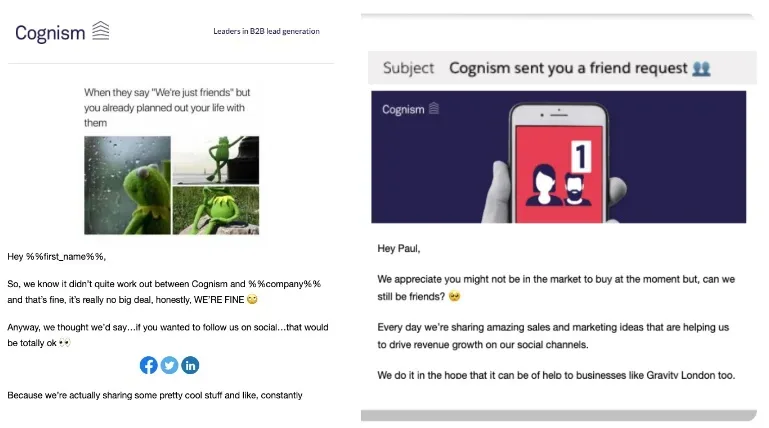
Cognism is an excellent example.
The brand ran an email marketing campaign to win back lost customers. The wording couldn't be simpler or closer to everyday life — so much so that it alone makes you want to resubscribe to the mailing list.
Use storytelling
By taking the focus off the sale and turning to storytelling, brands help customers feel empowered. They feel it's their decision to buy. Essentially, the brand isn't forcing a sale, it's simply telling a story.
By creating content customers see themselves in, the brand builds an emotional connection. Take the Maxmat campaign. The idea behind it is very simple! Someone who isn't much of a DIY expert but needs a hand. Who hasn't walked into a hardware shop looking for “that thingy that fits into the other thingy”?
By telling this story, Maxmat captures the day-to-day life of shops and customers all over Portugal. That's something the audience can easily relate to.
At the end of the day, people will remember how “that” campaign or “that” ad made them feel, not whether brand A or B is wonderful.
Own up to our imperfections
Nobody's perfect. We already know that. Even so, nothing stops us from trying. And the first step is acknowledging what we're not so good at.
That's exactly what Pepsi did with its “Is Pepsi ok?” campaign, naming its main competitor in the ad and admitting to being the customer's second choice. In this case, self-awareness was what made the whole campaign a success. Invest in omnichannel service
If you've read this far, you might have got the impression that H2H marketing rejects technology altogether. Well, it's precisely the opposite!
An H2H strategy uses technology to humanise communication with the customer. So, through an omnichannel service, brands deliver a consistent customer experience.
In other words, if we contact a company by email, then by phone and, a few days later, use Instagram chat, the brand will pull together everything we've told them so that next time we get in touch, we don't have to repeat it all over again.
Use customer relationship management (CRM) software
Omnichannel is an extremely powerful tool these days. But for it to do its job, you need CRM.
In short, this software collects the data customers provide to help the brand respond to their needs and wants. CRM therefore makes it easier for teams to work together, personalises the customer experience and supports efficient service.
The impact of omnichannel CRM on the success of an H2H strategy
Brands that adopt human-to-human marketing want to talk to customers the way we talk to the people closest to us.
Unless you're a corner shop, that kind of closeness is virtually impossible nowadays. Today's brands have too many customers and too few resources to handle each one individually. So they're forced to find technological solutions.
When we talk to a friend, they'll surely remember the conversation we had (unless they're the human version of Dory!).
So why can't brands do the same? Why do brands make us repeat everything we've already said, over and over again?
Omnichannel CRM brings out the benefits of the H2H strategy.
By using the information gathered through CRM software, you can improve the quality of the service delivered to customers across the brand's various communication channels. In this sense, omnichannel CRM makes it possible to achieve a near-perfect buying experience at every stage of the journey.
It all comes down to one word: consistency!
Customers know they have several channels available to communicate with the brand. And what they expect is the same tone, availability and quality of service across all of them.
Omnichannel CRM in service of an H2H marketing strategy helps maintain consistent service quality, improving the customer experience.
Back to basics: the human relationship
The human-to-human concept aims to go back in time and revive human relationships as they've always been. With emotion. With empathy.
Now, though, we have technology on our side. We can make the most of the huge technological leaps of recent decades to do something machines will never be able to do for us: build an emotional relationship.
Can you picture everything it could do for your brand?

Get what we write
No fixed calendar: only when there is something worth your time.