How brands interact on social media

Marta Peral Ribeiro – Communications Consultant –
We've talked about the impact digital influencers have on their followers' actions, with closeness being one of the things that makes the difference — namely through informal language and interaction with users. But what about brands? How can they connect with their target audience, and what impact does that interaction have?
Marta Peral Ribeiro – Communications Consultant –
We've talked about the impact digital influencers have on their followers' actions, with closeness being one of the things that makes the difference — namely through informal language and interaction with users. But what about brands? How can they connect with their target audience, and what impact does that interaction have?
Meeting point: social media
Based on their experience with the brand, audiences like to validate the information they receive. When that information chimes with their own experience, they identify with the brand and take an interest in it.
And where do we go when we want to know more about a brand? Social media. This is where brands and consumers meet. That's why it's essential for brands to be on these digital platforms.
Interaction as a differentiator
More than simply being on social media, it also matters that companies make room in their communications plan for interacting with their followers.
When a brand knows its audience well, when it takes the time to look at its followers and their comments, reading what they write and share, replying with empathy and care, it connects with them — and that makes it stand out in the digital sphere.
This matters all the more when a product or service is purely digital: the brand needs to focus on the conversation with its audience, getting to know their world, their tastes, interests and behaviours, as well as how they perceive the organisation.
Good interaction on social media certainly calls for plenty of agility, given what a megaphone social media can be, but the payoff can be considerable.
Good interaction with a customer can mean converting them
What customer forgets the moment someone solves their problem, especially when they're treated with care and given a personal response? The way people are treated often decides what they end up buying. In fact, even price tends to lose its pull when there's an emotional connection, as we know.
That delivers a return on investment — often higher than acquiring a new customer. On the other hand, an ill-judged reply can cost you a customer (or worse: a lot of customers).
4 things to bear in mind when you communicate
1. Language, tone and authenticity
Depending on the tone of the comment, the community it comes from, the product being sold and the organisation being represented, the language should be clear and light. And, wherever possible, answer with humour.
But not every brand has that leeway. What works brilliantly for some, because it reflects who they are, would be a disaster for others. Here, sensitivity and common sense rule.
2. Strategic thinking: staying one step ahead
Although the ideal is a personal reply (nobody likes canned responses), it's worth mapping out a flow of answers to likely comments, because an off-the-cuff reply can cause real headaches. In other words, think through in advance what kind of approach makes sense for the company in each situation.
3. Timeliness: context is crucial
Because it's asynchronous, communication on social media doesn't require an immediate reply. Even so, the communications team should keep up with what's going on in the world, because having or living through something in common with users strengthens the emotional connection.
4. What drives the brand? Restate your values
Through comments, a brand can and should reaffirm its principles and values, giving greater visibility to its reason for being. This kind of reply can be particularly useful when you get a comment questioning something the company has done.
A conversation guide — what we can learn from other people's experience
Empathy with the user
Handling comments takes a great deal of empathy. Users like to ask questions, to find out more, to give praise, so compassionate communication is always a good idea. After all, a user represents a customer — the company's whole focus.
Even when a comment looks negative, it may not actually be aimed at the brand in that way. It might simply reflect a need or a bit of anxiety — the anticipation of receiving a product or using a service, for instance.
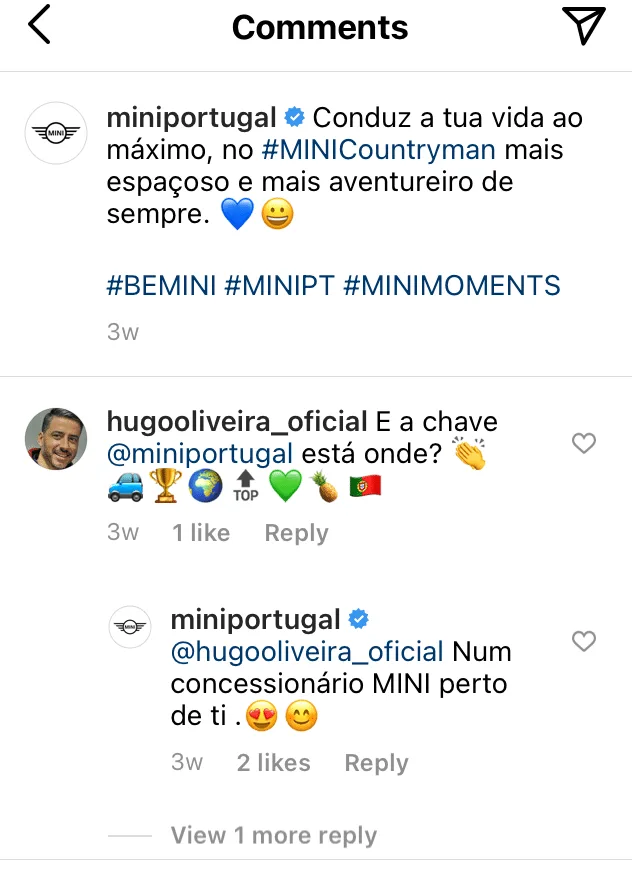

Showing understanding of a customer's need, McDonald's explains why a product isn't available:
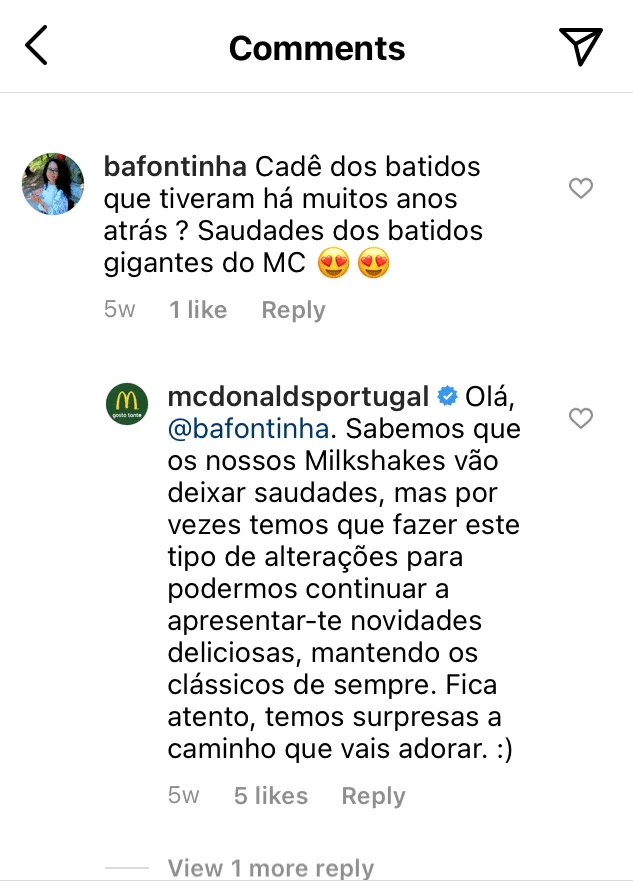
Principles, means and ends
There are always opportunities for a company to restate its principles.
When asked about its sustainability commitment, The Body Shop — a cosmetics brand known for its eco-friendly approach — set out exactly what it was doing, reaffirming its mission to reduce the environmental impact of its packaging.

Competitor alert
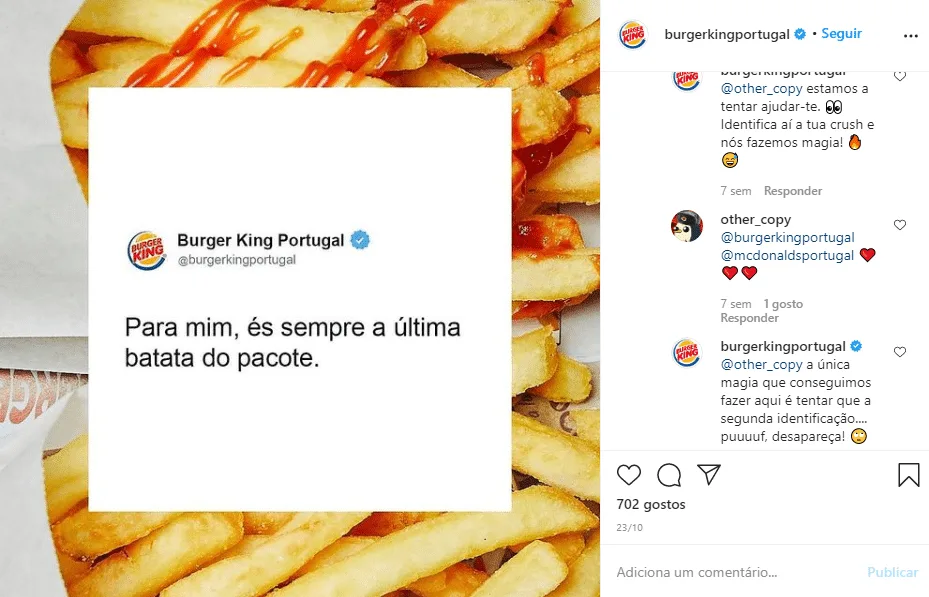
Some brands are particularly exposed to being compared by users — fast-food or supermarket chains, mobile operators or streaming platforms, for example.
Burger King is one of them:
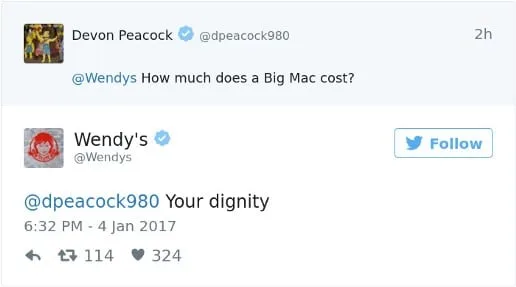
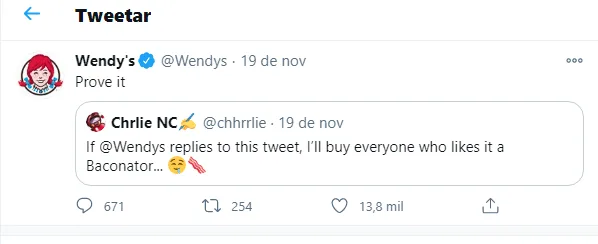
Wendy's, the American fast-food chain, is known for the strong conversation it keeps up with users on its social channels, with an authentic, unmistakable voice full of humour — often sharp-edged.
In this example, it didn't hold back from taking a swipe at rival McDonald's when Devon Peacock asked how much a Big Mac cost:
An audience invested in the brand
Sticking with Wendy's, the level of connection is so engaging that the brand proactively replied to a user who had promised to buy everyone a burger if the brand answered his post:
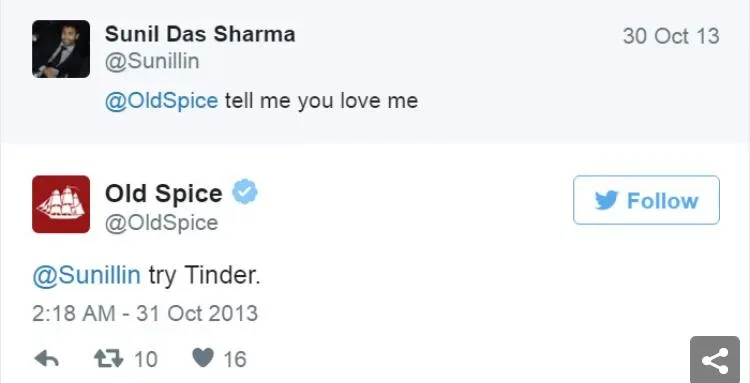
Old Spice also showed sharp humour when it suggested a follower try using Tinder:
Complaints
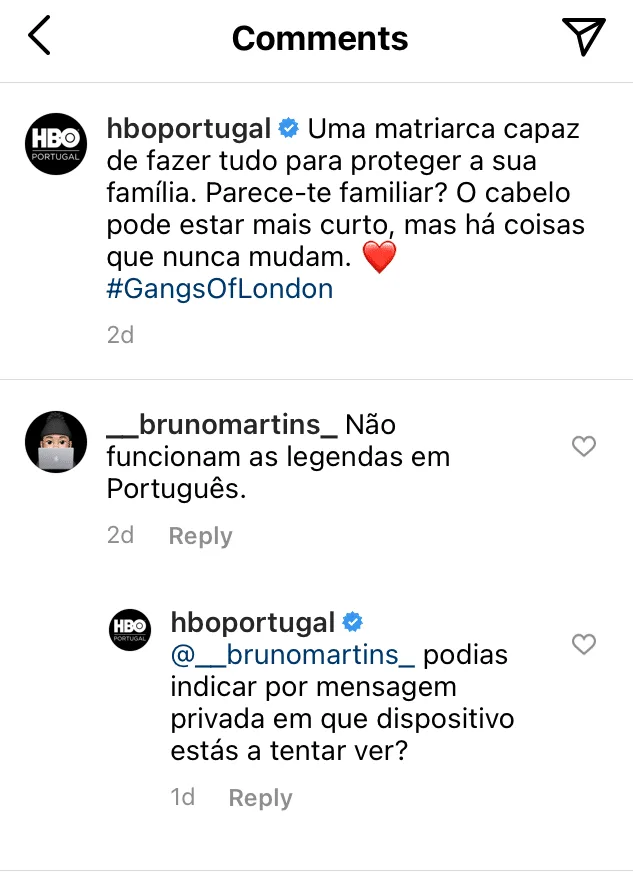
If a comment is a complaint, it makes sense to look for a solution to the problem in order to soften the negative effects. You could ask what happened (if it isn't obvious) or share a link or contact for support.
Mea culpa
If something really does go wrong, the best thing is to be transparent and own the mistake, stepping forward to win back followers' trust.
The response might be an apology, a formal statement, an explanation shared openly with users, or a post setting things out in a Q&A format.
Finally, the company shouldn't give in to the temptation to delete a negative comment. Imagine what can happen if the user takes a screenshot — which they very probably will.
The lesson we learned from McDonald's
Last year, McDonald's Portugal's Halloween campaign “Sundae, Bloody Sundae” led the brand to pull the ad and apologise for what had happened. What was meant to be a Halloween campaign playing on the U2 song “Sunday Bloody Sunday” caused offence (particularly to one Irish citizen), given that the song evokes the British army's massacre of unarmed civilians in Northern Ireland in 1972:

Outstanding customer service
A great example of excellence in customer service came from LEGO, in response to an appeal from a 7-year-old who had lost one of his figures.
The exchange took place by email and went viral at the time, because LEGO found its voice in a compassionate, creative reply to the child — someone who shares its passion for play and its inventive spirit.

Want to bet that family is a LEGO customer for life? And more to the point: how many users turned into customers after this story?
On social media, as in life, you won't please everyone, but working on interaction with users — mapping their comments, reactions and behaviours — is surely the best route to winning the loyalty of a good chunk of your audience.

Get what we write
No fixed calendar: only when there is something worth your time.