How did a brand in a sector in crisis manage to grow?

Miguel Afonso Gonçalves – Copywriter and Travel Blogger –
Do you work on a brand in a sector hit hard by Covid-19? Are the 2020 metrics that guide your brand's communications and marketing looking grim? Is the year that has just started already looking a lot like the last one? Well, under exactly the same conditions there are success stories out there — and the next one could be yours.
Miguel Afonso Gonçalves – Copywriter and Travel Blogger –
Do you work on a brand in a sector hit hard by Covid-19? Are the 2020 metrics that guide your brand's communications and marketing looking grim? Is the year that has just started already looking a lot like the last one? Well, under exactly the same conditions there are success stories out there — and the next one could be yours.
March 2020 was the month when the communications, marketing and business strategies of everyone connected to the travel world changed drastically. Without exception, brands in the sector felt the shock of the pandemic. From hotels to transport. From physical to
online
That said, if for the big brands — in terms of headcount, turnover, pageviews and so on — it was going to be impossible to hold on to the figures of recent years, for smaller brands the chances of winning visibility and improving results looked slimmer still.
After all, when natural growth in demand disappears, what levers do brands actually have to push themselves forward?
As the owner of a brand in the travel business, I was confronted with this scenario head-on. For the purposes of this exercise, the primary objectives for this particular brand are growth in pageviews, unique visitors, interaction with visitors and various other metrics that indicate whether the communications and marketing strategies are working. As with any product that needs to be handled with the full marketing toolkit, the question worth asking is: what strategy was used to grow in an atypical year, in a weakened sector?
Setting KPIs that are more rational than emotional
First of all, it helps to understand the numbers involved. This is a young brand, only in its second full year of activity, so aiming to double most metrics year on year was by no means impossible. In fact, January and February alone had already delivered 30% of the previous year's pageviews and visitors — partly thanks to natural growth in demand, but also proof that the strategies were working.
However, as with any brand, key performance indicators (KPIs) — in other words, the indicators that measure progress towards measurable objectives — can and should be revised when certain external variables change.
Precisely because they are essential to shaping a marketing strategy that ends up delivering the objectives set, KPIs need to be realistic rather than unreachable dreams.
So in March, with the global shutdown and the resulting natural drop in demand for anything travel-related, the objectives were rethought, which in turn led to a logical reworking of the communications and marketing strategy so that the brand could still grow compared to the previous year.
With the objectives set, then, which tools proved indispensable to the strategy that followed?
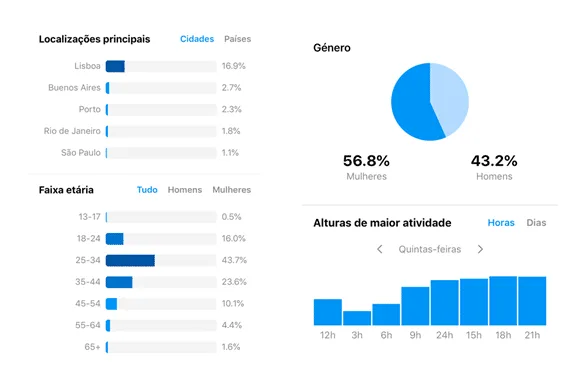
Understanding your audience
Every strategy is aimed at a target audience, so knowing that audience is the first, non-negotiable step and it defines everything that follows.
Whether from website metrics or the metrics available on social media, the information needed to profile an audience is readily available to any brand with an online presence. Understanding the main segments — customers, consumers or visitors — creates the opportunity to bring them closer to the brand through the various marketing levers, be it the product or the communications, tailored to the main segment or segments. You then decide where to be present, how, and what to say, and these factors can be adjusted, since audience motivations are not fixed, as we see when a sector is in crisis.
Improving the copy in your promotional work
The world, and the digital world in particular, has become increasingly seduced by sight, by image, by colour and by movement.
If the brand's objectives include increasing visits — pageviews and visitors — to a website, then it has to be promoted (along with the content) in an attractive, tempting way. And a big part of that comes down to the quality of the copy accompanying the promotion, whether in an ad or in a post on the brand's own online pages.
The world, and the digital world in particular, has become increasingly seduced by sight, by image, by colour and by movement. But there is no doubt about the persuasive power of words. It is in the combination of the two, though, that the real formula for success lies. They should complement each other, prompting a click from the customer/consumer/reader/follower without giving too much of the content away. But how do you write good copy?
In the case of the brand in question, the aim was to get the audience to click the links being shared, generating new pageviews. So how do you make a short piece of text appealing? For a start, by using eye-catching keywords that give at least some idea of what the post or product is about, combined with adjectives, since those are the words that give the product value, benefits and qualities. Finally, a call to action, whether direct — “See it here” — or dressed up as a question — “Shall we take a look?” — nudges the audience towards the action the brand wants: the click.
Making the most of audience engagement
If there is one thing a brand cannot afford to give up on, it is staying relevant to its audience. And an effective way of doing that is to keep in regular contact with followers.
Here, social media, as communications and marketing tools, are decisive in meeting those objectives, since in current practice they are one of the main meeting points between the two.
There is therefore room, from the brand's point of view, to build loyalty and interact with followers. And there is plenty of choice when it comes to giving them a voice: ask questions, create games or interactive formats such as polls or quizzes, set challenges and invite people to share their stories and content. More engagement not only builds closer relationships with followers, it also helps brands work around social media algorithms, making sure they stay visible to their audience.
By making the most of audience engagement, the brand stayed relevant, persuaded followers to take up the challenges it set, and generated more traffic to the site.
Results and conclusions
Before drawing any conclusions, it is worth stating clearly that with a communications and marketing strategy built on these four pillars, the brand in question did in fact grow compared to the previous year. The main objectives, readjusted after the impact of the crisis caused by the pandemic, were met.
Growth of 14.2% in visitor numbers, along with pageviews, which came in 4% above 2019, shows the value of better-crafted copy, careful research and interaction with the audience, as well as clear, sensible KPIs — enough to rescue a brand from a situation in which, relying on organic demand alone, it would have seen its metrics hit record lows.
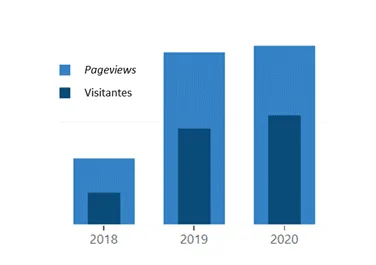
On top of these figures come the rising engagement rates (all interactions divided by impressions/reach) — which grew from 7% to 14% on the site and, per post, from 16% to 25% on social media — as well as growth in newsletter subscribers and in genuine followers on social media.
*The author of this article writes using the old Portuguese spelling rules.

Get what we write
No fixed calendar: only when there is something worth your time.