Influencers: how to find the right one?

Miguel Afonso Gonçalves – Copywriter and Travel Blogger – The label may be fairly recent, but the concept has been studied at length by marketing and advertising specialists. For decades, many brands have worked hard to associate themselves with faces recognised by a wide audience. More than simply being “familiar faces”, these are people capable of influencing the decisions of a significant number of others. And this idea runs through every advertising medium – from the most traditional to the most innovative – starting with the timeless word of mouth between friends or family!
Miguel Afonso Gonçalves – Copywriter and Travel Blogger – The label may be fairly recent, but the concept has been studied at length by marketing and advertising specialists. For decades, many brands have worked hard to associate themselves with faces recognised by a wide audience. More than simply being “familiar faces”, these are people capable of influencing the decisions of a significant number of others. And this idea runs through every advertising medium – from the most traditional to the most innovative – starting with the timeless word of mouth between friends or family! A new phenomenon has emerged, however, driven by social media and its hold over people: digital influencers.
Unlike those who once appeared in elaborate television adverts or on billboards “by the roadside”, digital influencers are marked out, first and foremost, by the simple fact that they need not be recognised celebrities to begin with. What is more, their influence may extend to no more than a few hundred people. Yet this supposed drawback does not stop them delivering positive results for the brands that back them.
In a digital world increasingly full of influencers, what guarantees do brands have that they are choosing the right ones? What characteristics suggest a digital influencer is the best fit for a given campaign? There are always a few myths…
Before we work out the route to a clear answer to that question, let us look at some of the myths commonly attached to this subject.
We have all grown up hearing the phrase “quantity is not the same as quality”, and it could not be more fitting here. One of the most common mistakes is to assume that investing in an influencer will only pay off if their follower count is high enough. Now let me ask you (yes, you, reading this article): how many times have you said or thought, faced with celebrity endorsement in any advertising format, that a particular public figure does not actually use the product they are promoting but is happy to lend their image for a fee? How credible is turning to an influencer in this way, really? And what actual return will it bring for such a large upfront investment?
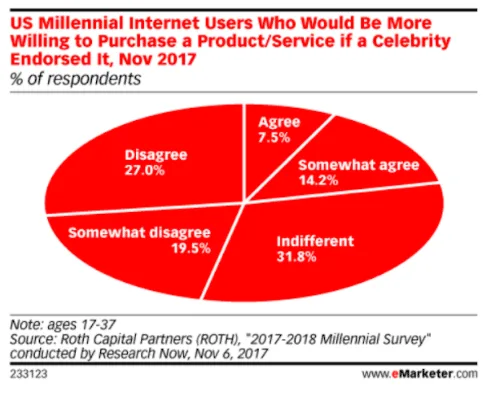
Take a look at the image below: a study conducted by eMarketer in 2017 found that almost 80% of US millennials do not feel influenced by celebrities advertising a product, and that celebrities lend no credibility to the brand in question (source).
A second myth that is still very much alive stems from the idea that the influencer’s field and the brand’s must necessarily match. In other words, to what extent can, or should, a healthy food brand only work with influencers whose profile is built on a lifestyle of sport, the gym and diets? Put simply, of course it should not! Doctors who are influencers in their spare time can also be valid options. In fact, not only do they reinforce an authentic, credible narrative, they also widen the pool of potential customers who come into contact with the brand (assuming both have a different follower profile).
The credibility and reputation of a brand or product is built, above all, across a much wider space – remember, as we have already said, how simple word of mouth between friends is powerful enough to drive our decisions. Indeed, I doubt there is a better example of anyone’s ability to be an influencer than review platforms. Why do the opinions of complete strangers influence us so much? Why do we decide against the hotel where user “LurdesDasViagens” had a bad experience she made a point of sharing on TripAdvisor?
In short, a brand’s reputation should not rest solely on influencers who are supposed specialists in the brand’s field, since any anonymous person has the power to contradict it.
So how do you map out the best strategy for deciding which influencers your brand should be associated with? (In)compatibility: brand vs influencer
The starting point is the same as in any human relationship: is there compatibility? And what needs to happen for that compatibility to exist? What should marketers be looking at in influencers?
Let us start with three crucial points:
1. You must know the brand inside out: its DNA, its values, its image.
This first point seems logical and obvious, but you can only define a profile that fits the brand by knowing it and what it stands for very well – including for its customers and target audience.
2. Analyse each influencer’s profile against the same characteristics – what values they stand for and convey, what image they have built around themselves.
One of the most important elements in communicating a brand effectively is creating a coherent, consistent narrative. If brand X “sells” a more extreme lifestyle, having ambassadors who live that same lifestyle helps hold the thread of the narrative together.
And how do you analyse an influencer’s profile? Look at their posts – everything counts: the visuals, the copy, the timing of posts, the interaction with followers, and so on.
What values do they stand for? Do they align with your brand’s? Are the images good quality and not over-edited? Remember that today, the audience you are trying to reach prefers authenticity to the selling of impossible dreams!
According to a recent study (Mazzin), “90% of young people value transparent brands” (source). Are the captions well written? If you prefer, in sponsored posts you can write the copy your brand will be associated with! Just do not fall into the trap of making it too “artificial”.
3. Nano-influencers, micro-influencers, macro-influencers?
It is time to get the calculator out (but do not focus on those numbers alone). Let us look at some facts. With the data set out above, we are not arguing for one group or against another. On the contrary, there are advantages and disadvantages in every scenario. What you must remember, though, is to maintain an authentic, credible, coherent and consistent narrative. These are the factors your target audience pays most attention to.
When it comes to choosing an influencer (or several), think about the brand’s profile. Think about the values it respects and stands for.
Naturally, the ideal ambassador for your brand will emerge as soon as you connect all the points described in this article and tie them to the DNA, the blood, “running through the veins” of your brand!

Get what we write
No fixed calendar: only when there is something worth your time.