Let’s talk, Chat! Our friend, ChatGPT.
Sandra Caravana – Copywriter – Oh no, not another piece about ChatGPT!
Easy, easy. Take it easy. Even I’ve had 16 emails from Neil Patel about this. Let’s take the hype of 2023 one step at a time.
For anyone who’s been away – what is ChatGPT?
First organic result from Uncle Google: Wikipedia. It reads: ChatGPT (Chat Generative Pre-trained Transformer) is a prototype artificial intelligence chatbot developed by OpenAI and specialised in dialogue. The chatbot is a language model fine-tuned with supervised and reinforcement learning techniques. The base model that was fine-tuned was OpenAI’s GPT-3.5 language model, an improved version of GPT-3.
Sandra Caravana – Copywriter – Oh no, not another piece about ChatGPT!
Easy, easy. Take it easy. Even I’ve had 16 emails from Neil Patel about this. Let’s take the hype of 2023 one step at a time.
For anyone who’s been away – what is ChatGPT?
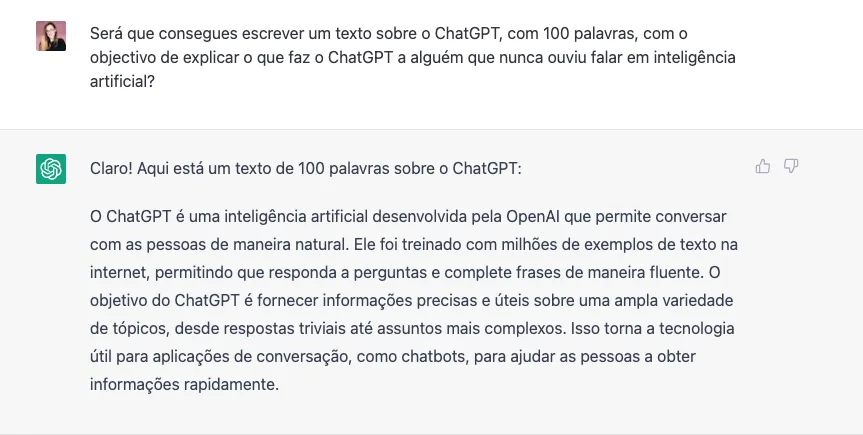
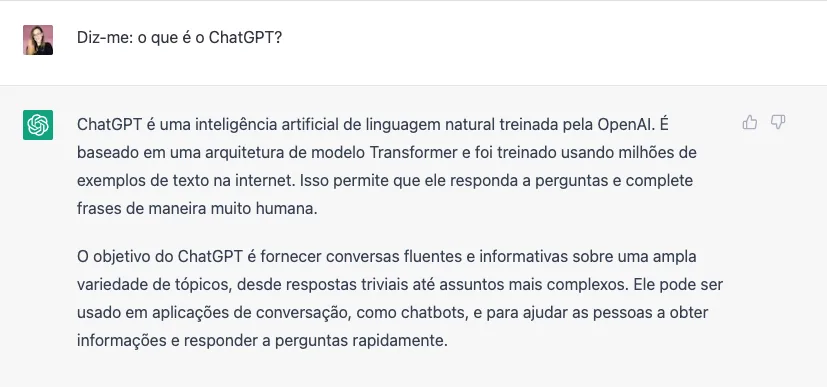
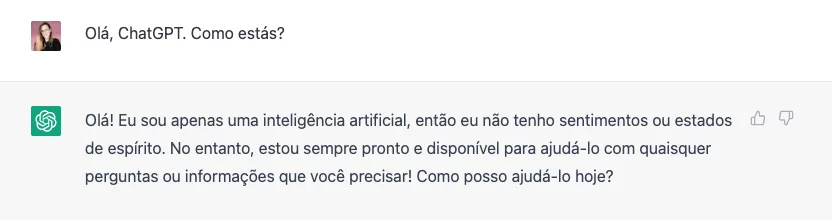
First organic result from Uncle Google: Wikipedia. It reads: ChatGPT (Chat Generative Pre-trained Transformer) is a prototype artificial intelligence chatbot developed by OpenAI and specialised in dialogue. The chatbot is a language model fine-tuned with supervised and reinforcement learning techniques. The base model that was fine-tuned was OpenAI’s GPT-3.5 language model, an improved version of GPT-3. The name says it all here: it’s a chat. In this case, we’ll be talking to an artificial intelligence system, but it’s a chat. And if it answers us, why not talk to it directly? Nice of him, this ChatGPT. He could have used his artificial intelligence to work out that I’m a woman and that I identify with female pronouns — especially since you have to log in to use the chat and I signed in with my Google account and… well, there’s my photo! And all the data, and then some, that Uncle Google keeps on me, but … fine. Moving on: OK, it matches the first research result, our good old Wikipedia. It’s actually a lot more thorough. Shall we keep chatting? Thumbs up. Well done, ChatGPT.
Cool, isn’t it? I think so too.
So why has ChatGPT stirred up so much controversy, so much debate, so many newsletters, so many social media posts and so many articles?
And the winner is…
Because we are nothing without writing.
Everything is communication, and communication has been worked on over the years to become ever more inclusive. Writing is the universal language. It started out as drawings and then moved on to writing, refined by us, human people.
The fear is that ChatGPT – and similar systems – will replace the work of people who write: copywriting services, translation and editing services, not forgetting the marketing community and, would you believe it, even teachers.
That isn’t going to happen, because, as Neil Patel explains in one of his newsletters: What threats does ChatGPT pose to writing professionals?
- Writing copy and using it in marketing, social media and academic work.
- Competition for the biggest search engine: Google.
- Less demand on human creativity
Will ChatGPT write everything for us?
No, but it can help a great deal.
Yeah, right, but that’s cheating.
Well… Let’s go back a few years, shall we?
Who remembers Diciopédia? Launched by Porto Editora and Priberam in 1997, Diciopédia is a multimedia encyclopaedia which, in the year it came out, meant CD-ROM. A new, fully updated edition was released every year. For Generation Y (or Millennials) this was today’s Google. For Generations Z and Alpha, allow me to explain:
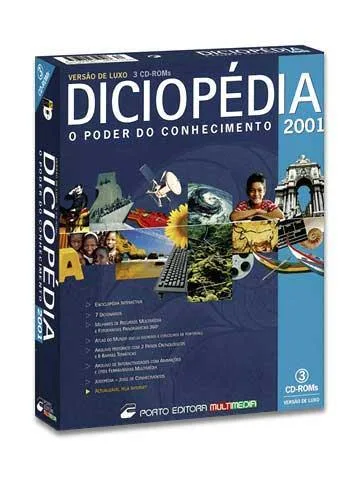
Once upon a time there was a girl who asked Father Christmas for a computer. As she had been very good that year, Father Christmas brought her not only a new computer but also the 1999 Diciopédia. This computer was so good and so new that it no longer had a floppy disk drive, but a CD/CD-ROM drive instead! So the girl was thrilled to be able to use Diciopédia on her very own computer. She tried it out as soon as term began. The History teacher asked the class to write a piece about Damião de Góis. Still buzzing about her Christmas presents, the girl decided not to go to the library to look for books on Damião de Góis, but to use her new Diciopédia instead. So she put the CD-ROM into her computer, waited for the program to start up and typed ‘Damião de Góis’ into the Diciopédia search box. Imagine her amazement when the program gave her several texts about Damião de Góis. All she had to do was copy and paste them into her Word document. Homework done.
Note: story written by the author of this piece and not by ChatGPT, despite the lack of emotion, incident and conflict.
Does this story sound familiar? Go on, you can admit it, nobody’s listening…
The last Diciopédia dates from 2010, the year another kind of encyclopaedia rose to prominence in Portuguese schools: Wikipedia, an online encyclopaedia. And the rest is history. However many search engines are out there, only one has turned its name into a verb: Google. Let’s be honest: who never handed in a piece of primary school work that was 87% the first three results from Uncle Google?
But the issue is more serious when it comes to academic work.
Is it, though? There have always been services that write university dissertations for you. Is that cheating? Hmm… We also pay a professional to write technical copy for our websites or blogs. Here, ChatGPT can be a great ally, BUT…
Google is rattled by the potential of this new AI era. It has already announced that it will soon launch its own chatbot, named Bard. Bard’s aim is to give the user a complete answer to whatever they searched for, without having to open several sites to cross-check and add information. Here’s hoping Bard recognises me as a cisgender woman.
ChatGPT is the new Resumos Europa-América (too many 1999 references?). The big difference is updating: Os Maias will always be Os Maias. Years and years of study and the conclusion is the same: our society is broken, shattered, devoid of values. With technical articles, the issue is how up to date they are. With every new discovery, there’s a time lag before things are published and verified online. So asking ChatGPT to write a technical article (something in the pharmaceutical industry, say) requires checking by professionals. Human ones.
Creativity has been called into question. Not just in writing, but in illustration too, using the Lensa app, for example. Does that mean there’s no work left for illustrators and designers?
If you’re reading this and you’re a mum or a dad, or have any other family role or job that involves spending a lot of time with children (or volunteering), here’s a challenge: read O Cuquedo and answer this question — could an AI system have created O Cuquedo?
Is ChatGPT useful across a range of fields?
Useful is indeed the right word. Yes, even in HR departments: at the first point of contact, if HR departments so wish, this clever chatbot can also draft an email introducing the company, thanking the candidate for their interest in the role in question and inviting them to interview. From there, contact with each candidate and the interview itself are jobs for HR professionals, who have capabilities such as empathy, for example, that are exclusive to humans and cannot be replaced by machines – as RH Magazine quite rightly puts it. Source: RH Portal It’s useful, but we – humans – need to know how to use prompts.
A prompt is the request we make to ChatGPT. It’s what we write, it’s our ask. And why do prompts matter so much?
- The content it delivers depends on what we ask for.
- It’s through prompts that ChatGPT learns and improves its answers.
Yes, you read that right, ChatGPT learns. As we humans request information from ChatGPT, we also ask it to cross-reference data – that, ultimately, is this tool’s great advantage. Asking it to cross-reference data forces ChatGPT to fetch more information from its databases. So it keeps learning. And that’s where the danger lies. Source: Pixabay Is ChatGPT the new Wikipedia?

Anyone can edit a Wikipedia page or write an article, with no fact-checking. Why? Because of that very important thing called the INTERNET. Does ChatGPT have a built-in lie detector? If so, can ChatGPT avoid fake news? Can ChatGPT tell facts from opinions? If it can’t yet, it’s expected to be able to, because even that can be trained. Scene from Disney’s “Inside Out” It’s a powerful tool. It’s the Canva of people who work in social media and don’t know how to use Photoshop – and don’t forget that Canva already has the Magic Write option, albeit with usage limits and blocked for education accounts: teachers and students.
We promise to use ChatGPT in moderation.
I fear it will become the next Netflix: it arrived, it’s for the whole family, at a good price (ChatGPT is completely free… for now). But there’s always someone who doesn’t get the point, and the password ends up shared with the entire class. And since in Portugal we have the saying ‘the innocent pay for the
guilty’, Netflix has decided to include our country in the new rule: Netflix is for household use and has to be tied to an address (all those grandparents who learned to use Netflix are now going to lose the service).
Will we one day have to pay royalties to ChatGPT? Google has already stated that it will penalise content, including advertising, created entirely with ChatGPT. How? With more artificial intelligence.
Joking aside, ChatGPT is, like any other artificial intelligence tool, the future.
But does the future depend on this particular tool?
No.

Get what we write
No fixed calendar: only when there is something worth your time.