Marketing Automation and Programmatic Advertising: has Web 3.0 already arrived?
Miguel Afonso Gonçalves – Copywriter and Travel Blogger – Anyone who has never heard the phrase “my Internet is different from yours”, own up. The growing personalisation of each user's online experience is just one of the many principles shaping Web3, or Web 3.0. And if phrases like these are now commonplace, it's probably because Web 3.0 is no longer just a dream or a mirage. Although I was familiar with the concepts, I remember very clearly one of the first times I heard the terms “marketing automation” and “programmatic advertising” described as tools that were starting to take centre stage in growing a business.
Miguel Afonso Gonçalves – Copywriter and Travel Blogger – Anyone who has never heard the phrase “my Internet is different from yours”, own up. The growing personalisation of each user's online experience is just one of the many principles shaping Web3, or Web 3.0. And if phrases like these are now commonplace, it's probably because Web 3.0 is no longer just a dream or a mirage. Although I was familiar with the concepts, I remember very clearly one of the first times I heard the terms “marketing automation” and “programmatic advertising” described as tools that were starting to take centre stage in growing a business. A couple of years ago, in the newsroom of a well-known media outlet, during yet another interview for my master's dissertation, these terms came up again and again in the answers I was getting.
In fact, the marketing manager at that same organisation told me that programmatic advertising had not only changed the way they looked at the business of selling ad space to advertisers, it had also redefined their own communication and marketing strategy in the business-to-business segment.
So what exactly do these bits of marketing jargon mean — the ones that so many specialist publications keep flagging as (essential) trends for 2022? Bringing in new technology
It's hardly news, but adopting new software and technologies, backed by more complete and more advanced algorithms and artificial intelligence, remains a constant investment in marketing efforts. And why do they matter so much to businesses?
Let's start by acknowledging that, with the word “advertising” in the name, this is clearly a tool for communicating services, products, ideas, values, dreams: brands.
At the start of this century, in his iconic book Purple Cow, Seth Godin questioned how effective advertising really was at the time, whether because there was too much “advertising noise” or because most advertising simply wasn't differentiating. Almost twenty years on, we can challenge that premise, because we now have increasingly intelligent tools at our disposal to help us.
There are countless ways to communicate successfully with an audience. To begin with, the route will differ depending on the primary objective of a given activity — whether you want to build awareness of the brand or product, or whether you want to generate leads and trigger a purchase process. Let's look closely at the second scenario. One possibility — and a very interesting approach for businesses — is knowing in advance that a particular audience is naturally, or potentially, receptive to your message. That's why, over recent years, marketing automation has been a central topic of debate. Marketing Automation
Before we go any further, let's look at the figures from emailmonday's study “The Ultimate Marketing Automation statistics”. Set out like this, the role these tools play across all marketing activity is beyond dispute. So let's see what it means in practice.
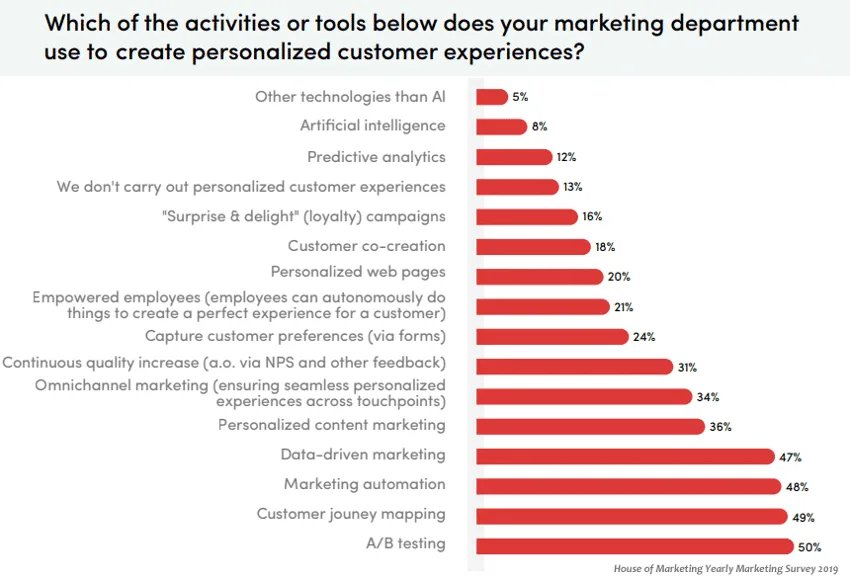
Marketing automation is simply the use of software and technologies based on data analytics and artificial intelligence algorithms to personalise the message for consumers and potential consumers. And how have brands been using these mechanisms? Examples include chatbots, virtual assistants, predictive marketing and — the main reason we're here — programmatic advertising. Source: https://www.emailmonday.com/marketing-automation-statistics-overview/ Programmatic Advertising
Looking back over the ground covered in this article, it's easy to see that programmatic advertising rests on the development of technologies tied to the fascinating world of artificial intelligence. But how, exactly?
First, let's define the concept. To be brief and clear, let's take the definition given by the Digital Marketing Institute itself — programmatic advertising buying is the use of software to buy digital advertising space. Similar to the previous point, right?
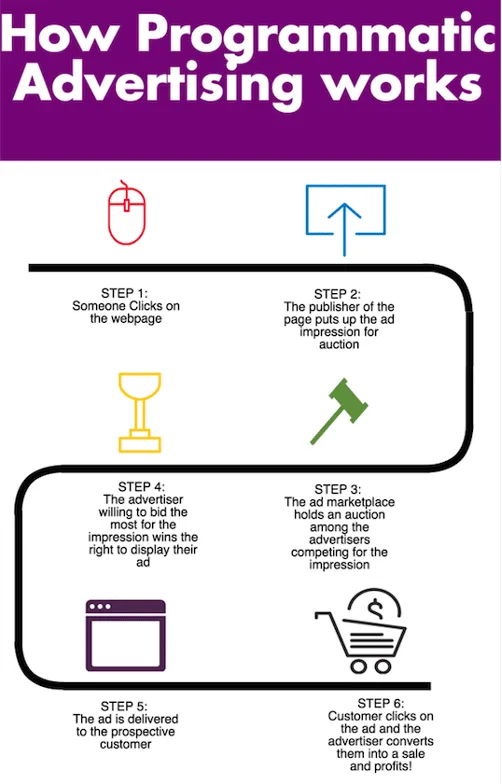
It's also worth taking a close look at three advantages of this tool, which bills itself as the standard-bearer for optimising digital marketing campaigns.
Source: https://www.singlegrain.com/marketing-automation/5-trends-that-will-define-the-new-vision-of-marketing-automation/
- It simplifies and speeds up the process of buying and selling ad space. Instead of a long negotiation between buyer and seller, an algorithm based on an online auction system (RTB, or real time bidding) finds the ad spot that best matches the amount the advertiser is willing to invest and the duration of the campaign. Bear in mind, though, that you'll still be competing with hundreds of other advertisers for the same space.
- More profitable and more sustainable, with a higher return on investment (ROI).
- When it comes to targeting, this tool helps, on the one hand, to define the target audience strategically, so you avoid wasting budget on visitors to a given website who won't be potential consumers. After analysing each user's data, including geographic, demographic and behavioural criteria among others, the algorithm picks out those most likely to be interested in that specific ad and, in turn, most likely to become customers. On the other hand, the reach of the advertising is potentially global, since the algorithm brings together the worldwide network of available ad space.
- Campaign performance can be measured in real time.
If you're still glued to this article, the subject clearly means something to you. So you'll be asking me, “how do I go from theory to practice?”. Over the past decade several platforms for managing programmatic advertising campaigns have launched, and three stand out: Adobe Marketing Cloud, DoubleClick and AdRoll.
Marketing automation processes and programmatic advertising are, in theory, an asset for businesses in general.
Even so, it's essential to have a team coordinating internal efforts so that the leads generated by the marketing team are actually converted into customers by the sales team.
In short, let's stop being surprised when, after a few searches about London, we start seeing ad after ad for flights to the English capital or hotel bookings. We are the main creators of “our” Internet, which is increasingly unique and unrepeatable on every phone, tablet or computer. Brands know this, and the algorithms behind their advertising strategy collect our information every day, with every click. The benefits of programmatic advertising have been set out, and so have the warnings about what can go wrong. You know the rules now. Shall we play?

Get what we write
No fixed calendar: only when there is something worth your time.