New Year, new marketing trends for 2023

Catarina Alves de Sousa – Social Media Manager – The past few years have brought big changes in the way we — people and brands — communicate, market and sell.
In 2022, marketers made a point of showing up where their audience is more than ever before, appearing in our feeds alongside influencers and content creators. As we get a better understanding of how the people we want to reach behave online, we adapt our strategies based on what we learn first-hand in the digital space and on the digital marketing trend forecasts for the year ahead. And speaking of those, shall we?
Catarina Alves de Sousa – Social Media Manager – The past few years have brought big changes in the way we — people and brands — communicate, market and sell.
In 2022, marketers made a point of showing up where their audience is more than ever before, appearing in our feeds alongside influencers and content creators. As we get a better understanding of how the people we want to reach behave online, we adapt our strategies based on what we learn first-hand in the digital space and on the digital marketing trend forecasts for the year ahead. And speaking of those, shall we? TikTok influencers, content creators and YouTube personalities are dominating digital engagement, consistently producing high-quality content that even rivals that of major brands.
For marketers to grow their brand in 2023, they need to reach customers online and adopt a more conversational, more viral way of marketing their brand or services digitally.
Social media, websites and ads are great ways to spark interest and build brand awareness, but with so many other companies “playing” by the same rules, getting your business noticed online and making an impact on potential customers has proved rather more challenging over the past two years.
So the trend is to keep going; in other words, brands need to keep working at building closer relationships with customers, prospects and followers — both in real life and on social media.
When it comes to social media, it is no longer enough to simply be where the people you want to reach are; you have to create what most of them want to consume, in the most original way possible. TikTok's rise won't stop in 2023 Source: Pexels In the new year, TikTok's meteoric rise is only going to accelerate.
Still benefiting from the weaknesses of other social media platforms, TikTok's growth as a communication platform for advertisers and consumers is expected to speed up.
Several trends are feeding this phenomenon, notably the Virtual Reality (VR) and Augmented Reality (AR) tools available on TikTok.
Here we are essentially talking about two digital marketing trends in one: on top of TikTok's growing popularity, we are also seeing VR and AR cement their place in the mainstream. In other words, in 2023, Virtual Reality and Augmented Reality are no longer talked about as new or emerging.
And in truth, TikTok is not the only platform making them this intuitive and accessible to users — we can create similar content with Snapchat Lens, for example — but TikTok had the novelty factor from the outset, which means the platform is now uniquely placed to lead in this field. Advantage: TikTok. News on TikTok: the potential for search strategies A more surprising development on this social network may be its growing use as a source of news, mostly among American users.
According to Pew Research, more and more Americans are getting their news on TikTok, unlike other social networks, which are seeing engagement stagnate and, in some cases, fall.
This ties in with growing comfort with the AR and VR features that TikTok is uniquely positioned to make the most of.
With TikTok continuing to lead Google and Bing for search among Gen Z, B2B brands will also start exploring TikTok for search strategies. An advertising force generating billions Still on TikTok, we have to address the more obvious changes.
This social network saw its popularity explode spectacularly during lockdown (early 2020), and while all that visibility happened among content creators and consumers, brands quickly realised they needed to be there too.
To meet brands' needs, TikTok expanded its range of services and now competes with the “big players” for ad budgets typically aimed at digital advertising platforms. With Twitter and other major digital platforms also struggling, TikTok is out in front to capitalise on brands keen to invest where the potential is greatest.
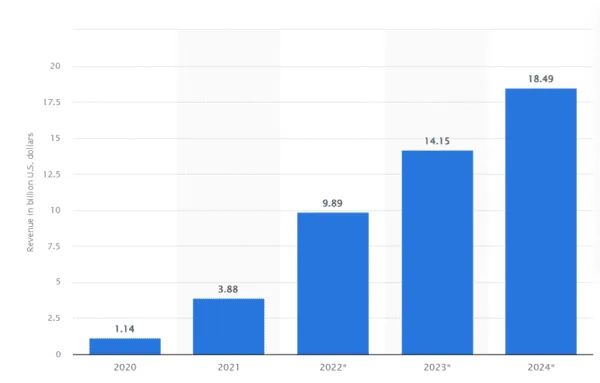
User growth and engagement are also on TikTok's side. Not only is TikTok's user base growing (it is forecast to top 800 million in 2023), but users are also making use of the app in new ways. TikTok's net advertising revenues worldwide between 2020 and 2024 (in billions of US dollars) Source: Statista In 2022, TikTok generated more than three times what it did in 2021. This year, net advertising revenues on the platform are estimated to reach more than 14 billion dollars.
By 2024, TikTok is expected to hit around 18.5 billion dollars in advertising revenue worldwide.
And since there is no arguing with facts, it is official: TikTok is no longer just an entertainment platform; it is an investment with plenty of potential returns. (Short) video content is king Source: Pexels It is nothing new, but it is a trend: backing short, vertical video.
With TikTok's undeniable rise, other platforms began offering their own version of video content in this shorter format. Instagram Reels and YouTube Shorts, for example, have also reached huge levels of popularity and demand, both in creation and consumption. Here again, brands started making appearances too.
Lately, short-form videos have become increasingly vital to marketing strategy. Online ads, particularly those in short-form videos, are expected to generate more advertising revenue than any other format by 2023.
Also read “Video is King of Content“
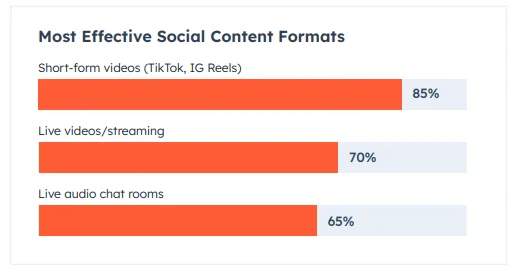
In a study by Influencer Marketing Hub, 85% of marketers say video is an effective strategy for capturing people's attention online. Customers were found to retain 95% of the information in videos, making them essential not only for marketing but also for building a strong brand. The impact of both long- and short-form video marketing is made very clear by this data. Source: Hubspot Let's look at some of the benefits of this format:
- Short videos get messages across in a fun, interactive way, making them more relatable for the target audience;
- They project authenticity and empathy, making consumers more willing to trust a company/brand;
- They are an excellent way to grab people's attention and encourage them to spread the word about your brand;
- They force marketers to cut down the time it takes to get a message across to their audience.
In short, backing this kind of format will translate into high levels of engagement and an excellent ROI, thanks to the high conversion rates of short-form video. If you want to grow your business or brand on social media in 2023, you should focus on creating content for the medium where consumers spend most of their time and in the format they consume most. Content Marketing, but Interactive With governments tightening GDPR laws and tech giants taking tough measures against third-party cookies, marketers are set to lose a great deal of data. That may explain why interactive content is one of the big digital marketing trends for 2023.
Through interactive content marketing, brands can gather data in a less invasive, less binding way. According to a 2022 survey of 1,600 marketers, 45% said interactive content was the content type they used most on social media and 77% said it was the most effective. Source: Wix Beyond the data-gathering benefits, interactive content also engages consumers. Data from more than 230,000 sales and marketing professionals shows that interactive content gets 28% more views than static content. On top of that, the average user spends 4.6 minutes longer viewing interactive content than static content.
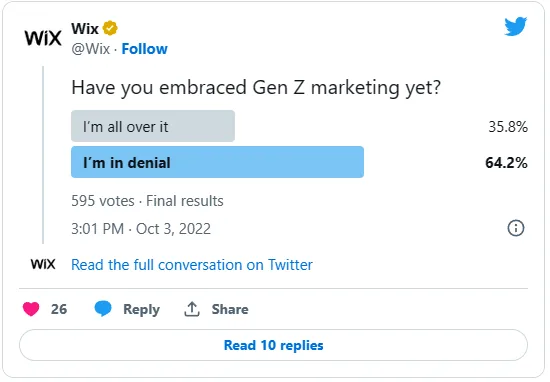
Here are some examples of interactive content to bring into your marketing strategy in 2023:
- Games
- Quizzes
- Calculators
- Polls
- Virtual reality
- Surveys
- Dynamic presentations
- Explainer videos
- Simulations
- Software demos
- Image sliders
- Interactive maps
- Interactive infographics
Already got ideas for applying this strategy to your content? Human brands are trusted brands Source: Pexels As we have already discussed here, a lot has changed in the way brands communicate on social media. The pressure to deliver what users and potential customers want to see keeps growing, but there are two communication strategies that work very well:
- the storytelling method: stories and entertainment over obvious sales tactics;
- humanising brands: using people, testimonials and faces wherever possible.
When it comes to humanising, brands can stay the course with User Generated Content and influencer partnerships. User Generated Content
User-generated content is more likely to be seen as trustworthy than other forms of marketing, which is why it will continue to thrive in 2023. Authenticity is one of the main reasons for this, since people tend to trust other consumers of the same products more than they trust marketers. Source: Calvin Klein (Instagram) This is an example of user-generated content created and reposted by Calvin Klein on its Instagram. The photograph was not taken at any brand photoshoot, but by a customer and fan of the brand. To encourage UGC, Calvin Klein uses a call to action and the hashtag #mycalvins to prompt more sharing from its fans.
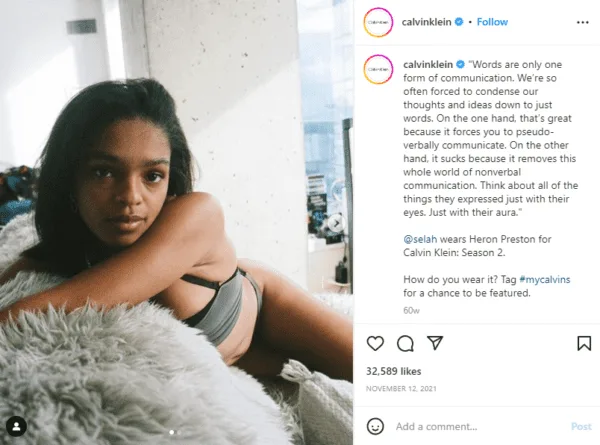
If you want your brand's customers to produce content using your products, try this same strategy: CTA + hashtag and, in return, the chance for your customers' content to be shared on your social channels, in whatever format suits you best.
Long-term influencer partnerships
Influencers are brilliant at making their followers feel part of their lives. Anyone who follows influencers on social media can't help feeling they know a great deal about their lives, their tastes, their adventures, their travels and even their family and friends. Marketers looking to capitalise on those connections have started to tap the real potential of influencer marketing, weaving their companies' DNA into the fabric of those relationships.
And whereas the trend initially was to work with several influencers who would post about a product a few times, brands are now investing in long-term partnerships with fewer influencers. They are also prioritising quality over quantity when deciding which influencers to work with. It is no longer just about the numbers; the size of an influencer's community and follower count matters less than whether — above all — their content is a good fit for the brand they represent, or might come to represent.
Shachaf Rodberg, Wix's marketing trends analyst, thinks it is not only influencer partnerships that are changing — influencer marketing appears to be changing marketing as a whole. “Social marketing channels are changing,” he explained. “They're bringing in semi-famous creators or letting their in-house creators be the face of the company.”
In Portugal, we have a good example of a brand working continuously with the same influencer: Source: Amoreiras (Instagram) In 2019, Amoreiras chose the well-known Portuguese actress, presenter and influencer Raquel Strada as the face of its shopping centre, and has been working with her ever since.

Bigger = Better?
“When it comes to influencers, the bigger their audience, the more successful the brands advertising with them, right?”
Well… no.
Future trends reflect past results, which means that since there is plenty of evidence that micro influencers deliver higher engagement rates, the suggestion is that in 2023 you back working with “smaller” content creators. As well as delivering good engagement, they are another way of reaching your target audience and finding out what they think of your products and services at a lower cost.
As the landscape keeps shifting and the quicksand of social media keeps moving, the most confident marketers will be those who spend less time worrying about trying every possible strategy and more time exploring the ones already proven to work. We learn from the past in order to keep achieving future successes. That, after all, is what studying trends is for. So in 2023, focus on creating content suited to the platforms you use, in the formats users are actually consuming. Fighting change is out of the question; the answer is to embrace it and adapt in order to win.



Get what we write
No fixed calendar: only when there is something worth your time.