Stop taking risks! Data Marketing is a ”right-hand man” when it comes to making decisions
Marta Miranda – Branded Content Specialist & Producer – If you tend to invest in Digital Marketing content without knowing why or who it's aimed at, then this piece is for you.
It's understandable that it feels easier to follow market trends or preferences based on the experiences we pick up along the way. But the truth is that an effective marketer today needs to be on first-name terms with numbers, analysis and technology. In fact, Digital Marketing has, at its very core, the ability to set KPIs and measure results (testing the feedback) in order to make decisions.
Marta Miranda – Branded Content Specialist & Producer – If you tend to invest in Digital Marketing content without knowing why or who it's aimed at, then this piece is for you.
It's understandable that it feels easier to follow market trends or preferences based on the experiences we pick up along the way. But the truth is that an effective marketer today needs to be on first-name terms with numbers, analysis and technology. In fact, Digital Marketing has, at its very core, the ability to set KPIs and measure results (testing the feedback) in order to make decisions. Fittingly enough, we increasingly live in a “trial and error” reality that is massively shaped by the generation of data, which allows us, more precisely, to map out inbound strategies, sharpen content production and optimise sales.
It's no surprise, then, that the creative and communication strategies of digital agencies are increasingly guided by the data collected from a brand's different channels. Data is the lead player in today's reality of Digital Transformation; it is data that allows us, for example, to analyse the sales volume of an e-commerce product, or to send emails to a contact list.
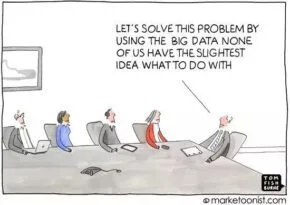
It is data that allows us to analyse behaviours and trends and, as a result, to promote services, products and campaigns to specific segments of people. In fact, back in 2018, 61% of consumers already expected brands to be able to tailor the experiences they offer to their preferences (source: Think with Google study, 2018). Source: Marketoonist.com Let's start with these two concepts
In other words, empirical facts shouldn't override the information drawn from mathematical algorithms – or data sources – when implementing solutions and helping a company grow.
In this Marketing universe built around data, there are two concepts to bear in mind straight away: Big Data and Data-Driven, i.e., respectively, analysing and interpreting the mass of information held in the huge databases of servers and companies and turning it into useful information; and, based on that processing and understanding of the data, making decisions and setting strategies to improve results.
YouTube, streaming apps such as Spotify, and Wikipedia are examples of Big Data online — with videos, music and text — as databases available for users to access. The customer journey or, more specifically, the trail users leave as they browse the Internet, is also part of the Big Data dataset.
Why use data?
Broadly speaking, a Data-Driven culture makes it possible to manage Big Data within the world of brands. It allows you to monitor data on traffic acquisition, visitor interaction on websites and apps – as well as in physical environments – and on behaviour patterns across the different sales acquisition channels, making it clearer which strategies to adopt in the market (do we push promotions or new product launches?).
With the insights gained from integrating this data, you can: carry out market analysis (segmentation, benchmarking); explore new markets; assess the health of your Marketing activity; diagnose problems and seize opportunities; understand consumer needs and improve the relevance of your relationship with them; plan strategies and forecast sales. Especially in a fast-moving reality of constant change, data reduces uncertainty and gives brands greater confidence.
In short, data should allow you to turn information into action in order to achieve good results!
We're living in what is considered the Golden Age of data, in which Intelligence teams can gather abundant data about audiences through various types of social media platforms and different devices. Data is seen as a genuine treasure. And you don't need to be a big company to make use of that information and adopt a mindset geared towards a data-driven culture.
Making decisions based on data requires Data Literacy
However, data-driven management only delivers good results if it's carried out by Marketing Analysts working with qualified data and specialist tools. In the field of Analytics, it's crucial to have what is known as Data Literacy: knowing how to read and understand algorithms so that they become useful information for a business strategy can also mean experimenting and challenging their results. Assessing the artificial intelligence (AI) – the broad science of reproducing human capabilities – implicit in a data-driven methodology depends on human intelligence.
Data-driven Marketing therefore needs a human component with the skills to be impartial and objective, and to steer the analysis towards the reality of a specific business. Not least because, contrary to what you might have thought while reading this piece so far, data can also distort reality.
There's a controversial example that illustrates how important the origin of the data feeding the algorithms is: Amazon's attempt, in 2018, to use AI to optimise the candidate screening process within Human Resources. However, the developers, without proper development work and a critical mindset, fed in biased data — namely the very specific characteristics of candidates who had been recruited many years earlier, such as being male, caucasian and holding a degree from one of the top universities in the United States.
The AI model's algorithm therefore began to reject all the other excellent CVs that didn't fit the profile. Naturally, they scrapped the model as soon as the flaw was discovered.
As a point of interest, demand for Analytics professionals or “Data Scientists” is increasingly clear, and a study by the Marketing Week Career and Salary Survey even found them to be the Career of the Future (source: Marketing Week website).
So how do you actually collect and analyse data?
Data Marketing requires you to acquire tools and software for data analysis. There are various types of data that can be collected, with huge potential to be explored. Market analysis usually distinguishes between primary data – also known as first party data – and secondary data.
Primary data is data collected first-hand by the company itself; secondary data has been researched by other organisations and is available to consult. Secondary data ends up being the less interesting kind for anyone wanting to apply a differentiated Marketing strategy, because it relates to the general characteristics and behaviours of the population (rather than a brand's audience), doesn't specifically answer a brand's research question, and makes it harder to monitor data independently over time (control over data publication is, after all, in someone else's hands).
This secondary data is basically what you find through desk research – via the press, advertising agencies (Think with Google, LinkedIn Business, Socialbakers, McKinsey, etc.), government organisations, academic papers, and so on.
Let's focus on first party data
There are various methods for collecting primary data, from the most traditional to the most technologically advanced tools. The best-known primary research methods are, for example, interviews, questionnaires, focus groups and participant observation (in person or online).
When it comes to online tools and software for collecting and analysing data, there are options that deliver very interesting insights (including some free ones such as Google Analytics):
- Web analytics: user data on websites is collected via cookies – Google Analytics, Google Trends, SEMrush (SEO analysis), among others;
- Heatmaps and screen recordings: tools such as Hotjar that record user behaviour on websites (which areas do they visit most?);
- Social analytics: data on social media users, extracted for example by Hootsuite Analytics, Facebook Adds, Instagram Insights;
- CRM: Customer Relationship Management software that automates customer relationship processes;
- Mention monitoring or Social Listening: how brands are mentioned on the web and on social media, analysed for example by Buzzmonitor and Scup;
- Business Intelligence (BI) tools using AI: new AI approaches such as Machine Learning, with platforms that can structure information and automate email marketing, social media, ads, analytics tools, Marketing automation software and chatbots – Google Data Studio, Microsoft Power BI, Tableau, SAS Business Intelligence, Adobe Analytics, Buzzmonitor (Social Business Intelligence), etc.
It's worth noting that
Machine Learning
draws on the vast amounts of data on the
web,
which is why it's so closely tied to the world of Digital Marketing.
It is
software
with
Machine Learning
that makes it possible, for example, to recommend suggestions (autonomously, with no human interference) to Netflix or Spotify users (it uses AI to recognise patterns and understand user preferences within the data analysed), to route emails to
spam,
to reach us on Instagram with ads that seem to have read our minds, to personalise communication for each customer, and much more. With
Machine Learning
the capacity for interpretation is far greater than our own.
Generally speaking, all data (whether primary or secondary) needs to be well organised so that it can be properly evaluated, and this is crucial from the moment it is extracted, which happens from a range of sources and ends up being continuous. It's important to understand the objectives behind collecting and analysing the data; for example, if a brand wants to boost its brand awareness, then it should prioritise analysing reach metrics, assessing its position in Google results, and so on. The duty to protect data
The opportunities that came with Digital Transformation for processing so much data also opened the door to its misuse by large companies. That's why legislation emerged to regulate and protect data worldwide (in Portugal, the General Data Protection Regulation – GDPR, since May 2018), so that data can only be used with consent and can also be kept private, forcing companies to be more transparent and to act responsibly.
This will mean that Marketing strategies end up being more targeted at the people who genuinely matter, since only those who are truly interested will authorise the consensual use of their personal information.
The cookie controversy
Cookies, as mentioned earlier, are the codes a website collects when a user visits. But they're not all “the same”. First-party cookies can be categorised as those relating to language preferences, payment methods, products in the basket, and so on; users provide this data to the company, or it can be inferred from their behaviour.

They have delivered genuinely useful information for Marketing professionals, since they make it possible to understand user activity on the site (for example, the number of clicks, pages visited and conversions) and therefore to improve experiences. Source: Google Images There are also zero-party cookies, which is declared data — explicit information intentionally provided by users.
Third-party cookies, on the other hand, are created by a domain other than the one the user is visiting, and are widely used for advertising and Marketing purposes. This is the data that underpins Marketing automation tools: it allows user browsing to be monitored across different sites (cross-site tracking), retargeting ads to be served (based on previous behaviour patterns) and ads to be delivered across different sites in an optimised way (ad serving).
And it is precisely third-party cookies that are at the centre of the controversy, as they call users' right to privacy into question, prompting the leading authorities worldwide to adopt new protocols. For that reason, the biggest players on the web, such as Google and Apple, are already announcing updates to give consumers more privacy, which means “killing off” browser cookies as we know them in the digital Marketing ecosystem. Safari and Firefox have already blocked them. Apple has begun to move away from the world of third-party cookies with the launch of iOS 14, which already requires permission for data tracking.
The end of the third-party cookie era therefore means Marketing strategies will have to become more transparent and invest more in first-party data – building their own channels (email marketing, content such as e-books, surveys via social media, organic traffic, SEO) – in order to get to know their audiences better and earn the trust that encourages people to “contribute” their data.
It's true that online advertising looks set to be affected, since it may call into question brands' investment in ads, whose data will become less specific. But it's also an opportunity for brands to get closer to their consumers, without compromising the protection of their data, and to build better content experiences!
Big Data insights become Big Ideas
With today's technology, and precisely in these times of Big Data, it's easier for brands to gather rich first-party data insights to analyse and shape their content strategies. All they need is creativity and quality in their Content Marketing to make an impact on a lead, or a potential consumer who has already shown interest in the brand. In other words, Data Marketing guides Content Marketing to make it more effective: the planning (such as defining the target audience), the production and the communication (such as choosing the communication channels) of content are all based on the information analysed from the data.
Are we producing content that responds to market trends and to people's questions or problems? Which are the best channels for our brand to communicate on – blog, Instagram, Pinterest, email marketing? What impact has the content we've been putting out had? What strategies have our competitors been using?
With data as a guide, the chances of content sparking the target audience's interest increase. It really is important to create the right content formats to boost engagement at every stage of the funnel along the consumer journey.
Engagement is therefore achieved by delivering impactful, involving and relevant experiences to consumers, taking into account the stage of the journey they're at and the channel they're on. Content guided by a data-driven culture follows strategies geared to the persona and focused on achieving results. The cherry on top is, of course, hitting your Inbound Marketing objectives and driving conversion.
Shall we look at some practical examples of how Data can inspire Content Marketing?


The #KillerSkin campaign by cosmetics brand Olay with actress Sarah Michelle Geller for the Super Bowl
Source: filmow.com
If you were a cosmetics brand and had to create an ad for skincare, would you think of investing in the famous Super Bowl (the American football championship) to get your message across? Well, Olay chose to invest in that event after analysing data on its target audience and finding that, as well as being interested in skincare, they also liked football and horror films. That research produced the
insight
for the “Killer Skin” campaign, with horror
storytelling
at its heart – fronted by the actress known for the horror films she has appeared in, Sarah Michelle Gellar – to run at the Super Bowl.
Another example of the insights Big Data can give Content Marketing is known precisely as Data Storytelling. It's nothing more than using user data as the content of the communication itself, not only for online communication personalised to each customer, but also for communication in traditional media. One of the best-known examples of Data Storytelling is Spotify's “Wrapped” campaign (which started in 2016), communicating the consumption patterns it has identified: it presents the year's most-listened-to artists, tracks and podcasts. By way of conclusion, I think it's fair to say that the digital ecosystem has everything to gain from extracting and analysing data, since it stands a good chance of hitting a brand's objectives spot on (acquiring more traffic and building customer loyalty), achieving a distinctive, competitive position in the market and being able to spot more opportunities.

The digital era will keep moving forward, data will continue to be generated whatever the source and, above all, people will always be the main protagonists, whether they're working in the back office of a business (as Data Marketing Analysts or Content Marketing professionals) or whether they are a brand's persona. Ads from the streaming app Spotify based on Data Storytelling Source: Ads.spotify.com


Get what we write
No fixed calendar: only when there is something worth your time.