The end of third-party cookies

Marta Peral Ribeiro – Communications Consultant – And what marketers can do about it Safari and Firefox have already done away with third-party cookies, and now it's Google's turn. By 2023, the biggest search engine of them all will be putting an end to third-party cookies. What does that mean for digital marketing? And how can marketers adapt their strategy?
Marta Peral Ribeiro – Communications Consultant – And what marketers can do about it Safari and Firefox have already done away with third-party cookies, and now it's Google's turn. By 2022, the biggest search engine of them all will be putting an end to third-party cookies. What does that mean for digital marketing? And how can marketers adapt their strategy? The background
The internet is an open space where our personal data circulates around the clock. And it is precisely for security reasons that consumers are demanding ever greater privacy over their information.
With that in mind, the relevant authorities — and, as a result, companies too — are taking steps to limit third-party access to that data.

And this is where the famous cookies come in. They store information on a user's computer from a site they have visited (their ID, the name of the site, language preferences and the products they searched for, for example), allowing that site to show them personalised information later on. But not all cookies are the same. Source: Unsplash, @engin akyurt 3 types of digital cookie:
Cookies are essentially about who owns them and who distributes them. These are the data a website collects about the users who visit it, which it can then process (particularly when users fill in a form) in order to improve the user experience. These are the data two organisations collect and share with each other, and only with each other. A website gathers data on its visitors, segments it and sells it on to outside companies with which it has no direct connection. In other words, on top of not really knowing where the data came from, whoever buys it has access to exactly the same information as every other company that buys it too. In this article we'll be focusing on third-party cookies, since they're the ones at stake here.
They are how advertisers gather information about users, from the pages they visit and the products they search for and buy, through to personal details such as name, age, contact details and so on. By getting to know users, their interests and their online habits, companies are able to segment their ads and target them at a specific audience. This is the premise behind most advertising platforms.
A practical example of third-party cookies: you search for a gadget on the Fnac or Amazon website, and shortly afterwards you come across an ad for that same gadget, or something similar, on Facebook. Google Chrome and the end of third-party cookies
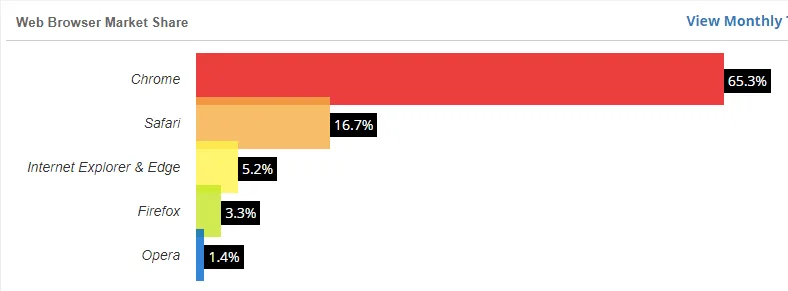
Here are the main search engines in use today:
Source: W3Counter
Both Safari (Apple) and Mozilla (Firefox) have stopped allowing third-party cookies.
Now it's Chrome's (Google's) turn: it has announced that it will be putting an end to third-party data by 2023.
With Google Chrome being the most widely used search engine in the world and the biggest distributor of digital advertising, it was only to be expected that marketers would feel uneasy about the new data privacy policies.
What does it mean in practice?
It's simple: with the end of third-party cookies, many organisations will lose access to the valuable information that allows them to deliver targeted advertising, which dramatically reduces conversion rates. In other words, turning users into customers becomes far less likely.
So redesigning your marketing strategy is essential.
Privacy Sandbox
Google has launched the “Privacy Sandbox” initiative, which will allow users to be segmented without compromising their privacy. In the first phase, companies will be able to retarget their ads; in the second, third-party cookies will finally be phased out.
Brands would do well to keep a close eye on the whole process. How can companies make sure a marketing campaign succeeds?
There is no single answer. Every organisation comes up with its own solutions.
Facebook, for instance, set up the Pixel, which allows third-party cookies to be saved as first-party cookies. That way, when it's triggered on a website, the data is still accessible. Google itself recently launched the “Privacy Sandbox” initiative, which will allow users to be segmented without compromising their privacy.
But there are other options. 1. Focus on first-party cookies
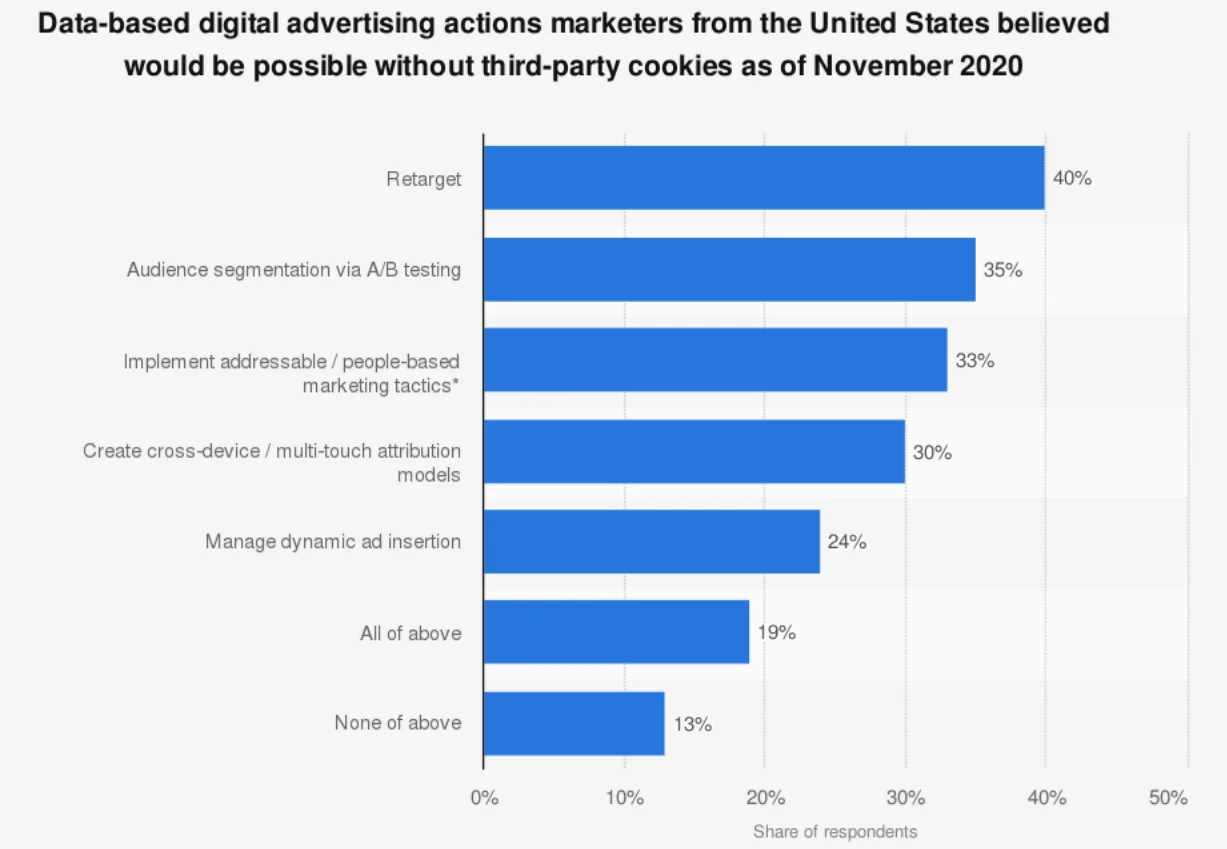
One sensible option is to concentrate on the cookies your own company generates, processing and segmenting them. This not only guarantees data protection, it also lets you set or readjust your own metrics. Source: Statista 2020 Redefine your target audience
The previous point leads us inevitably to this one: redefining your target audience. This is the main measure that 40% of marketers in the US intend to invest in, according to a Statista study.
Try out different campaigns
One strategy that helps you work out who your persona is involves, as the chart above shows, testing different campaigns with different audiences and seeing which performs best. 2. The watchword: personalisation
Even with first-party cookies, users — increasingly alive to the value of their data — expect something in return for handing it over. And there are several strategies for this:
Invest in content marketing
With content marketing, readers get access to content that is genuinely useful to them, because it answers their questions and meets their needs. An e-book, a checklist or a planner, for example. Here brands can combine content with email marketing, since the user submits their email address in order to receive the material.
Offers tailored to the consumer
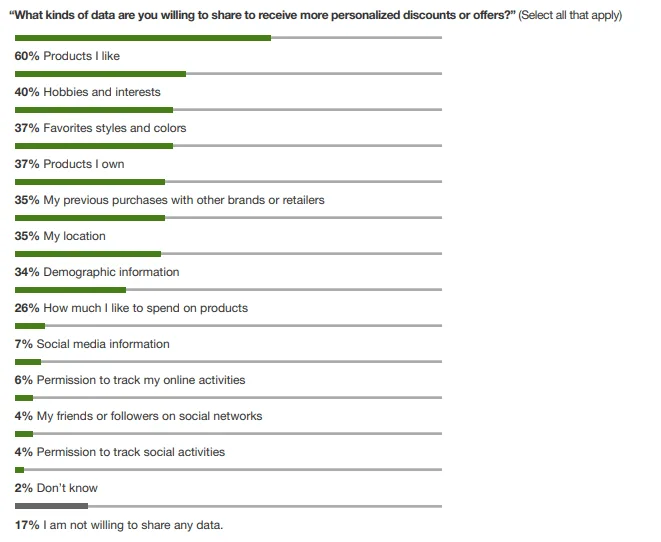
A Forrester/Retail Me Not report reveals the kind of information most users are willing to share in exchange for discounts and exclusive offers — as long as the interaction isn't perceived as intrusive. Top of the list of motivations are the products they like and their interests and hobbies: Source: Retail Me Not (2018) 3. Make the most of your resources Mobile marketing
That same 2018 report indicates that mobile is the preferred version for 60% of consumers. I'd say that in 2021 the figure is higher still.
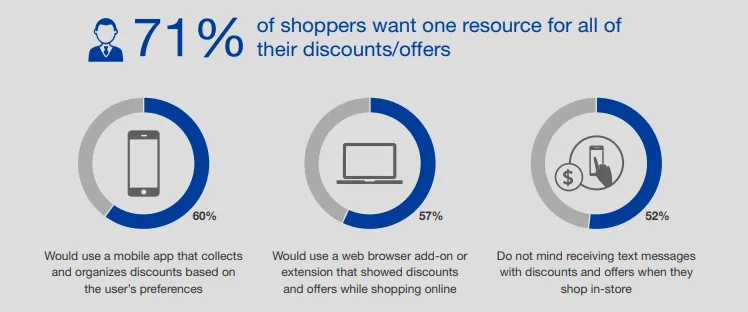
So having a branded app not only strengthens your relationship with the consumer, it also brings all your offers, based on consumer preferences, together in one place, which makes the sales process easier. Source: Retail Me Not (2018) Social media
As you'd expect, social media is one of brands' greatest allies. It lets them promote their products and services, increase engagement with followers and attract new users, as well as build their reputation.
Using chatbots
Artificial Intelligence makes it possible to communicate with users in a more personalised way. With chatbots, engagement with the consumer is far more meaningful, and it becomes easier to collect data that they hand over voluntarily. Conclusion
The new security and privacy policies, demanded by consumers and driven by governments around the world, have brought about the end of third-party cookies.
While on the one hand this might look like a major headache for marketing teams, on the other it's a great opportunity to refresh advertising strategies.
For companies that invest effectively in first-party data, there will also be a much sharper focus on the consumer, making it possible to identify who your real target audience is and, as a result, serve them relevant ads. Alongside that, relationships with audiences will rest on firmer, more trusting foundations, since users will know their data isn't circulating indiscriminately around the digital world.
It isn't the end of the world, after all. Just the end of third-party cookies.

Get what we write
No fixed calendar: only when there is something worth your time.