The new way of searching with Generative AI

Sandra Caravana – Copywriter –
Content creation and discovery, search, customer service – it's all about to change and, once again, Artificial Intelligence has a lot to say about it.
The main goal of AI (and, in a way, of any kind of technology) is to make our lives easier. When it comes to web searches, AI is teaming up with generative technology to give you more information and more context in your searches. How does all this work, and what does the future hold for search and SEO?
Sandra Caravana – Copywriter –
Content creation and discovery, search, customer service – it's all about to change and, once again, Artificial Intelligence has a lot to say about it.
The main goal of AI (and, in a way, of any kind of technology) is to make our lives easier. When it comes to web searches, AI is teaming up with generative technology to give you more information and more context in your searches. How does all this work, and what does the future hold for search and SEO? What is Generative AI?
Generative AI refers to the use of machine learning algorithms and techniques to create original, one-off content such as images, music and even text. Generative AI offers a range of applications that can transform the way businesses operate.
Right now, we can already tell two generations of AI apart: traditional AI (the older one, the first, the mother) is programmed to carry out specific tasks, whereas Generative AI is able to learn from existing data and generate new content based on the data it has taken in.
In other words, Generative AI (the new one, the daughter, the latest generation) learns.
Generative AI uses a Machine Learning model to learn the patterns and relationships within a dataset of human-created content. It turns that dataset into patterns and uses them to produce more information, as explained here.
Speed of content production VS quality of the final product
We don't have quantitative data (yet!) to draw conclusions about the quality of the products developed by Generative AI. Used properly, these applications can deliver impressive results – but, above all, fast ones.
Plenty of people have shared the mistakes ChatGPT comes out with. Given that ChatGPT is one of the applications using Generative AI, its information is the result of the data we humans feed it. So, much like a primary school teacher passing on practical knowledge to children, we humans will have to be the teachers of Generative AI applications.
Generative AI in creating content for social media
This is one of the most widely used and successful applications: creating quick content for quick consumption on social media. Being visible and present has never been easier. The secret lies, as already revealed, in the prompts you give the AI software. But if it uses Generative AI, that means it will take our prompts as absolute truth, just like a child telling their parents 'that's how the teacher taught us'. For educational purposes, let's use the following example: we asked ChatGPT to create an Instagram post comparing branded medicines and generic medicines. The quality and accuracy of the result depends on us, the humans. Like a subliminal message, ChatGPT will learn from our question.
Which of these two prompts is the right one for the content we want to create?
- Write a post copy of X words comparing branded medicines and generic medicines and the advantages of each.
- Write a post copy of X words explaining the benefits of branded medicines compared with generic medicines.
The right answer is 1, because it makes a request without any judgement – unlike prompt 2, which creates the idea – the myth – that there are more benefits to taking a branded medicine than a generic one. And since it learns and takes information in as fact, when we build false judgements into a prompt, ChatGPT will learn that a branded medicine brings more benefits than a generic one and pass that message on to other users when asked about the difference between the two.

If we already have a king for text, do we have a queen for images?
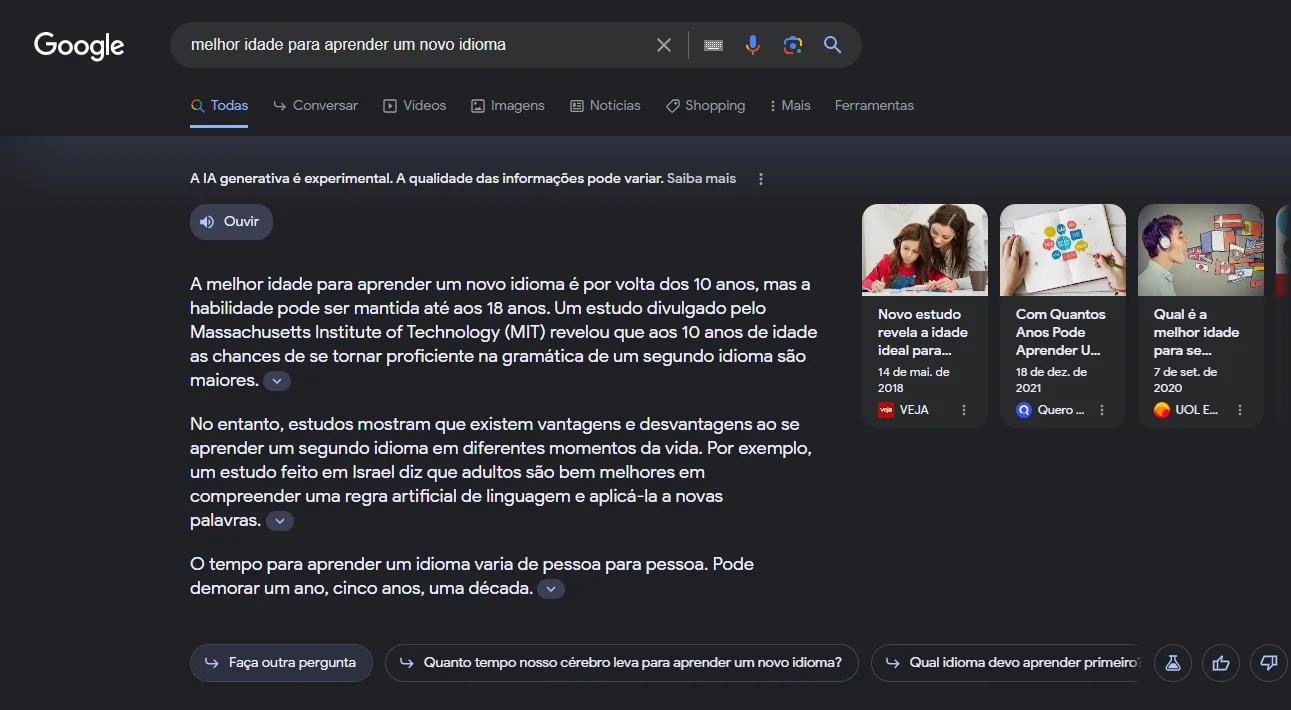
Yes. Google is already testing its new search model – SGE – Search Generative Experience: Google's super AI tool, which uses a conversational style for searches. Well, for everything. This technology will change the way information is searched for and how people browse.
If you've searched for an image of a family all dressed in traditional Minho costume eating spider crab and found nothing like it, not even on stock image banks, you should know you can create that image in the new Google experience. Which means Dall-E has met its match.
We can create the result we can't find in our search. And that changes everything.
Searches with Generative AI
What is the future of online search with Generative AI? Like a superhero, there's always an upgrade each season, and you can see it in the costume – increasingly elaborate and packed with gadgets.
Say you're looking for a hotel for a family holiday, with everyone from the children to the grandparents. A quick Google search for 'hotels for family holidays' gives you several suggestions of hotels with indoor and outdoor pools, a playground, large rooms and full board. This is an example of a traditional search, the kind we're used to doing every day.
And what if we add more conditions to that search?
You'd prefer an accessible hotel, in a mountain setting, with suggested dates for days when the temperature doesn't go above 24ºC.
Using generative AI in search helps the user get the full picture at the point of purchase, making even the more considered and complex buying decisions faster and easier to make.
Ads in Generative AI search
In the Search Generative Experience (SGE), search ads will continue to appear in specific spots throughout the page, with product images and videos given prominence.
As well as listing products with the features you specified, it may also show other users' opinions.
The idea isn't new and has been widely used by hotel booking sites. What is new is being able to bring all this information together in a single search.
Voices and sources
Just as dubious information can be fed into apps like ChatGPT, comments and reviews in ads can also be biased. On the other hand, taking a responsible approach, the new generation of AI in the SERPs brings back the debate about the importance of websites and blogs: are social media enough, or should we own our own home?
This whole SGE – Search Generative Experience – is in beta on Search Labs, on Chrome for desktop and in the Google app (Android and iOS) in the US (English only at launch, in May 2023), so that feedback can be gathered and the experience improved over time.
Bard was only the beginning
Search results – SERPs – generated by Generative AI will be highlighted at the top of the page, in a different colour: organic results, the knowledge panel and 'people also ask' sit below the AI answer.
The Local Pack – or Google Local Pack, a section of the search results where Google shows a list of local businesses related to your search – will have 5 results instead of 3.
What changes for SEO professionals?
Search Engine Optimization (SEO) is the set of actions taken to achieve better positioning in search engine results (such as Google) and to be found more easily. With AI changing the way people search the web, the goal of SEO may no longer be to reach the top positions in the SERP, but rather to turn content into featured highlights within the SGE model.
Content creation is once again the trick to getting visibility on Google.
In short: the impacts of generative AI on content creation, SEO and search:
- Increasingly personalised searches;
- Fewer ads in the results;
- More personalised, in-depth content creation, using AI;
- Conversational mode will go deeper into information during searches;
- Users will be able to understand a topic more quickly, discover new points of view and carry out tasks more easily;
- Prominence for the source content behind the information shown in artificial intelligence search.
Google is leaving the door open for more evolution, innovation and digital freedom. The paradigm is going to shift: Google has aligned itself with AI to stop being a search engine and become an answer engine.

Get what we write
No fixed calendar: only when there is something worth your time.