The power of going live
Miguel Afonso Gonçalves – Copywriter & Travel Blogger – Live streaming isn't an invention of the post-pandemic marketing model, but it has been one of the main discoveries for brands and consumers during this period. No surprise, then, that it features on every one of those familiar “current digital marketing trends” lists put out by the various magazines and specialist publications in the field (10 tendências no online para 2021 – Marketeer (sapo.pt) or Seven Digital Marketing Trends For 2021 (forbes.com)).
Miguel Afonso Gonçalves – Copywriter & Travel Blogger – Live streaming isn't an invention of the post-pandemic marketing model, but it has been one of the main discoveries for brands and consumers during this period. No surprise, then, that it features on every one of those familiar “current digital marketing trends” lists put out by the various magazines and specialist publications in the field (10 tendências no online para 2021 – Marketeer (sapo.pt) or Seven Digital Marketing Trends For 2021 (forbes.com)). So what is the real power of a live broadcast?
Let me open the discussion with a brief look back at the history of this phenomenon. Before we think about brands, let's think about people, about the history of communication and entertainment.
There's no denying that much of the success of the various technological innovations tied to this medium — radio, television, even the Internet — has rested on the immediacy and closeness of the communication. But it's also worth remembering that big audiences have always gathered around events broadcast live.
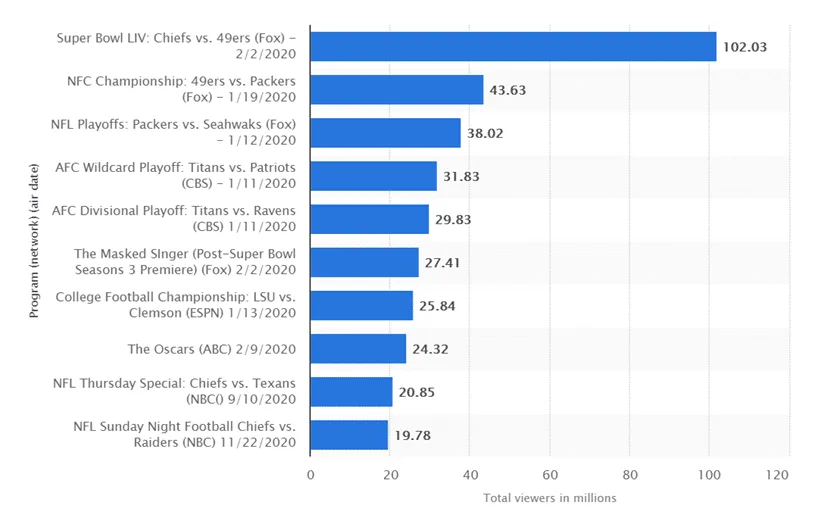
The statistics of recent decades bear this out, pointing us towards the key moments in the sporting calendar — World Cups, Olympic Games — or historic events such as the 11 September attacks and Princess Diana's funeral, among others. The image below illustrates the point, with figures for the most-watched television broadcasts in the United States in 2020 (nine of the ten were live): Source: U.S: most watched telecasts 2020 | Statista Having established that the public at large is more inclined towards live events, let's look at how this idea can be applied to brands' communication and marketing strategies. What tools do they have at their disposal? What has been put into practice? With what success? And what might still be to come? Humanising the brand
In an earlier article on the Jelly blog, we saw how video has established itself as a useful tool in any brand's marketing strategy — particularly on social media.
Live streams, being video, enjoy all the advantages already set out, plus a few more. Humanising the brand is far and away the most important of them, because this is not only the best opportunity brands have to achieve high levels of interaction with their consumers or potential customers, it's also the one that effectively brings a face, empathy and emotion to the brand-audience relationship.
And why does humanising the brand matter so much? In recent years, chatbots have also been held up as a relevant marketing tool. From a “macro” point of view, you could say chatbots are the main rivals to live streams, in the sense that both offer the same kind of practical solution to certain problems — FAQs.
The human factor, however, remains what lends the relationship the most transparency, credibility, trust and empathy — all indicators that help brands build customer loyalty, potentially even turning customers into “brand ambassadors”, and in turn generating a greater financial return from those stronger relationships. But the list of advantages of a live stream doesn't stop there. New business models…
The specialist press suggests that social networks and live-streaming platforms have themselves become tools for buying and selling products. Alongside this, and with growing regularity, the term “live stream/video shopping” has been cropping up in trend reports and in how brands are approaching the current global context.
It's worth noting that, according to a study by Vimeo — one of the leading video distribution platforms — 82% of users of these digital tools would rather watch a brand's live stream than the traditional promotional posts, and 80% of audiences would choose to watch a live stream over reading a blog article (Why a Live Streaming Strategy is a Must-Have for Marketing). And new audiences
Reaching new audiences has never been easier. During live broadcasts, many brands have taken the chance to link up with specialists in particular fields — related to the market the brand operates in — or with high-profile figures who bring their own followers into the brand's world. It's one of the best organic ways to drive traffic to a brand's channels and bring a large number of people into its network of potential customers. For everyone: B2C and B2B
According to the latest research from the Content Marketing Institute (Livestreaming Tips Every Content Marketer Needs to Hear (contentmarketinginstitute.com)), “the number of B2C content marketers using live streaming tripled between 2019 and 2020 — 13% vs 35%”. And while it's natural to assume that brands operating in the B2C segment tend to be the first to adopt new marketing tools and strategies, in this particular case the shift was equally well received in the B2B segment.
Operating in a segment that is usually more traditional and conservative, B2B brands have always relied above all on in-person events as a way of humanising themselves. The pandemic, however, turned that idea on its head, and digital channels did much to make it happen. Over the past year we've seen webinars, video calls, interviews and more spread through a strictly corporate environment, without following the one-to-one logic.
Video was already being held up as one of the best formulas for effective brand communication, but the opportunity to do it live has revealed the full potential for building meaningful relationships between brands and consumers — because it is, unquestionably, video's most genuine, authentic, credible and empathetic format.

Get what we write
No fixed calendar: only when there is something worth your time.