Video: a winning formula in communication

Miguel Afonso Gonçalves – Copywriter and Travel Blogger –
Have you ever wondered about the overnight success of platforms like TikTok? Still not convinced that video has taken over social media? Infotainment is increasingly proving to be a viable thread running through a brand's communication — and it's the audience that's setting the terms.
Miguel Afonso Gonçalves – Copywriter and Travel Blogger –
Have you ever wondered about the overnight success of platforms like TikTok? Still not convinced that video has taken over social media? Infotainment is increasingly proving to be a viable thread running through a brand's communication — and it's the audience that's setting the terms.
Over the past few years, alongside the social media boom, countless tools have emerged to support brands in their communication strategies.
Communication and marketing evolve, audiences evolve too, and brands have no choice but to adjust the channels they use to reach the people they want. Over the past few years, alongside the social media boom, countless tools have emerged to support brands in their communication strategies. And they all share one trait: they drive infotainment.
Today, in the middle of the digital and technological age, several studies — one conducted by Microsoft, for instance — have reported a declining average human attention span, a dramatic finding for brands trying to win their audience's attention.
So it stands to reason that infotainment, a blend of the words information and entertainment, should be treated as a key pillar of successful digital communication for brands. Why? And what's been done about it so far?
Video: infotainment at its peak
Video is more likely to be shared, drives more interaction and boosts brand awareness.
There's little doubt that strong storytelling drives greater interaction and connection with an audience, holds people's attention for longer and, of course, gives you a clear advantage when it comes to getting your message and information across effectively.
Looking at the concept of “storytelling”, we know brands tell stories through two primary formats: text — or copy — and image. As a marketing and communication tool, video combines both, which makes it the main way to create infotainment. Unsurprisingly, video is more likely to be shared, drives more interaction and boosts brand awareness.
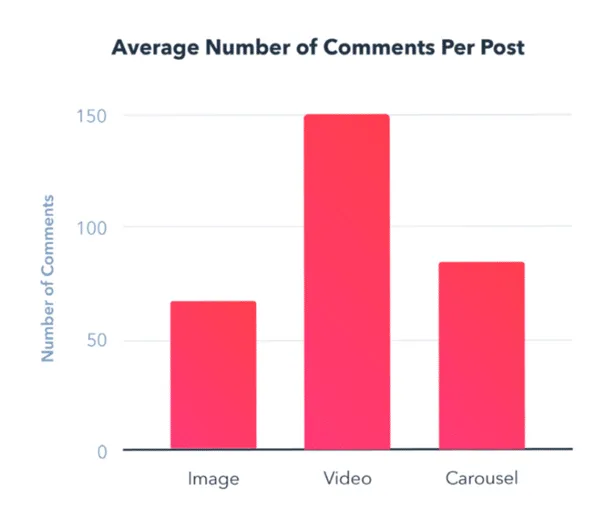
Mention's Instagram Engagement Report (Mention is a social media monitoring platform) puts this quality of video in plain sight, showing it far outstrips the ability of a static image to generate engagement.
Video's place on social media
In another article on the Jelly blog, which looks at the different features across social networks, it's clear that social media platforms have grasped how important video is for holding attention and driving interaction between users. Take Instagram's Instastories — later replicated on Facebook — and the success of platforms like TikTok and YouTube, both of which have effectively “forced” Instagram to develop new features to stay relevant: Reels and IGTV.
In a Marktest study on “The Portuguese and social media” in 2020, there are two very interesting conclusions about how video inevitably draws in social media users.
On the one hand, analysed for the first time in 2020, TikTok not only entered straight in at 9th place for penetration, but also climbed to 5th place for spontaneous awareness. This platform's success was instant, both in Portugal and worldwide. On the other hand, YouTube holds on to its relevance in this space. It's the third most visited social network, with almost 95% of social media users going there at least once a week, beaten only by Facebook (96%) and WhatsApp (95.7%).
A shift in paradigm… in traditional media
Video's impact on the entertainment industry hasn't gone unnoticed, even in so-called traditional media.
Radio, long used to having its “demise” predicted by so many, has been one of the clearest examples of adapting to reality and to its audience. Voice is no longer its only distinguishing feature and, particularly over the past decade, we've come to associate radio with images, faces and moments. Without exception, and looking at the Portuguese case, the country's main radio stations have got audiences used to shared videos that frequently go viral on social media.
Likewise, over the past decade, podcasts have become widely popular, prompting a range of brands — especially in the media sector — to invest in the format. Yet while the original concept was audio only — much like radio — recent years have seen audiovisual podcasts become increasingly popular, a recognition that the visual dimension is essential to achieving infotainment.
Conclusion
The relevance of video — increasingly referred to as video marketing — is beyond question. So far, it looks like the go-to communication formula for brands to build awareness, develop closer relationships with their audience and make the most of everything social media has to offer.
Infotainment is a concept born in the world of news media, and its principles are hugely useful to communication and marketing management for any brand: competent, memorable storytelling to get a message across, in the format that appears best equipped to capture an audience's ever more fleeting attention.

Get what we write
No fixed calendar: only when there is something worth your time.