Video Is the Content King

Inês Tito – Copywriter – To anyone consuming digital content, it can all look like happy coincidence. The reality is rather different.
Content creation follows a rigorous plan, backed by in-depth research. To reach consumers, brands invest time and money in understanding what those consumers want and need.
That is why trillions of new pieces of data appear on the internet every day, all over the world. Among them are the blog articles, videos and social media posts that show up on our devices. The numbers are absolutely astronomical!
Inês Tito – Copywriter – To anyone consuming digital content, it can all look like happy coincidence. The reality is rather different.
Content creation follows a rigorous plan, backed by in-depth research. To reach consumers, brands invest time and money in understanding what those consumers want and need.
That is why trillions of new pieces of data appear on the internet every day, all over the world. Among them are the blog articles, videos and social media posts that show up on our devices. The numbers are absolutely astronomical! Even so, content is not distributed evenly. In recent years, video content has grown across all kinds of digital platforms. What is driving this trend? And what can we expect in the future? Source: Freepik The growth of video content
Video marketing has been around for a few years, but it was the pandemic that accelerated its growth. Successive lockdowns forced the world's population to live within four walls and to look for alternative sources of entertainment and information.
According to a Cisco study, 82% of all online traffic will soon be video. The trend is confirmed by Wyzowl too: 86% of the companies surveyed use video. On top of that, 92% of professionals say they use this type of content to strengthen their marketing strategy.
What is behind this growth?
- The decline of traditional advertising media
Easy access to the internet, and its ever-growing use, has had dramatic consequences for traditional marketing. Since consumers spend most of their time online, traditional advertising strategies are losing their effectiveness.
Marketers are therefore forced to find alternatives to print ads, billboards and radio spots. For most, the answer lies in creating video content.
- A shift in attention spans
A study sponsored by Microsoft shows that, over the past 20 years, our attention span has changed to the point where we can now focus on a given task for only eight seconds.
That claim has, however, caused controversy among academics. Experts argue that our level of attention depends on the task at hand.
Debate aside, technology users do recognise that their ability to concentrate over long periods has decreased. In this survey by the Policy Institute and the Centre for Attention Studies at King's College London, there is a widespread belief that young people are the most affected by this trend.
The pandemic also fed into this feeling. Emotional and psychological exhaustion, brought on by constant anxiety and uncertainty and by the sheer flow of new information, left people struggling with tasks that demand high levels of attention.
As a result, there is a growing appetite for digital content that is easy to digest. And video is the clear favourite.
- The rise of TikTok
Just as everyone had come to know TikTok as a platform for user-recreated music and dance videos, the social network reinvented itself.
The focus is still on short-form video. But more and more users are looking for educational and informative videos. This trend has made the platform hugely popular and driven a growing volume of video content.
- More user-generated content
For many brands, capturing consumers' attention means combining traditional advertising with user-generated content.
The impact of this kind of content comes down to something very simple: it is people like us, with the same everyday difficulties and challenges, recommending products and services that will make our lives easier.
Essentially, it is content anyone can easily relate to. Add that to the desire for simplified information and you have the perfect recipe: video content.
Why should companies double down on video content?
If you already use video marketing to promote your products and services, you are on the right track. The next step is to double everything you are already doing. Here's why! Source: Freepik The Picture Superiority Effect
You are bound to know the saying "a picture is worth a thousand words". You have probably used it yourself. But do you really know what it means?
Images can tell stories that are sometimes impossible to put into words.
That is exactly what the Picture Superiority Effect describes. The human brain memorises and recognises new information far more easily when it is presented as images rather than text. This happens because images generate a verbal and a visual code that help us form new memories. As a result, the brain processes visual information 60,000 times faster than written information.
For business owners and marketers, this is a chance to develop memorable content. And what is the best way to do it? Through emotions.
According to neuroscience, decision-making is closely tied to what we feel. Through visual stimulation, it is possible to activate areas of the brain that do not process language but do trigger emotions and lead to a decision.
So why turn to video content?
There are several reasons. Here are the ones most often cited by marketing professionals around the world.
- Customer engagement with the brand
If images are powerful, video is unbeatable!
Video allows brands to capture customers' attention. Combining text, images and sound makes it possible to pack essential information into a short space of time. The information is processed faster and is more likely to be remembered.
According to Brightcove, video content generates 1,200% more social media shares than any other type of content. Its ability to stir strong emotions makes consumers want to comment on and share what they have just watched.
- Brand recognition
More and more companies are betting on video content as a way to build brand recognition. If the goal is to capture and hold consumers' attention, video may well be the key.
With so much information available online, everyone wants to find what they are looking for quickly. Video allows marketers to present relevant content in very little time. As well as attracting the consumer, they are delivering information that genuinely matters to them and that is easy to remember.
- Prompting consumers to act
Storytelling makes it possible to create emotional videos that prompt consumers to act. Not only those who want to share what they have seen, but also those who genuinely intend to buy a product or service.
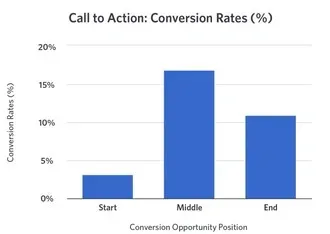
According to Wistia, calls to action (CTAs) placed within a video have a conversion rate of around 16%. CTAs shown at the beginning and end of the content, on the other hand, perform less well. This comes down to the relationship between curiosity and consumer interest. Generally, using CTAs mid-video reveals genuine interest in the products and services, rather than mere curiosity on the customer's part. Source: Wistia.com Increasing organic traffic
Opening a business and not promoting it is the perfect recipe for failure. Exactly the same applies online. In a space where competition is global, brands need to encourage consumers to visit their "home".
Video content is therefore a crucial search engine optimisation tool. It can increase unpaid website visitors by around 10%.
What's more, when consumers share a video, they create a link from that page. For Google, the more links a website has, the more trustworthy it is. As a result, its position in search results rises, making it visible to new consumers.
The importance of a content strategy
A content strategy works like an architect's plans for a building. In this document, the marketer sets out all the information needed to create content.
So it takes thought and research to work out who our target audience is, why we should be creating content and how it will be distributed. The goal is to attract and engage the audience in order to promote the business and generate revenue.
Among its many benefits, a content strategy makes it easier to reach objectives and to track progress towards them. It also helps identify new opportunities and produce content that converts. What should we consider when developing video content? Source: Freepik Capturing the consumer's attention
According to YouTube, the first 15 seconds of a video are vital in keeping the customer on screen. The aim is to show them quickly what the video is about and what to expect. Tactics such as speaking directly to camera or asking the viewer a question can help sharpen their attention.
- Choosing the right platform to distribute content
The spread of social networks offers plenty of places to publish and distribute video. That does not mean you have to use them all.
YouTube leads the way for both consumers and content creators. There is little point publishing on other social networks if you are not present on this platform.
And unlike on Facebook, TikTok or Instagram, YouTube's most popular videos carry on gathering views for years after they are published.
- Optimising videos for YouTube
These days, creating viral content on its own is not enough to reach millions of views. Optimising videos so they appear in YouTube's suggested videos list is a strategy widely used by business owners, marketers and influencers.
The platform's algorithm looks at watch time and viewer engagement to rank content. Much like Google, the higher a video ranks, the more visible it becomes.
To achieve this, it is important to use relevant keywords, optimise the video description, make use of hashtags and create playlists to reach a wider audience.
- Writing a script
Speaking to camera can be intimidating. Even the most acclaimed actors have their notes to hand! That is why a content strategy should include writing a script.
This lets you plan and put down on paper all the ideas you want to get across. As with other content creation strategies, a script should have a beginning, a middle and an end, and should not forget the CTA.
There is one important factor to bear in mind, though: the way we speak is very different from the way we write. So, to build rapport with the consumer, it is important to write a script that sounds like natural speech.
The video content of the future
The arrival of YouTube in 2005 revolutionised the way we watch and create video. As society evolves, the tools we use every day adapt to our needs.
The growing popularity of video content is a reflection of exactly that. As younger generations move into the digital world, new trends emerge. So what can we anticipate in the near future?
User-generated content, educational videos and social commerce are the most popular trends and the ones most likely to keep growing. We can also expect more partnerships between brands and influencers.
The growth of digital communities will lead to greater diversity in the platforms consumers use. Video marketing specialists therefore predict an increase in the number of digital events.
Alongside all of this is technological evolution, which shows no sign of slowing down. Hence the rise of augmented reality (AR) content, which is particularly important with younger audiences. By creating an immersive digital experience, brands easily reach an audience that was born into the digital world.
The next few years will be challenging for content creators. Which raises the big question: how do you make compelling videos for an audience with less and less time to give?
Every brand will have its own view of the way forward. But there is one thing they can never overlook: their ability to build rapport with the customer by appealing to their emotions.



Get what we write
No fixed calendar: only when there is something worth your time.