What impact will COVID-19 have on e-commerce?

António Sousa Rêgo (freelance copywriter)
On 13.03.2020 the World Health Organisation declared the COVID-19 virus a pandemic. By that date, the virus had already spread across 114 nations, infected 118,000 people and caused 4,291 deaths.
António Sousa Rêgo (freelance copywriter)
On 13.03.2020 the World Health Organisation declared the COVID-19 virus a pandemic. By that date, the virus had already spread across 114 nations, infected 118,000 people and caused 4,291 deaths.
The cost of closing businesses, closing schools, closing football stadiums and banning gatherings of any kind may prove unbearable. The financial market crash could be worse than the 2008 crisis.
Although the virus does not have a high mortality rate (around 3.74%), its transmission rate (between 1.6 and 2.4) is considerably higher than that of ordinary flu (1.2), and the virus creates other very serious social and economic problems.
The infrastructure needed to provide medical care to everyone infected, should the infections occur simultaneously, may not be enough. The cost of closing businesses, closing schools, closing football stadiums and banning gatherings of any kind may prove unbearable. The financial market crash could be worse than the 2008 crisis.
And what about the digital world? What impact will COVID-19 have on e-commerce and on companies selling online? Let's find out…
- The general evolution of e-commerce
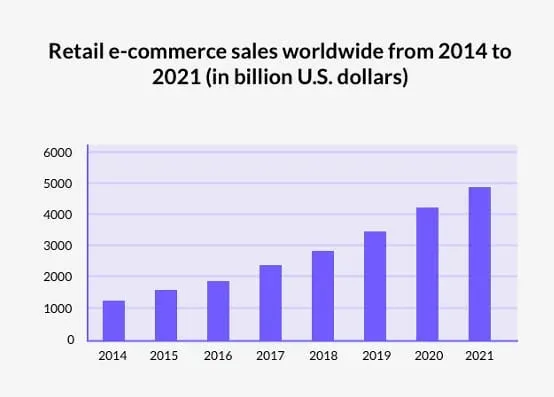
Note: the forecasts in the chart above do not take the COVID-19 pandemic into account. Even so, it is worth noting that e-commerce is growing constantly.
There are several reasons why e-commerce and online sales grow every year: the number of people with internet access keeps rising, there is ever more trust in online buying and selling processes, there are ever more offers online, and so on. Broadly speaking, online sales tend to increase.
Even so, the question we set out to answer remains… What will the impact of COVID-19 be on e-commerce?
- The Chinese Example
In China, more than 40 hotels, cinemas and restaurants "lent" staff to a company called HEMA, owned by Alibaba, to help with the delivery of online orders.
A cosmetics company called Lin Qingxuan closed 40% of its (physical) shops during the crisis caused by the virus, but put a good number of its make-up artists and qualified staff to work influencing audiences online through video.
A video company called Kuaishou, valued at 28 billion dollars, tried to make up for the lack of classes in schools and universities by creating an offering in partnership with the Chinese ministry of education.
55% of Chinese consumers admitted to using e-commerce platforms to stock up during this crisis. 600% was the increase recorded in fresh food deliveries in China in 2020. Will the habits adopted in China stay in place once the crisis passes? We don't know. Can we expect an increase in social media use and online sales? Clearly, yes.
Without crisis there are no challenges; without challenges, life is a routine, a slow agony. Without crisis there is no merit. It is in crisis that the best in each of us comes to the surface. To speak of crisis is to promote it, and to stay silent about it is to glorify conformism.
People are talking about a new crisis, worse than 2008. On that note, here is an excerpt from Einstein on crisis:
We cannot expect things to change if we always do the same thing. Crisis is the best blessing that can happen to people and countries, because crisis brings progress. Creativity is born of anguish, just as day is born of the dark night. It is in crisis that inventions, discoveries and great strategies are born. Those who overcome crisis overcome themselves without being "overcome". Those who blame crisis for their failures and hardships do violence to their own talent and show more respect for problems than for solutions. The real crisis is the crisis of incompetence. The trouble with people and countries is the hope of finding easy ways out and easy solutions.
Without crisis there are no challenges; without challenges, life is a routine, a slow agony. Without crisis there is no merit. It is in crisis that the best in each of us comes to the surface. To speak of crisis is to promote it, and to stay silent about it is to glorify conformism.
Instead, let us work hard. Let us put an end once and for all to the only threatening crisis, which is the tragedy of being unwilling to fight to overcome it.
– Albert Einstein –
Every trend points to digital continuing to grow. COVID-19 may deal a heavy blow to the world economy and lead to one of the biggest crises humanity has ever faced, but it can also drive digital, innovative and creative solutions that might otherwise have struggled to emerge.
What is the impact of COVID-19 on e-commerce? It is positive. It may well be the virus's only positive impact. Let us believe, as Einstein did, that this crisis will lead us to progress. JTNDZGl2JTIwY2xhc3MlM0QlMjJmYi1jb21tZW50cyUyMiUyMGRhdGEtaHJlZiUzRCUyMmh0dHBzJTNBJTJGJTJGd3d3LmplbGx5Y29kZS5wdCUyRm1hcmtldGluZy1kaWdpdGFsJTJGcXVhbC1vLWltcGFjdG8tZG8tY292aWQtMTktbm8tZS1jb21tZXJjZSUyMiUyMGRhdGEtd2lkdGglM0QlMjIxMDAlMjUlMjIlMjBkYXRhLW51bXBvc3RzJTNEJTIyMTAlMjIlM0UlM0MlMkZkaXYlM0U=


Get what we write
No fixed calendar: only when there is something worth your time.